Paris Safety Guide (2026): What’s Real and What’s Exaggerated
Paris is a safe city for tourists. The risk most visitors actually face is petty theft and targeted scams, not violent crime. Knowing where these happen — and what each scam looks like before you encounter it — removes most of the risk.
This guide covers the specific hotspots, the specific scams (named and described), which areas are safe at night, which require more awareness, and what to do if something does go wrong.
By Mara Vale for Eurly
How this guide was built: Based on direct experience across multiple Paris research trips, verified against guidance from the Paris Prefecture of Police and Brigade des Touristes.
Last verified: 2026-04-18
The real picture
Violent crime against tourists in Paris is rare. Paris ranks consistently as one of the safer major European capitals for visitors. The threats that are real — and worth taking seriously — are pickpocketing in specific high-density tourist locations, and a set of well-documented confidence scams that target visitors.
Both are entirely avoidable once you know what to look for.
Pickpocket hotspots
These are the five locations in Paris with the highest pickpocket activity. Staying alert in these specific places covers most of the real risk.
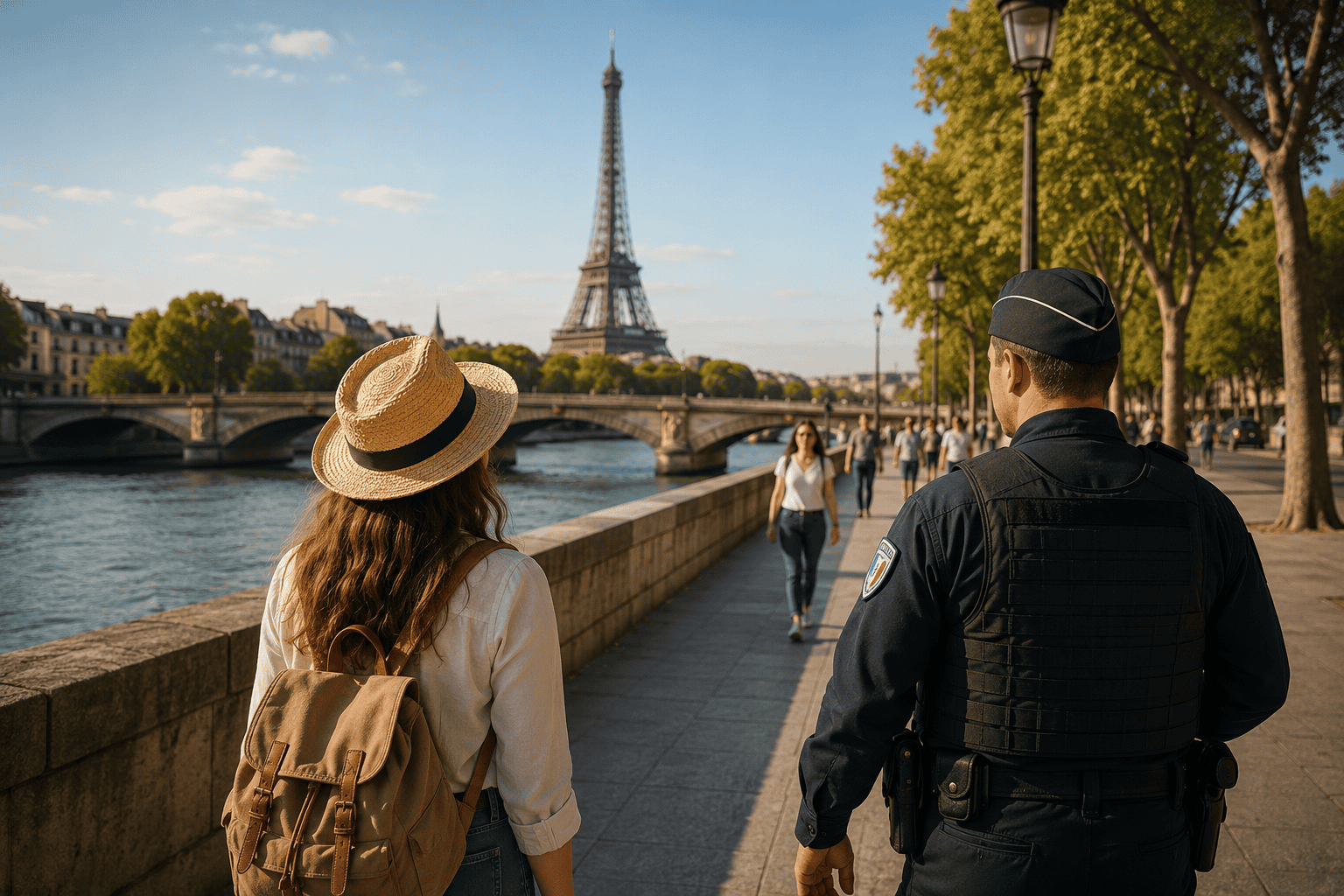
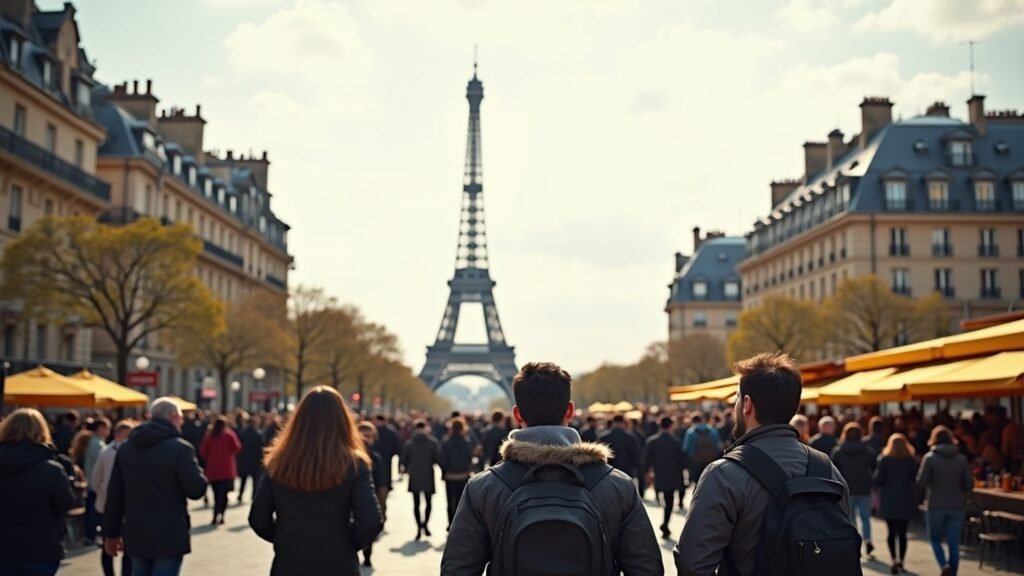
Eiffel Tower area — the highest pickpocket density in Paris. Crowds at the base and on the Champ de Mars are the primary environment. Keep bags in front of you, zip all compartments, do not put your phone in a back pocket. The queues for the lifts are particularly targeted.
RER B (CDG airport train) — targeted by thieves, specifically on trains to and from Charles de Gaulle. Keep luggage in sight at all times. Do not put bags in overhead racks on airport trains. The busiest risk points are around Gare du Nord and on the train in the direction of CDG.
Montmartre steps and Place du Tertre — congested tourist areas where organised groups work together. The steps below Sacré-Cœur are a known location. Keep bags secured and be aware of anyone who approaches you uninvited (see the friendship bracelet scam below).
Louvre queues — both the external queue under the pyramid and inside the museum near the Mona Lisa. The Mona Lisa crowd is one of the most densely packed tourist spaces in Europe.
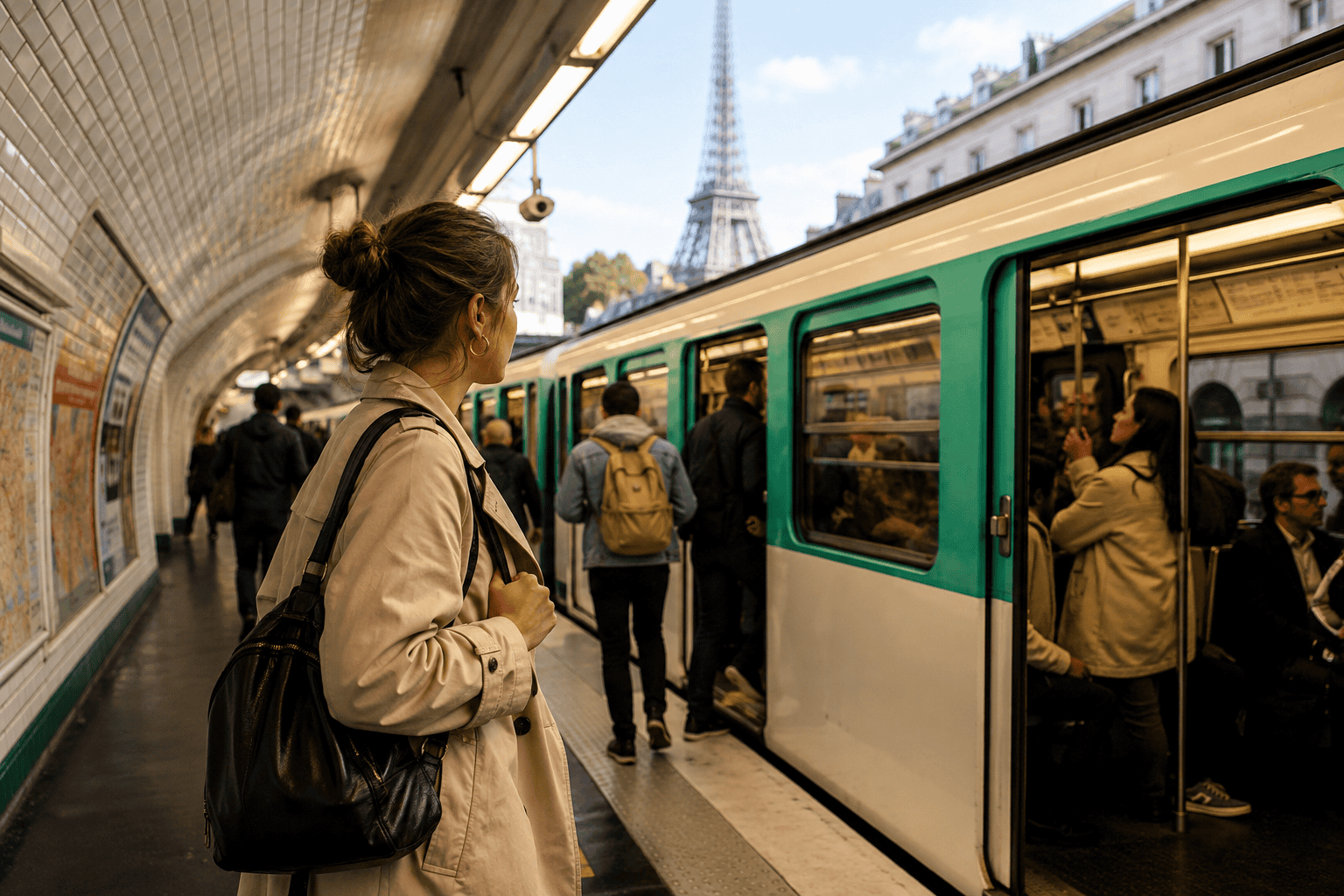
Metro Line 1 — the main tourist line, running from CDG (via RER connection) through central Paris past all major sights. Crowded carriages at rush hour, and at Châtelet and Gare de Lyon stops, are the highest-risk environment. Use a crossbody bag with the clasp at the front.
Common Paris scams
Each of these scams is well-documented. Knowing what they look like before you encounter them is the complete defence.
1. The friendship bracelet scam
Location: Sacré-Cœur steps, primarily. A person approaches and ties a bracelet around your wrist before you can object, then demands payment. Do not let anyone touch your wrist. Say “non” firmly and walk away without breaking stride. Once the bracelet is on, the social pressure to pay is the mechanism.
2. The petition scam
Someone approaches with a clipboard asking you to sign a petition for deaf children, disabled people, or a similar cause. While you are looking at the clipboard, an accomplice picks your pocket. Do not engage with clipboard approaches in tourist areas. Say “non” and keep walking.
3. The gold ring scam
Someone ahead of you on the pavement “finds” a gold ring and offers it to you as a generous gesture, then asks for a small cash gift in return. It is not gold. Walk past without engaging.
4. The shell game
Cards or cups on a folding table, usually near Sacré-Cœur, the Eiffel Tower, or along the Seine. Always a rigged game — the early “winner” you see is a plant. You cannot win. Do not engage, do not stop to watch.
5. Fake taxi outside arrivals
Unlicensed drivers approach arriving passengers at CDG and Orly before you reach the official taxi rank. Official Paris taxis have a white illuminated roof light. Only use the official taxi rank (follow airport signs for “Taxis”) or a pre-booked VTC (Uber, Bolt, or similar). The official fixed fare from CDG to central Paris is €56 (Right Bank) or €65 (Left Bank).
6. Mirror ticket sites
For the Eiffel Tower, Louvre, and Versailles especially. Sites that rank in searches for “buy Eiffel Tower tickets” charge inflated prices for official tickets — sometimes 2–3x the official price — with no additional service. Always buy directly from the official .fr websites: toureiffel.paris, ticket.louvre.fr/en, chateauversailles.fr.
Areas that are safe at night

These areas are safe after dark for tourists and are active enough that being alone does not feel exposed:
- Le Marais — lively until midnight, well-lit, restaurants and bars open late, the streets are full of people throughout the evening
- Saint-Germain-des-Prés — restaurants and cafés until midnight, polished and well-lit
- Bastille and the 11th arrondissement — one of the main Parisian nightlife areas, active and safe
- Montmartre (Abbesses area) — atmospheric and safe; the area around the Abbesses and Lamarck-Caulaincourt metro stops is residential and calm
- Canal Saint-Martin — popular evening destination, particularly in spring and summer
Areas where extra awareness is sensible
These are not unsafe areas to visit, but they require the same awareness you would apply in any busy urban environment:
Gare du Nord immediate surroundings — the station itself is fine, but the streets immediately around it have higher petty theft activity than most of central Paris. Transit through confidently; do not wander the surrounding streets alone late at night without purpose.
Châtelet-Les Halles late at night — the large underground station and connecting shopping complex can feel intimidating after midnight. Not unsafe, but not the place to be lost or distracted.
Bois de Boulogne after dark — avoid. The park has a specific character after midnight that is well-documented. It is not a safety concern during daylight.
Northern peripheral areas (Porte de la Chapelle, Porte de Clichy) — these are not tourist areas. Apply standard big-city awareness if you find yourself there.
What to do if you are robbed
Report to the police commissariat nearest to where the incident happened. You need an official police report to make any insurance claim — without it, most travel insurance policies will not pay out. The report is straightforward and the tourist-facing police speak English.
The Brigade des Touristes (tourist police) is specifically set up for this purpose. They speak English and are located at:
8 Boulevard du Palais, Île de la Cité (1st arrondissement), near the Cité metro stop.
French emergency numbers:
- 15 — SAMU (medical emergency)
- 17 — Police
- 18 — Fire (Pompiers)
- 112 — EU-wide emergency number, works from any phone including phones with no SIM
Digital safety and card security
Card skimming — rare but present at standalone ATMs in heavily touristed areas. Use ATMs attached to bank branches (BNP Paribas, Société Générale, CIC, LCL branches have ATMs in their lobbies) rather than standalone machines on pavements near the Eiffel Tower or Champs-Élysées. Cover the keypad when entering your PIN.
Contactless card tap-and-go fraud — occasionally reported on crowded metro carriages, where a contactless reader is held near your wallet or bag. A standard RFID-blocking card sleeve prevents this. Most modern bank apps allow you to set a daily contactless limit and enable push notifications for each transaction — turn these on before you travel so you see any fraudulent charge in real time.
Public WiFi — available at most Paris cafés and in the metro on some lines. Avoid accessing banking apps or entering payment details on public networks. A VPN provides a reasonable layer of protection if you use public WiFi regularly.
Phishing at mirror ticket sites — when searching for “Paris Museum tickets” or “Eiffel Tower entry”, paid search results often surface reseller sites that charge service fees on top of official prices. Always navigate directly to the official site: toureiffel.paris, ticket.louvre.fr, or chateauversailles.fr.
Health, pharmacies, and medical emergencies
Pharmacies — French pharmacies (marked with a green cross) are excellent first-response resources. Pharmacists are authorised to dispense advice and a wide range of over-the-counter medication that requires a prescription in some countries. For minor ailments — stomach issues, blisters, a cut, a mild infection — a pharmacy visit is faster than finding a doctor. Paris has multiple 24-hour pharmacies; the best-known is Pharmacie des Champs-Élysées (84 Av. des Champs-Élysées, 8th arrondissement), open around the clock.
SOS Médecins — a doctor home-visit service that operates in Paris and covers hotel visits. Call 3624 for a same-day or next-day appointment. Useful for anything beyond what a pharmacist can address but that does not require emergency care.
Hospitals — Paris has excellent public hospitals. Hôpital de l’Hôtel-Dieu (1 Parvis Notre-Dame, 4th arrondissement) is the closest major hospital to the central tourist area. For emergencies, call 15 (SAMU) or go directly to the nearest urgences (emergency room).
EHIC / GHIC card — if you are an EU citizen or hold a UK Global Health Insurance Card, carry it. It entitles you to treatment at French public hospitals at the same rate as French citizens. You will typically pay upfront and claim reimbursement, so keep all receipts.
Travel insurance
Carry travel insurance that explicitly covers medical evacuation and trip interruption. For most Paris trips the risk is low, but the Eiffel Tower stairs, cobblestone stumbles, and the occasional café chair collision account for a non-trivial number of sprained ankles and minor injuries among tourists.
Key things to confirm in your policy:
- Medical cover of at least €1 million (EU hospital costs for serious cases are high)
- Cover for pre-existing conditions if applicable
- Trip cancellation and delay cover (relevant for Eurostar and air disruption)
- Theft cover — confirm the excess and whether it requires a police report (it almost always does)
Save your policy number, emergency contact number, and a summary of covered amounts in your phone notes before you leave home.
Solo female travellers
Paris is generally comfortable for solo women travelling. The primary concerns are the same as for any visitor: pickpockets and scams. Street harassment is less common in Paris than in some southern European cities. The areas that require awareness for solo women late at night are the same as above: Pigalle and the streets around Gare du Nord after midnight. Everywhere else on the standard tourist itinerary is fine.
FAQ
Is Paris safe for tourists?
Yes. Paris is a safe city for tourists. Violent crime against visitors is rare. The realistic risks are pickpocketing in specific high-density tourist locations (Eiffel Tower, RER B, Louvre, Metro Line 1, Montmartre steps) and targeted confidence scams (bracelet scam, petition scam, gold ring, shell game, fake taxis). Both are avoidable once you know what to look for.
What are the most common Paris scams?
The six most common scams targeting tourists in Paris: the friendship bracelet tie (Sacré-Cœur steps), the petition clipboard (tourist areas generally), the found gold ring (streets near tourist sites), the shell game (card or cup tables near major sights), fake taxis at CDG and Orly airport arrivals, and mirror ticketing sites for the Eiffel Tower, Louvre, and Versailles.
Is Paris safe at night?
The Marais, Saint-Germain-des-Prés, Bastille, Canal Saint-Martin, and the Abbesses area of Montmartre are all safe after dark. Apply extra awareness around Gare du Nord late at night. Avoid Bois de Boulogne after midnight.
Which parts of Paris should I avoid?
There are no areas of Paris that tourists need to avoid entirely. The areas that require more awareness than central tourist Paris are: the streets immediately around Gare du Nord late at night, Châtelet-Les Halles after midnight, and Bois de Boulogne after dark. The northern peripheral areas (Porte de la Chapelle, Porte de Clichy) are not tourist areas — exercise standard big-city caution there.
Is Paris safe for solo female travellers?
Yes. Paris is generally comfortable for solo women. The concerns are the same as for any visitor — pickpockets and scams. Street harassment is less frequent than in many other European capitals. Avoid the area around Pigalle and Gare du Nord very late at night if travelling alone.
Official resources
- Brigade des Touristes (tourist police): 8 Boulevard du Palais, Île de la Cité, 1st arrondissement
- Official Eiffel Tower tickets: toureiffel.paris
- Official CDG taxi information: aeroportsdeparis.fr
Next reads
Schema
“`html
{
"@context": "https://schema.org",
"@type": "BreadcrumbList",
"itemListElement": [
{
"@type": "ListItem",
"position": 1,
"name": "France",
"item": "https://eurly.com/france/"
},
{
"@type": "ListItem",
"position": 2,
"name": "Paris",
"item": "https://eurly.com/france/paris/"
},
{
"@type": "ListItem",
"position": 3,
"name": "Paris Safety Guide",
"item": "https://eurly.com/france/paris/safety/"
}
]
}
{
"@context": "https://schema.org",
"@type": "Article",
"headline": "Paris Safety Guide (2026): What's Real and What's Exaggerated",
"image": [
"https://eurly.com/wp-content/uploads/2026/04/paris-safety-eiffel-crowds.jpg"
],
"author": {
"@type": "Person",
"name": "Mara Vale",
"url": "https://eurly.com/about/mara-vale/"
},
"publisher": {
"@type": "Organization",
"name": "Eurly",
"logo": {
"@type": "ImageObject",
"url": "https://eurly.com/images/logo.png"
}
},
"datePublished": "2026-04-13",
"dateModified": "2026-04-25",
"mainEntityOfPage": "https://eurly.com/france/paris/safety/",
"description": "Honest Paris safety guide covering pickpocket zones, common scams, safe areas at night, and what first-time visitors actually need to know."
}
{
"@context": "https://schema.org",
"@type": "FAQPage",
"mainEntity": [
{
"@type": "Question",
"name": "Is Paris safe for tourists?",
"acceptedAnswer": {
"@type": "Answer",
"text": "Yes. Paris is a safe city for tourists. Violent crime against visitors is rare. The realistic risks are pickpocketing in specific high-density tourist locations (Eiffel Tower, RER B, Louvre, Metro Line 1, Montmartre steps) and targeted confidence scams. Both are avoidable once you know what to look for."
}
},
{
"@type": "Question",
"name": "What are the most common Paris scams?",
"acceptedAnswer": {
"@type": "Answer",
"text": "The six most common scams: the friendship bracelet tie (Sacré-Cœur steps), the petition clipboard, the found gold ring, the shell game near major sights, fake taxis at CDG and Orly, and mirror ticketing sites for the Eiffel Tower, Louvre, and Versailles."
}
},
{
"@type": "Question",
"name": "Is Paris safe at night?",
"acceptedAnswer": {
"@type": "Answer",
"text": "The Marais, Saint-Germain-des-Prés, Bastille, Canal Saint-Martin, and the Abbesses area of Montmartre are all safe after dark. Apply extra awareness around Gare du Nord late at night. Avoid Bois de Boulogne after midnight."
}
},
{
"@type": "Question",
"name": "Which parts of Paris should I avoid?",
"acceptedAnswer": {
"@type": "Answer",
"text": "There are no areas of Paris that tourists need to avoid entirely. Areas that require more awareness: streets immediately around Gare du Nord late at night, Châtelet-Les Halles after midnight, and Bois de Boulogne after dark. Northern peripheral areas are not tourist zones — exercise standard big-city caution."
}
},
{
"@type": "Question",
"name": "Is Paris safe for solo female travellers?",
"acceptedAnswer": {
"@type": "Answer",
"text": "Yes. Paris is generally comfortable for solo women. The concerns are the same as for any visitor — pickpockets and scams. Street harassment is less frequent than in many other European capitals. Avoid the area around Pigalle and Gare du Nord very late at night if travelling alone."
}
}
]
}
“`