
This Spain travel guide helps you plan a smoother, more affordable trip through one of Europe’s most rewarding destinations. Learn where to go, when to visit, how to get around, what to budget, and how to avoid the common mistakes that make first-time visits feel rushed or expensive.
Whether you have one week or one month, Spain works best when you understand its rhythms: late dinners, regional differences, and a pace of life that actively resists rushing.
Quick Takeaways
Start here: This Spain travel guide helps you plan a smoother, more affordable trip through one of Europe’s most rewarding destinations.
Planning note: Whether you have one week or one month, Spain works best when you understand its rhythms: late dinners, regional differences, and a pace of life that actively resists...
Why Spain Works for Almost Every Type of Traveler
Few countries pack this much variety into one destination. Spain offers:
- Historic cities with world-class museums and architecture
- Mediterranean and Atlantic coastlines with very different characters
- A high-speed rail network that connects major cities in hours
- Food culture that is both exceptional and relatively affordable
- Island destinations (Balearics and Canary Islands) that add beach options year-round
- Distinct regional identities — Andalucía, Basque Country, Catalonia, and Galicia each feel like a separate country in terms of food, culture, and even language
Unlike destinations where the itinerary is essentially fixed, Spain rewards choices. Your trip to Seville and Granada will feel almost nothing like a trip to San Sebastián and Bilbao. Recognising this variety is the first step to planning well.
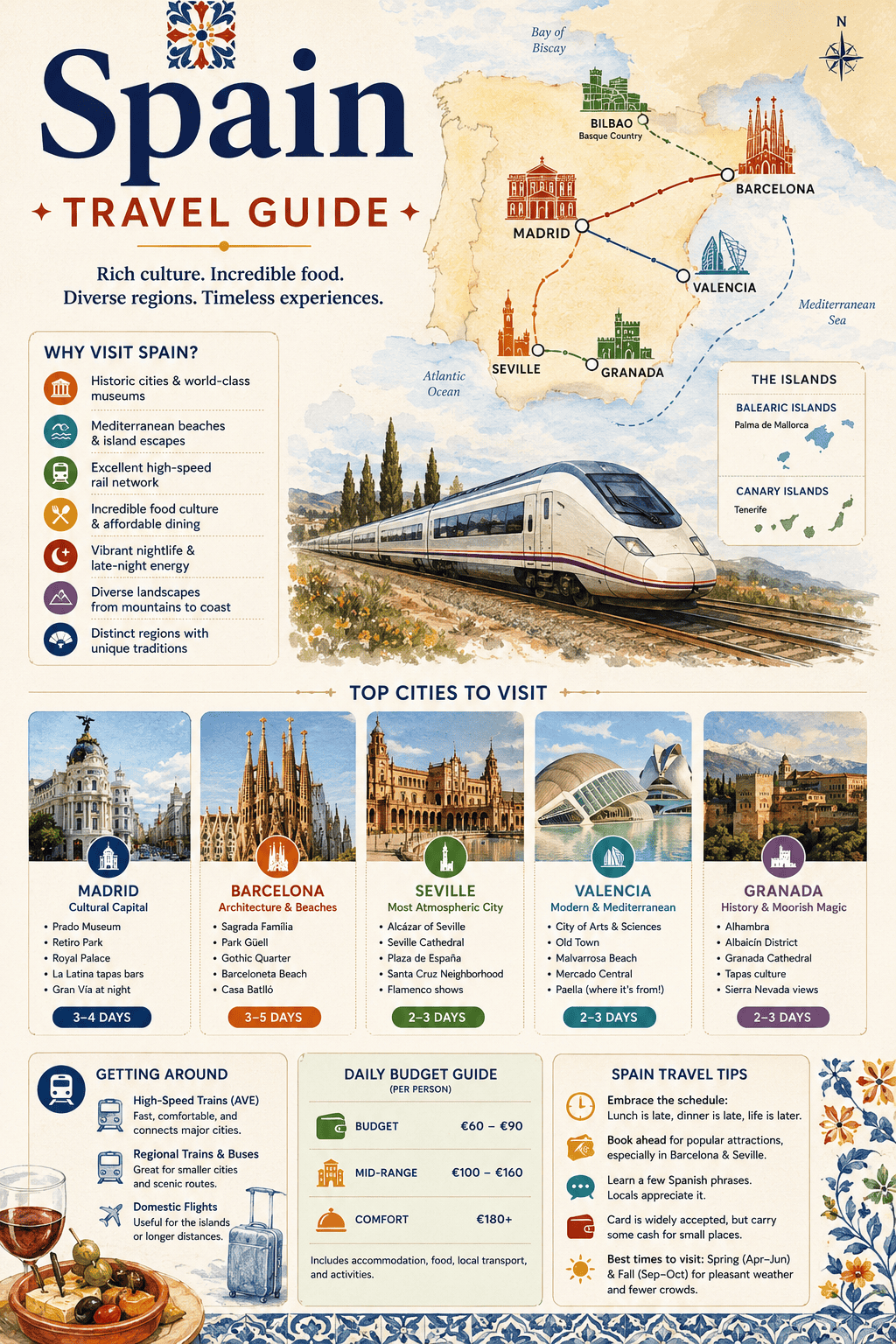
Best Cities in Spain and How Long to Spend in Each
Madrid
Spain’s capital often catches visitors off guard — it lacks Barcelona’s postcard identity, but for many travelers it ends up being the favorite. Madrid delivers world-class art museums (the Prado, Reina Sofía, and Thyssen-Bornemisza are within walking distance of each other), excellent tapas neighborhoods, and a night scene that runs genuinely late.
Don’t miss: Prado Museum, Retiro Park, the Royal Palace, La Latina for tapas, and the buzz around Gran Vía after dark.
Recommended stay: 3–4 days
Common mistake: Using Madrid only as a transit hub. The city’s energy is one of Spain’s strongest experiences and deserves proper time.
Barcelona
Barcelona is Spain’s most internationally famous city, and with good reason — Gaudí’s architecture, a Gothic quarter you can get lost in for hours, a functioning beach, and food markets like La Boqueria and Santa Caterina all within a compact, walkable city.
The tradeoffs are real: Barcelona is more expensive than most of Spain, significantly more crowded in summer, and its most central areas are heavily tourist-oriented. Plan around this rather than hoping it won’t apply.
Don’t miss: Sagrada Família, Park Güell, Gothic Quarter, Barceloneta, Casa Batlló
Recommended stay: 3–5 days
Practical tip: Book Gaudí sites weeks in advance during peak season. Same-day tickets regularly sell out by mid-morning.
Seville
Seville is Spain at its most atmospheric. Orange trees line the streets, flamenco is a living tradition rather than a tourist show, and Moorish architecture at the Alcázar rivals the Alhambra for visual impact. The city also has a social energy — in plazas, along the Guadalquivir riverfront, and in the Triana neighborhood — that makes time pass easily.
Don’t miss: Real Alcázar, Seville Cathedral and La Giralda, Triana, a live flamenco performance, sunset from the Metropol Parasol
Recommended stay: 3–4 days
Important note: Summer heat in Seville is not a mild inconvenience. Temperatures regularly exceed 40°C (104°F) in July and August. Visit in spring or October if possible.
Best time to visit Seville: March–May or October
Granada
Granada earns its place on almost every Spain itinerary thanks to the Alhambra — genuinely one of Europe’s great historic sites. Beyond that, the city offers a tradition of free tapas with drinks, a compact and walkable old town, and dramatic views toward the Sierra Nevada.
Don’t miss: The Alhambra and Generalife gardens, Albaicín neighborhood, Sacromonte cave district, tapas bars near Plaza Nueva
Recommended stay: 2–3 days
Critical tip: Alhambra tickets sell out weeks in advance. Book the moment you know your travel dates. This is not an exaggeration — last-minute tickets are often unavailable.
Valencia
Valencia sits in an underappreciated sweet spot: a genuine city with real neighborhoods and daily life, a working beach, strong cycling infrastructure, and a food identity (paella was born here) that gives it cultural credibility. It’s less crowded and cheaper than Barcelona, and more relaxed in pace.
Don’t miss: Central Market, City of Arts and Sciences, Malvarrosa Beach, Ruzafa neighborhood, a proper paella lunch
Recommended stay: 2–3 days
Best for: Families, slower-paced travelers, digital nomads, and anyone who felt priced out of Barcelona
San Sebastián and Basque Country
Northern Spain operates differently from the south. Basque Country is greener, cooler, and unmistakably food-obsessed. San Sebastián may have the highest concentration of Michelin-starred restaurants per capita of any city in the world, but its pintxos bars — where small bite-sized snacks are displayed along the counter — are accessible to any budget.
Don’t miss: Old Town pintxos crawl, La Concha beach, Guggenheim Museum in Bilbao (day trip or overnight), Monte Igueldo
Recommended stay: 2–3 days
Budget note: This is one of Spain’s most expensive regions. Expect to pay more for accommodation and food than in southern Spain.
How Long to Spend in Spain
Spain is larger than many travelers anticipate, and its regions are spread across a genuinely big country. Trying to cover too much leads to exhaustion and surface-level experiences. Here is a realistic framework:
1 week
Pick a focused pairing rather than attempting the whole map:
- Madrid + Seville (with a day trip to Córdoba or Toledo)
- Barcelona + Valencia
10 days
A classic south-to-north route works well:
- Madrid (3 nights) → Seville (3 nights) → Granada (2 nights) → Barcelona (2 nights)
2 weeks
Add Valencia and either San Sebastián or a slower stop in Andalucía. Consider ending with a Mallorca or Menorca add-on if the timing suits.
3+ weeks
Slow down significantly. Galicia (Santiago de Compostela), Asturias, the Canary Islands, and smaller towns in Extremadura or Aragón all reward unhurried visits.
Best Time to Visit Spain
Spring (March–May) — Best Overall
Comfortable temperatures across most of the country, fewer crowds than summer, and a calendar of festivals including Semana Santa (Easter week) and Valencia’s Fallas. Note that Semana Santa drives up accommodation prices and crowds in Seville and other Andalucían cities — book well ahead if you plan around it.
Summer (June–August) — Best for Beaches, Hardest for Cities
Peak season for islands and coasts. Inland cities — especially Seville and Córdoba — become extremely hot. Prices are at their highest, and popular sites reach maximum crowds. Worth it if beaches or summer festivals are the priority.
Autumn (September–October) — Second Best Overall
Temperatures remain warm but not oppressive, accommodation costs drop after August, and cities feel noticeably less crowded. September in particular hits a sweet spot for both city travel and coastal destinations.
Winter (November–February) — Best for Museums and the Canaries
Madrid and Barcelona remain engaging year-round for culture-focused travelers. The Canary Islands offer warm weather when the rest of Europe is cold. Smaller coastal towns and beach resorts go quiet or close partially in winter.
Getting Around Spain
High-Speed Trains (AVE)
Spain’s AVE network is genuinely world-class. Key routes:
- Madrid → Barcelona: approximately 2h 30m
- Madrid → Seville: approximately 2h 30m
- Madrid → Valencia: approximately 1h 45m
- Madrid → Granada: approximately 3h 15m (via newer direct service)
Renfe (Spain’s national rail operator) offers early-booking discounts that can reduce prices significantly. Leaving tickets to the last week often means paying close to full price. Book via Renfe’s official site.
Budget Flights
Useful for reaching the islands or for long north-south routes where train times stretch beyond 5 hours. Vueling, Ryanair, and Iberia Express are the main domestic operators. Check baggage fees carefully — budget fares often cover cabin bags only, and hold luggage charges can close the price gap with trains.
Car Rental
A car is the right choice for:
- Exploring Andalucía’s white villages (Ronda, Arcos de la Frontera, Vejer de la Frontera)
- Northern Spain road trips along the coast or through wine country (Rioja, Ribera del Duero)
- Rural regions with limited public transport
Avoid driving in Madrid, Barcelona, and most historic city centers. Parking is expensive, restricted areas (ZBE environmental zones) have expanded significantly, and navigation in old town centers is stressful. Trains serve the cities better anyway.
Spain Travel Budget
Spain offers better value than France, the UK, or Scandinavia, but costs vary significantly by city and season.
Budget traveler
- Daily range: €60–100 per person
- Hostel dorms or budget guesthouses, set lunch menus (menú del día), public transport, selective paid attractions
Mid-range traveler
- Daily range: €150–250 per person
- Comfortable hotels or apartments, restaurant meals, fast trains booked in advance, main attractions
Comfort or luxury traveler
- Daily range: €400+ per person
- Design hotels, fine dining, flexibility on transport — particularly in Barcelona, San Sebastián, Mallorca, and Ibiza
Where Spain offers exceptional value: The menú del día (a set lunch of 2–3 courses with drink) at non-tourist restaurants routinely costs €12–18 and represents one of Europe’s best affordable dining traditions. Tapas culture in Andalucía, especially Granada, means drinking and eating simultaneously at low cost.
Where costs catch travelers out: AVE train tickets booked late, peak-season accommodation in Barcelona or the Balearics, and tourist-facing restaurants near major landmarks.
Spanish Food: What to Know Before You Arrive
The schedule is different
Spain eats late by most international standards. Lunch runs from roughly 2pm to 4pm and is the main meal of the day. Dinner rarely starts before 9pm, and restaurants may be quiet until 10pm. Turning up at 7pm expecting a lively dinner scene in a local restaurant will often result in disappointment — or being the only table seated.
Many restaurants close between lunch and dinner service. Plan around this rather than against it.
Tapas vs pintxos
Tapas are small plates served across most of Spain — sometimes free with drinks (still common in Granada, Almería, and parts of Castile), sometimes ordered and priced individually. Pintxos (the Basque spelling; also written as pinchos elsewhere) are the northern equivalent: small bites typically displayed on bar counters on bread or skewers. In San Sebastián, bar-hopping for pintxos is the entire point of an evening out.
Regional dishes worth seeking out
- Madrid: Cocido madrileño (slow-cooked chickpea stew), bocadillo de calamares (fried squid roll)
- Valencia: Paella Valenciana (with rabbit and chicken, not seafood — that is a different dish)
- Andalucía: Salmorejo (thick cold tomato soup), jamón ibérico, pescaíto frito (fried fish)
- Basque Country: Pintxos of all kinds, bacalao (salt cod) dishes, Basque burnt cheesecake
- Galicia: Pulpo a la gallega (octopus with paprika), Albariño wine
Where to Stay in Spain’s Main Cities
Madrid
The best neighborhoods for visitors are Malasaña (bohemian, central, good nightlife), La Latina (tapas-heavy, historic feel), and Salamanca (upscale, quieter). Stay close to a metro line if budget requires a less central location — the metro is fast and reliable.
Barcelona
Eixample is the most practical base — central, grid-planned, close to Gaudí sites and excellent transport. El Born suits travelers who want more local character near the Gothic Quarter. Gràcia offers a village-within-a-city feel. Avoid the noisiest stretches of Las Ramblas for overnight stays — overpriced and unnecessarily chaotic.
Seville
Stay in or near Santa Cruz for proximity to major sights, or Alameda de Hércules for a more local, bar-heavy atmosphere. Both are walkable to the main attractions.
Granada
Staying in or near the Albaicín puts you close to the Alhambra views and old-town atmosphere, but involves hills. The area near Plaza Nueva balances access and convenience.
Common Spain Travel Mistakes
Trying to cover too many cities
Four cities in seven days is physically possible but experientially hollow. Spain rewards slowing down — one extra day in Seville beats a rushed half-day in a fifth destination.
Visiting Andalucía in July or August
The heat is not just uncomfortable — it actively limits what you can do. Sightseeing by 11am becomes difficult. Plan for spring or autumn in the south.
Eating near the main attractions
Restaurants directly beside the Sagrada Família, the Alhambra entrance, or Seville Cathedral tend to be expensive and mediocre. Walking two or three streets away typically solves both problems.
Booking trains at the last minute
Spain’s AVE trains have tiered pricing. Early purchases can cost a fraction of last-minute fares. Build train booking into your trip planning from the start.
Treating Spain as culturally uniform
Catalonia, Basque Country, Galicia, and Andalucía have distinct languages, food cultures, and identities. Assuming everywhere will feel the same leads to misread expectations. Lean into the differences — they are part of what makes Spain worth visiting repeatedly.
Suggested Spain Itineraries
Classic First Visit — 10 Days
- Days 1–3: Madrid — Prado, La Latina tapas, day trip to Toledo
- Days 4–6: Seville — Alcázar, Triana, flamenco, day trip to Córdoba
- Days 7–8: Granada — Alhambra (pre-booked), Albaicín, free tapas bars
- Days 9–10: Barcelona — Sagrada Família, Gothic Quarter, beach, evening in El Born
Food-Focused Trip — 12–14 Days
- San Sebastián (pintxos, La Concha)
- Bilbao (Guggenheim, market, day-trip wine country)
- Madrid (Mercado de San Miguel, Malasaña restaurants)
- Valencia (Central Market, authentic paella lunch)
- Seville (tapas culture, sherry in nearby Jerez)
Beach and Island Add-On
Pair any city-based itinerary with 3–5 nights in Mallorca (good for all-round beaches), Menorca (quieter, more natural), or the Canary Islands (year-round warmth). Flying from Madrid or Barcelona to the islands takes under 2 hours.
Safety and Practical Tips
Pickpocketing
Spain is generally safe, but pickpocketing is the most common issue in tourist-heavy areas — particularly on Las Ramblas in Barcelona, the Madrid metro, and around major attractions. Use a crossbody bag with a zipper, keep phones in front pockets, and stay aware in crowds. This is standard European city advice, not a specific Spain warning.
Cash and cards
Cards are widely accepted in hotels, restaurants, and shops. Carry some cash for small bars, rural areas, local markets, and transport situations where card readers fail. €50–100 in cash is usually sufficient for a week alongside card access.
Language
Spanish (Castilian) works everywhere. English is widely spoken in tourism-focused areas of Barcelona, Madrid, Seville, and Granada. In Catalonia, you will see Catalan prominently displayed. In Basque Country, Euskara appears alongside Spanish. Making a small effort with Spanish — greetings, please, thank you — is appreciated.
Connectivity
EU roaming rules mean travelers from EU countries pay no extra for data. Travelers from outside the EU should check coverage — Spanish SIM cards from operators like Orange, Movistar, or Vodafone are easy to buy at airports and city centres.
Frequently Asked Questions: Spain Travel
What is the best time of year to visit Spain?
Spring (March–May) and early autumn (September–October) offer the best balance of comfortable weather, manageable crowds, and reasonable prices. Summer is ideal for beaches but brutal for inland cities in the south. Winter suits museum-focused trips to Madrid or Barcelona, and the Canary Islands remain warm year-round.
How many days do you need in Spain?
Ten days is a practical minimum for seeing 3–4 regions without feeling rushed. One week works well if you focus on just two cities. Two weeks opens up a much richer itinerary including northern Spain, the islands, or slower travel through Andalucía. The biggest mistake is fitting in too many destinations.
Is Spain expensive to travel?
Compared with France, the UK, or Scandinavia, Spain offers better overall value. Budget travelers can manage on €60–100 per day. Mid-range travel runs €150–250 per day. Barcelona, Ibiza, Mallorca, and San Sebastián sit at the higher end of Spain’s cost spectrum. Eating the menú del día at lunch in non-tourist restaurants is one of the best ways to eat well and cheaply anywhere in Spain.
Do you need to book attractions in Spain in advance?
For some, yes — and this is not optional. The Alhambra in Granada regularly sells out weeks ahead. Sagrada Família and Park Güell in Barcelona sell out days to weeks ahead in peak season. The Real Alcázar in Seville books up quickly during spring festivals and summer. Book these the moment your dates are confirmed.
Is it better to fly or take the train between Spanish cities?
For most routes between major cities, the AVE high-speed train is faster door-to-door than flying when you account for airport transit time and check-in. Madrid–Seville and Madrid–Barcelona are clear examples. Flights become more practical for reaching the Canary Islands, the Balearics, or for very long routes like Madrid–Santiago de Compostela where the train is slower.
What Spanish foods should first-time visitors try?
At minimum: a proper menú del día lunch, jamón ibérico, paella in Valencia (not elsewhere first), tapas or pintxos depending on the region, salmorejo in Andalucía, and churros with thick hot chocolate for breakfast at least once. Each region has its own culinary identity — eat locally rather than seeking the same dishes everywhere.
Useful Official Resources
- Spain Tourism Official Site (spain.info) — Regional guides, event calendars, and trip inspiration
- Renfe Official Train Booking — Book AVE and regional trains directly
- Alhambra Official Ticket Site — The only reliable source for Alhambra tickets
By Mara Vale for Eurly
Last verified: May 2025. Train schedules, ticket prices, and entry requirements are subject to change. Confirm details directly with operators before travel.

Mara Vale
Mara Vale writes Eurly travel guides for first-time Europe visitors who want practical routes, realistic pacing, and fewer avoidable planning mistakes.
Eurly guides are written to help readers make confident travel decisions, but opening hours, ticket rules, transit disruptions, and local conditions can change. Always verify key reservations and official schedules before you travel.