
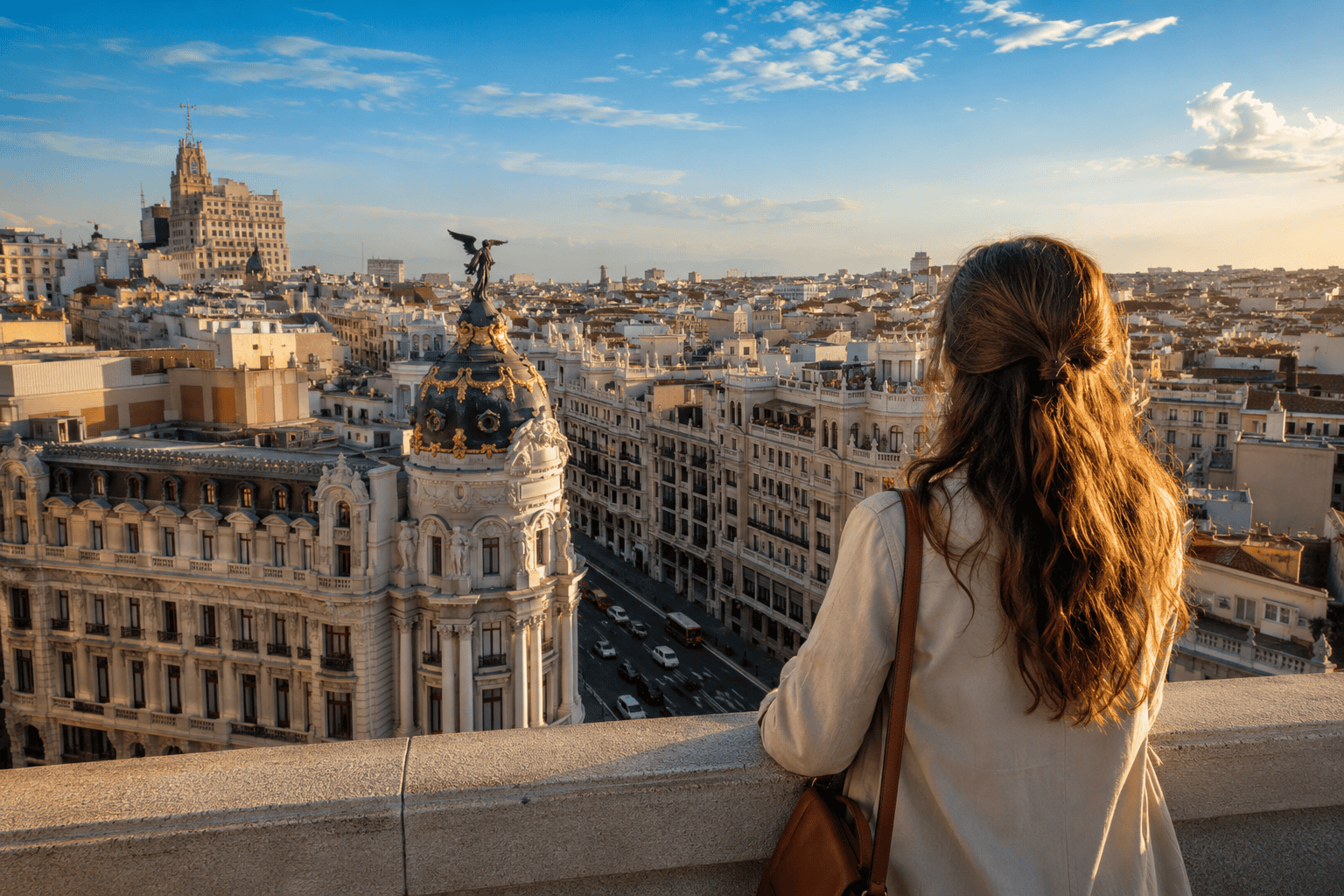
This Madrid travel guide helps you plan your trip with practical advice on where to stay, what to eat, how to get around, and how to budget your time and money. Spain’s capital reveals itself through long lunches, late-night plaza life, world-class art, and neighborhoods that each have their own distinct character.
Quick Facts: Madrid at a Glance
- Country: Spain
- Currency: Euro (EUR)
- Language: Spanish (Castilian); English widely understood in tourist areas
- Best season: Spring (March–May) and autumn (September–November)
- Recommended stay: 4–7 days
- Daily budget range: €70–350+ depending on travel style
- Main airport: Adolfo Suárez Madrid-Barajas (MAD)
- Getting around: Metro, walking, bus, rideshare
Why Visit Madrid?
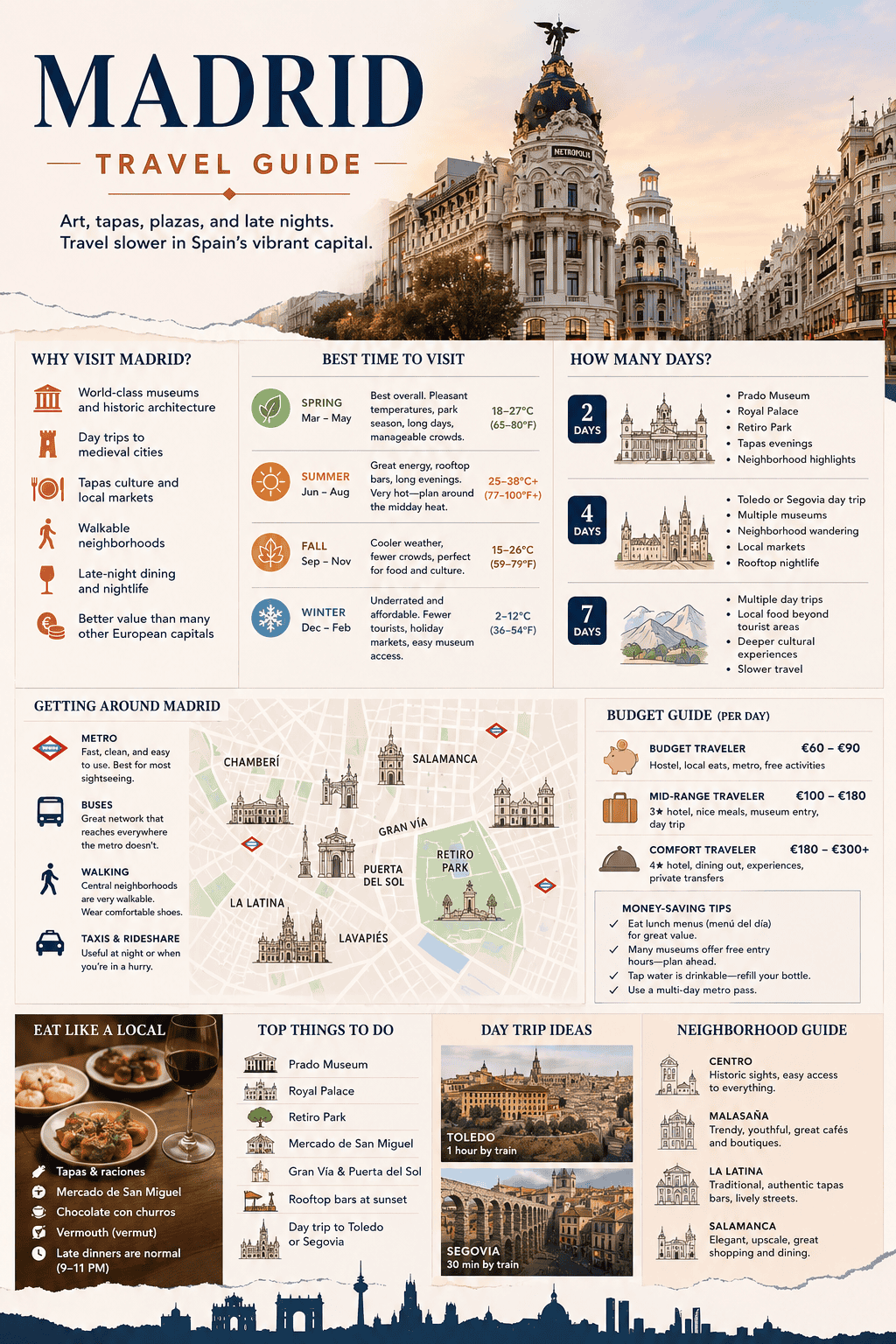
Madrid sits in a rare category among European capitals: genuinely world-class for art, food, and nightlife, yet less aggressively touristy than many comparable cities. It works especially well for travelers who enjoy:
- Major art museums without the crowds of Paris or London
- Tapas culture rooted in real neighborhood life, not just tourist streets
- Walkable, characterful districts within easy reach of each other
- Day trips to some of Spain’s most historic towns (Toledo, Segovia, Ávila)
- Late-night dining, rooftop bars, and nightlife that runs genuinely late
- A cost of living that remains lower than Western European peers
Compared with Amsterdam, Paris, or London, Madrid still offers meaningful value. A sit-down lunch with wine can cost €12–15 at a local restaurant. Museum free hours are regular. The metro is affordable and covers almost everything.
Best Time to Visit Madrid
Madrid has sharper seasonal swings than most Spanish cities. Summers are genuinely hot. Winters are colder than most visitors expect. The shoulder seasons deliver the most comfortable travel experience.
Spring (March to May) — Recommended
The most comfortable time overall. Temperatures range from around 15°C to 27°C (59–80°F), outdoor café culture is at its best, and Retiro Park comes alive. Crowds are manageable compared with summer, and hotel prices sit in the mid-range. If you can only visit once, aim for April or May.
Summer (June to August) — Hot, Busy, But Energetic
Madrid in July and August regularly exceeds 38°C (100°F). Many locals leave the city in August, but tourists fill the central districts. The trade-off is long evenings, festivals, rooftop bars running at full energy, and a genuine nightlife buzz. If visiting in summer: start sightseeing before 10am, take a long midday break, and save outdoor activities for early evening when the heat softens.
Autumn (September to November) — Excellent for Food and Culture
September is arguably the most underrated month in Madrid. Locals return from summer holidays, restaurants fill up, and cultural events ramp up — all with temperatures that have dropped to a much more pleasant 18–26°C range. October and November bring further cooling and noticeably thinner crowds.
Winter (December to February) — Affordable and Undervisited
Madrid winters are cold but rarely extreme — expect 4–12°C on most days. The city sees its lowest accommodation prices, minimal queues at major museums, holiday markets around Plaza Mayor in December, and an authentically local atmosphere. Bring layers rather than expecting southern Spanish warmth.
How Many Days Do You Need in Madrid?
2 Days in Madrid
Enough for the Prado, the Royal Palace, a walk through Retiro Park, and a tapas evening in La Latina. Good as a short stop if you’re combining Madrid with Barcelona, Seville, or Lisbon. You’ll leave wanting more.
4 Days in Madrid — The Sweet Spot
The ideal length for a first visit. You can comfortably cover the major museums across separate days, add one day trip (Toledo or Segovia), explore multiple neighborhoods, and still have time for late dinners and rooftop evenings without feeling rushed.
7 Days in Madrid
Perfect for slower travel. A full week gives you time for multiple day trips, deeper neighborhood exploration in Malasaña and Lavapiés, flamenco performances, local restaurants well off the tourist trail, and mornings that actually match Madrid’s rhythm rather than fighting it.
Where to Stay in Madrid: Neighborhoods Compared
Where you base yourself shapes the feel of the entire trip. Madrid’s neighborhoods are distinct enough that the choice genuinely matters.
Sol — Best for First-Time Visitors
The geographic center of Madrid and the easiest base for orientation. Everything major is within walking distance or one metro stop. The downside is noise — Sol is busy, touristy, and loud late into the night. Best for short stays or travelers who want maximum convenience without research.
La Latina — Best for Food Culture
La Latina is Madrid’s most rewarding neighborhood for eating. Cava Baja is lined with traditional tapas bars, El Rastro flea market fills the streets on Sunday mornings, and the overall atmosphere is more lived-in than central Sol. Excellent choice for food-focused trips or anyone visiting over a weekend.
Malasaña — Best for Cafés, Bars, and Nightlife
Madrid’s creative, younger-feeling district. Expect independent coffee shops, vintage stores, and bars that fill up well after midnight. The neighborhood energy is relaxed by day and genuinely alive at night. Best for couples, younger travelers, or repeat visitors who already know the city basics. Less suited to those sensitive to noise after midnight.
Chueca — Best LGBTQ+-Friendly Base
One of Madrid’s most welcoming districts and one of Europe’s best-established LGBTQ+ neighbourhoods. Centrally located, with excellent restaurants, boutique hotels, and nightlife options. Works well as a base for almost any type of traveler — not only those who identify with the community.
Salamanca — Best Upscale Option
East of the center, Salamanca is Madrid’s elegant, quieter quarter. Wide boulevards, designer boutiques, stylish restaurants, and higher-end hotels. The metro connects it easily to the rest of the city. Best for families, luxury travelers, or anyone who wants central access without the noise of Sol or Malasaña.
Getting Around Madrid
Metro
Madrid’s metro is one of the most practical in Europe: clean, frequent, and covering nearly every point of interest. A 10-trip Metrobus card (around €12.20) or a Tarjeta Multi loaded with credit is the most cost-efficient way to travel if you’re staying more than two days. Single tickets cost €1.50–2.00 depending on journey zones. The metro runs from roughly 6am to 1:30am daily.
For navigation, both Google Maps and Citymapper work well — Citymapper is often more precise for transfers and real-time delays.
Walking
The central neighborhoods — Sol, Gran Vía, La Latina, Chueca, and Malasaña — are all walkable from each other, though the distances are larger than they first appear on a map. Comfortable shoes are genuinely important; Madrid’s streets are harder on feet than most visitors expect after a full day.
Taxis and Rideshares
Uber and Cabify both operate in Madrid, with Cabify often showing better availability and slightly lower prices for local journeys. Taxis from the airport to the city center operate on a fixed fare (currently €30 flat to the city center perimeter, confirmed by the Madrid city authority — always worth verifying this hasn’t changed before you travel). Rideshares from the airport are generally cheaper but require a slightly longer walk to the pick-up zone.
Arriving in Madrid from the Airport
Madrid-Barajas Airport (MAD) is one of Europe’s busiest hubs and is well-connected to the city center by several options.
- Metro Line 8: Runs from all four terminals to Nuevos Ministerios, where you transfer onto other lines. Journey time around 20–25 minutes to central stations. Note: there is a €3 airport supplement on top of the standard ticket price.
- Airport Express Bus (Exprés Aeropuerto): Runs 24 hours (including overnight when the metro is closed) to Atocha, Cibeles, and Nuevos Ministerios. Costs €5. Easy, no transfers, and luggage-friendly — the best option for most travelers.
- Cercanías Train (Line C-1): Connects Terminal 4 only to Chamartín and Atocha stations. Cheapest option at around €2.60 but only useful if your accommodation is near those stations or you’re continuing by AVE high-speed train.
- Taxi: Fixed fare of €30 to anywhere within the city center perimeter (M-30 ring road). No negotiating required — the price is regulated.
Best for most travelers: The Airport Express Bus. Simple, affordable, no metro transfer, and runs all night.
Top Things to Do in Madrid
Prado Museum
The Prado is non-negotiable. It holds one of the world’s great collections of European painting, with particular strength in Spanish masters: Velázquez, Goya, and El Greco. Rubens, Titian, and Hieronymus Bosch feature prominently too. The single most common mistake is attempting to cover the entire museum in one visit — art fatigue is real and the Prado is enormous. Pick two or three artists or periods, spend time properly in those rooms, and come back if you have more days. Free entry on weekday evenings from 6pm (check current hours on the official site before visiting).
Museo Reina Sofía
Spain’s national museum of modern and contemporary art, most famous for housing Picasso’s Guernica. The painting is larger and more affecting in person than most visitors anticipate. The museum’s collection also covers Dalí, Miró, and a strong selection of 20th-century Spanish art. Free entry on certain afternoons and Sunday mornings.
Thyssen-Bornemisza Museum
The third of Madrid’s “Golden Triangle” of museums completes what the other two miss — a wide-ranging collection that bridges medieval European painting through to 20th-century Expressionism and American pop art. Less crowded than the Prado and often more enjoyable for non-specialist visitors. Don’t attempt all three major museums in a single day.
Royal Palace of Madrid
The largest royal palace by floor area in Western Europe, though the Spanish royal family no longer lives here. The interior — particularly the throne room and grand staircase — is genuinely over-the-top in the best possible way. Go early to avoid the longest queues, especially in summer. The adjacent Sabatini Gardens and views toward the Casa de Campo are worth a slow walk after the tour.
Retiro Park
Madrid’s main green lung: 125 hectares of paths, gardens, a boating lake, and the beautiful 19th-century Crystal Palace. Weekends bring locals with picnics, musicians, and street performers. On hot days, it provides the best urban shade in the city. The rowboats on the artificial lake are a cliché for good reason — worth doing.
Gran Vía
Madrid’s grand boulevard, built in the early 20th century as a deliberate statement of civic ambition. It’s touristy and commercially busy, but the architecture — a mix of Spanish Baroque, Art Deco, and early Modernism — is genuinely impressive when you look up above the shop fronts. Several of the best rooftop bars are accessed from buildings along this stretch.
Flamenco
Madrid isn’t the geographical heart of flamenco (that’s Andalusia), but the city has excellent performers and venues. Avoid dinner-show combos marketed primarily at tourists. Look instead for smaller tablaos with a performance-first focus and a mixed local-and-visitor audience. Tickets typically run €25–45 for a show without dinner. Book ahead for weekend performances.
What to Eat in Madrid
Food is one of the strongest arguments for visiting Madrid. The city has a serious eating culture that runs far deeper than tourist menus near the major sights.
Bocadillo de Calamares
A fried squid ring sandwich on a crusty roll, eaten at any time of day. Iconic, cheap, and best found around Plaza Mayor and the surrounding streets. Simple in the best possible way.
Tortilla Española
Spanish potato omelette done properly — thick, slightly runny in the center, and served at room temperature. Every bar has a version; quality varies enormously. Worth trying at a few different places.
Jamón Ibérico
Spain’s cured ham at its finest. A small plate of hand-sliced Jamón Ibérico de Bellota at a good bar is one of the more memorable things you can eat in Madrid. Don’t buy pre-packaged versions from tourist shops as a substitute.
Churros con Chocolate
Not just a dessert — in Madrid, churros with thick hot chocolate are a legitimate breakfast or late-night snack. Chocolatería San Ginés, near Sol, is the famous option (it runs 24 hours and has a devoted local following even at 4am).
Menú del Día
The set lunch menu offered by most restaurants on weekdays: two courses, bread, a drink, and sometimes dessert for €12–15. The single best way to eat well in Madrid without spending much. Avoid restaurants near major tourist sights that charge €18+ for the same format.
Best Food Markets in Madrid
Mercado de San Miguel
An elegant covered iron market a short walk from Plaza Mayor, stocked with high-quality produce stalls, wine bars, and tapas counters. It’s undeniably touristy and priced accordingly — a quick stop for atmosphere and a glass of vermouth makes more sense here than trying to build a full meal around it.
Mercado de San Antón (Chueca)
Three floors in the Chueca neighborhood with a more local feel, a proper rooftop terrace restaurant, and a good mix of produce, specialty food stalls, and casual eating options. Easier to linger in than San Miguel.
El Rastro
Madrid’s famous Sunday flea market in La Latina. Not a food market primarily, but the surrounding tapas bars come alive on Sunday mornings when the market runs. Arrive before noon for the best atmosphere and least crowded streets.
Madrid Nightlife: How It Actually Works
Madrid runs later than almost anywhere else in Europe, and that’s not an exaggeration. Adjust your expectations accordingly:
- Dinner: Locals eat between 9pm and 10:30pm. Restaurants before 8:30pm will feel empty.
- Bars: Get going from 11pm onward.
- Clubs: Don’t fill up until after 1:30–2am. Many run until dawn.
The biggest mistake new visitors make is eating at 6:30pm, wondering why Madrid feels flat, and concluding it’s overrated. It isn’t — it just hasn’t started yet. Build your first evening slowly: a vermouth before dinner, dinner at 9pm, bar by 11pm.
Day Trips from Madrid
Toledo — Best Overall Day Trip
A medieval hilltop city 35 minutes south by high-speed train from Madrid-Atocha, Toledo packs in a Gothic cathedral, a Jewish quarter, a Moorish fortress, and narrow cobbled streets that have barely changed in centuries. It’s the single most rewarding day trip from Madrid for history and architecture. Go early, walk the old town before tour groups arrive, and take a train back in late afternoon. Return tickets on the AVE typically cost €20–28 booked in advance.
Segovia — Best for Architecture and Lunch
About 30 minutes northwest by high-speed train, Segovia is famous for its Roman aqueduct (still standing without mortar after nearly 2,000 years), the fairy-tale Alcázar castle, and roast suckling pig (cochinillo) as a regional specialty. Slightly quieter than Toledo and excellent for a long lunch-focused day trip. Train tickets are similarly priced to Toledo.
El Escorial — Underrated and Quieter
Philip II’s enormous 16th-century royal monastery and palace complex, about an hour from Madrid by Cercanías train. Less visited than Toledo or Segovia, which means smaller crowds and an easier, more contemplative visit. Combine with a walk in the surrounding Sierra de Guadarrama foothills if visiting in spring or autumn.
Ávila — Medieval Walls
About 90 minutes by train, Ávila is completely encircled by the best-preserved medieval city walls in Spain. A niche choice, but ideal for travelers who’ve already done Toledo and Segovia and want something different. The scale of the walls viewed from outside the city is genuinely impressive.
Madrid Travel Costs: What to Budget
Budget Travelers (€70–120/day)
- Hostel dorm or budget private room
- Metro card for transport
- Menú del día lunches, supermarket or market dinners
- Free museum hours + one or two paid entries
Mid-Range Travelers (€150–250/day)
- Comfortable 3-star hotel in a central neighborhood
- Sit-down dinners at proper restaurants
- Museum entries, one day trip, rooftop drinks
- Occasional taxi or rideshare
Comfort and Luxury (€300–500+/day)
- 4- or 5-star hotels in Salamanca or Gran Vía
- Tasting menus, wine, private experiences
- Flamenco shows with premium seating
Money-Saving Tips
- Use free museum entry hours (Prado, Reina Sofía, and Thyssen all have free windows — check current schedules directly with each museum)
- Order the menú del día at lunch instead of à la carte at dinner prices
- Load a Tarjeta Multi metro card rather than buying single tickets
- Stay one neighborhood away from Sol — prices drop noticeably in Malasaña, La Latina, or Chueca
- Book AVE train tickets to day trips at least a week in advance for the best fares
- Drink vermouth at local bars rather than craft cocktails at tourist-facing rooftop venues
Sample 4-Day Madrid Itinerary
Day 1 — City Center Foundations
- Morning: Royal Palace and Almudena Cathedral area
- Midday: Bocadillo de calamares near Plaza Mayor, walk to Sol
- Afternoon: Gran Vía architecture walk, Malasaña explore
- Evening: Rooftop sunset drink, dinner in La Latina around 9pm
Day 2 — Museum Day
- Morning: Prado Museum (pick 2–3 rooms rather than rushing through everything)
- Afternoon: Retiro Park — rowboats, Crystal Palace, slow walk
- Evening: Salamanca for dinner, flamenco show
Day 3 — Day Trip
- Full day in Toledo or Segovia by high-speed train from Atocha
- Return by late afternoon, tapas evening in Chueca
Day 4 — Neighborhoods and Food
- Morning: El Rastro (if Sunday) or Mercado de San Antón
- Afternoon: Reina Sofía (Guernica) or Thyssen-Bornemisza
- Evening: Tapas crawl along Cava Baja in La Latina
Practical Tips for Visiting Madrid
Learn a Few Words of Spanish
English is widely spoken in hotels and tourist areas, but basic Spanish — por favor, gracias, una cerveza, la cuenta — goes a long way in neighborhood restaurants and local bars where menus may be in Spanish only.
Adjust to the Local Schedule
Many smaller shops close between roughly 2pm and 5pm. Museums and major attractions stay open through the afternoon. Plan your day around this rather than fighting it — a long midday lunch or a rest back at the accommodation is a very Spanish approach, and makes evenings considerably more enjoyable.
Pickpocket Awareness
Madrid is a safe city by European standards, but pickpocketing is the main issue for tourists. Be particularly alert on the metro (especially Line 8 from the airport), around Sol, and in crowded markets. Keep bags in front of you on transit. A money belt or hidden pocket for cards and cash is sensible if you’re easily distracted when navigating.
Don’t Overfill the Schedule
Madrid rewards travelers who leave gaps. Spontaneous café stops, stumbling into a market, following a street that looks interesting — these are the experiences people remember. Travelers who book every hour often leave feeling they missed the city’s actual character.
Useful Official Links
- Madrid Tourism Official Site (esmadrid.com) — event calendars, free hour schedules, and current attraction information
- Prado Museum Official Site — tickets, free entry hours, and current exhibitions
- Madrid Metro and Transport Authority (CRTM) — fares, route maps, and transport cards
Frequently Asked Questions: Madrid Travel Guide
How many days is enough for Madrid?
Four days is the recommended minimum for a first visit — enough to cover the major museums, one day trip, and several neighborhoods without feeling rushed. Two days works as a short stop if you’re combining Madrid with other Spanish cities, but you’ll leave with a partial picture. A week allows you to actually settle into the city’s pace.
Is Madrid expensive compared to other European cities?
Madrid is notably more affordable than Paris, London, or Amsterdam. A daily budget of €70–120 is achievable for budget travelers using the metro, eating menú del día lunches, and visiting museums during free hours. Mid-range travelers spending €150–250 per day can eat well, stay comfortably, and do most activities without compromises.
What is the best neighborhood to stay in Madrid?
Sol is the most convenient for first-time visitors who want to walk to everything without planning. La Latina suits food-focused travelers and weekend visitors. Malasaña is the best base for nightlife and café culture. Salamanca is ideal for quieter, upscale travel. Chueca works well for almost any traveler type and has excellent restaurant and hotel options.
Is Madrid safe for tourists?
Yes — Madrid is generally considered safe by European standards. The main concern is opportunistic pickpocketing in crowded tourist areas and on the metro. Standard precautions (bags in front, cards in a secure pocket, awareness in crowded spaces) are sufficient for most travelers. Violent crime targeting tourists is rare.
What is the best way to get from Madrid airport to the city center?
For most travelers, the Airport Express Bus (Exprés Aeropuerto) is the easiest option: it runs 24 hours, costs €5, requires no metro transfers, and stops at Atocha, Cibeles, and Nuevos Ministerios. The metro is slightly cheaper but adds a transfer and a surcharge. A regulated taxi costs a fixed €30 to anywhere within the M-30 city ring.
When should I avoid visiting Madrid?
August is the least ideal month: extreme heat (regularly above 38°C), many local restaurants and smaller businesses closed, and peak tourist pricing in central hotels. If August is your only option, plan your sightseeing for early mornings and evenings, stay air-conditioned during midday, and book accommodation early as options narrow.
By Mara Vale for Eurly
Last verified: May 2025. Museum free-entry hours, transport fares, and airport taxi rates are subject to change — confirm directly with official sources before travel.

Mara Vale
Mara Vale writes Eurly travel guides for first-time Europe visitors who want practical routes, realistic pacing, and fewer avoidable planning mistakes.
Eurly guides are written to help readers make confident travel decisions, but opening hours, ticket rules, transit disruptions, and local conditions can change. Always verify key reservations and official schedules before you travel.