
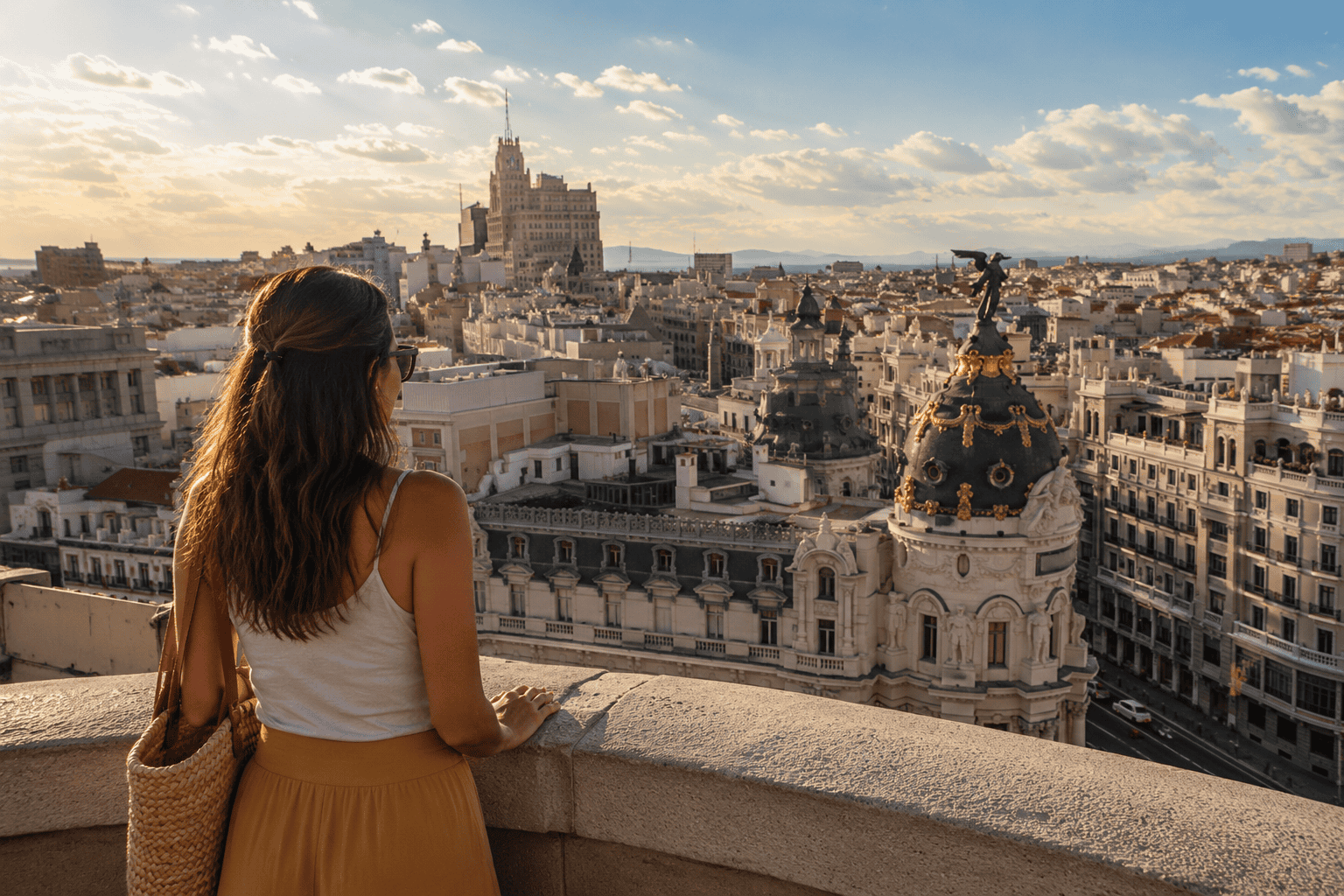
This Madrid travel guide covers everything you need to plan a smarter trip to Spain’s vibrant capital, from neighborhoods and budgets to food and itineraries. Madrid combines world-class museums, walkable historic districts, and an easygoing dining culture with lower daily costs than many major European capitals.
Quick Facts: Madrid at a Glance
- Country: Spain
- Language: Spanish (Castilian)
- Currency: Euro (€)
- Recommended stay: 3–4 days minimum
- Best seasons: Spring (March–May) and early fall (September–October)
- Daily budget range: €70 (budget) to €350+ (luxury)
- Airport: Adolfo Suárez Madrid–Barajas (MAD)
- Main transport: Metro, walking, taxis, Uber/Cabify
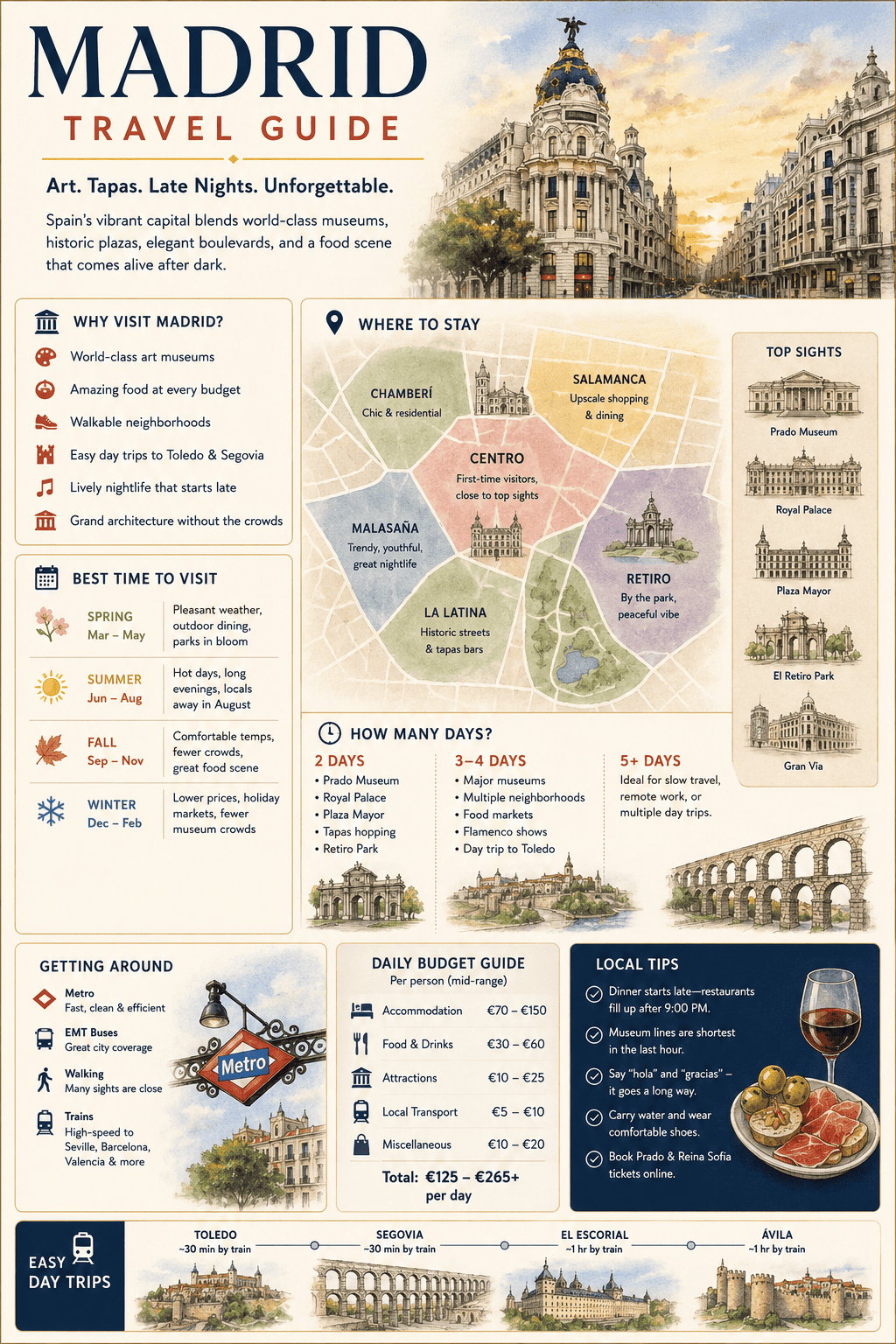
Why Madrid Works So Well as a Destination
Madrid doesn’t hinge on a single iconic sight the way some European capitals do. The city functions through its atmosphere — outdoor terraces that stay busy until midnight, neighborhood markets with no tourist pricing, and a museum district that can occupy days without feeling repetitive. Travelers who come expecting Barcelona or Paris often find Madrid hits differently: quieter in the right places, more local-facing, and genuinely easier to enjoy at any pace.
It also makes an excellent gateway. High-speed AVE trains connect Madrid to Seville (around 2.5 hours), Valencia (roughly 1.5 hours), Barcelona (around 2.5 hours), Córdoba, and Málaga — meaning a Madrid base can anchor a much broader Spain trip without a single internal flight.
Best Time to Visit Madrid
Spring: March to May
Spring is the most consistently enjoyable time to visit. Temperatures sit comfortably between 15°C and 22°C, outdoor terraces reopen, and Retiro Park reaches its best. Easter week (Semana Santa) brings processions and atmosphere but also crowds and higher hotel rates. May is particularly pleasant and busy — book accommodation early.
Summer: June to August
Madrid gets seriously hot in summer. July and August regularly push past 35°C at midday. The upside: many locals leave the city in August, creating a calmer urban feel, and evenings cool down enough for outdoor dining. If you visit in summer, schedule museum visits for the early afternoon heat and save outdoor exploration for mornings and evenings.
Early Fall: September to October
Early fall rivals spring as the best window to visit. Temperatures drop back to comfortable levels, restaurant terraces stay open, and tourist volumes are lower than peak spring. Late October sees cooler evenings and the occasional rain.
Winter: November to February
Madrid’s winter is mild compared with northern Europe — cold but rarely harsh. Hotel rates drop, museums are less crowded, and December brings Christmas markets around Plaza Mayor and Puerta del Sol. Evenings can be genuinely cold, so pack a proper coat.
How Many Days Do You Need in Madrid?
2 Days
Tight but workable for a first glimpse. You can cover the Prado, the Royal Palace, Plaza Mayor, Retiro Park, and a tapas crawl in La Latina. You won’t have room for day trips or neighborhood wandering.
3 to 4 Days
The sweet spot for most visitors. Enough time for the major museums, at least two or three distinct neighborhoods, a food market, a flamenco performance, and one half-day trip out of the city.
5 or More Days
Well-suited to slow travelers, remote workers, or anyone combining multiple day trips to Toledo, Segovia, and El Escorial. Madrid becomes noticeably more rewarding when you stop trying to optimize every hour.
Where to Stay in Madrid: Neighborhood Guide
Where you base yourself shapes your experience more than any single attraction. Madrid’s central neighborhoods are distinct enough that the choice genuinely matters.
Sol and Gran Vía — Best for First-Time Visitors
The geographic and transit center of Madrid. You’ll be within walking distance of Plaza Mayor, Puerta del Sol, and every major metro line. The tradeoff is noise, tourist-heavy restaurants, and higher baseline hotel prices. That said, for a first visit, the convenience is hard to argue with.
La Latina — Best for Tapas Culture
This is the neighborhood that most people mean when they talk about traditional Madrid. The streets are narrow and hilly, the taverns have been open for decades, and the Sunday El Rastro flea market is a genuine Madrid institution. Stay here if food and atmosphere matter more to you than transit convenience.
Malasaña — Best for a Younger, More Local Feel
Northwest of Sol, Malasaña is where vintage shops, independent cafés, and cocktail bars cluster. It has a lived-in energy that contrasts with the more tourist-polished center. Expect late-night noise on weekends.
Lavapiés — Best for Budget Stays and Multicultural Dining
One of Madrid’s most international neighborhoods, with affordable accommodation and a dense collection of non-Spanish restaurants. It’s less polished than other central neighborhoods but more affordable and genuinely interesting.
Salamanca — Best for Upscale Stays
East of the center, Salamanca is Madrid’s luxury district — wide boulevards, designer boutiques, high-end restaurants, and quieter evenings. It’s the right choice if comfort and calm matter more than proximity to historic sights.
Getting to and Around Madrid
From the Airport
Adolfo Suárez Madrid–Barajas Airport (MAD) is one of Europe’s better-connected airports for onward travel. From the terminal, you have four realistic options into the city center:
- Metro (Line 8): The cheapest option — requires a special airport supplement on top of the standard fare. Takes around 40–45 minutes to Sol.
- Cercanías train (Line C-1): Connects Terminals 1–4 to Nuevos Ministerios and Atocha. Faster than the metro for some destinations.
- Airport Express bus (Exprés Aeropuerto): Runs 24 hours, stops at Atocha, Cibeles, and Plaza de España. Around €5 and takes 40 minutes depending on traffic.
- Taxi: Madrid operates a fixed-rate taxi fare from the airport to anywhere within the M-30 ring road (the zone covering central Madrid), currently set at €30. No meter negotiations needed — confirm the fixed rate before departure.
Getting Around the City
Madrid’s metro is extensive, cheap, and easy to navigate. For most visitors, a multi-trip or tourist travel card (available for 1, 2, 3, 5, or 7 days) is worth buying on arrival. The central zone covers everywhere most visitors will go.
Central Madrid is highly walkable. The Prado, Retiro Park, Plaza Mayor, the Royal Palace, and La Latina are all within a 20–30 minute walk of each other. Uber and Cabify operate freely alongside standard licensed taxis, and fares are reasonable compared with most European capitals.
Top Things to Do in Madrid
Prado Museum
The Museo del Prado is genuinely one of Europe’s great art collections — Velázquez, Goya, El Greco, Titian, Rubens, and Hieronymus Bosch under one roof. Don’t attempt to see everything. Two focused hours with a map and a shortlist of rooms beats an exhausted half-day shuffle. The museum is free in the last two hours before closing most evenings, which reduces crowds slightly.
Official site: museodelprado.es
Retiro Park
Madrid’s 350-acre central park functions as an outdoor gathering place for locals rather than a tourist attraction. The Crystal Palace hosts free art exhibitions, the boating lake rents rowboats by the hour, and the rose garden (Rosaleda) peaks in late May. Go in the evening when families, joggers, and musicians fill the paths.
Royal Palace (Palacio Real)
The official residence of the Spanish royal family — though they don’t live here — is the largest royal palace in Western Europe by floor area. The Throne Room, Royal Armoury, and ceremonial halls are genuinely impressive in scale. Arrive at opening time (typically 10 AM) to avoid queues at security. Admission includes an audio guide.
Plaza Mayor and Puerta del Sol
Both squares are unmistakably touristy but still worth spending time in. Plaza Mayor, completed in 1619, is architecturally coherent in a way few historic squares are — sit at a café terrace with a coffee and take it in before the midday crowds arrive. Puerta del Sol is the symbolic heart of the city and the starting point of Spain’s national road network.
Food Markets
Mercado de San Miguel, just off Plaza Mayor, is the most visited and the most expensive — good for grazing on jamón and wine but not representative of everyday Madrid food. For a more local experience, try Mercado de San Antón in Chueca or Mercado de la Paz in Salamanca, both of which mix working food stalls with casual eating spaces.
Flamenco
Madrid has a strong flamenco scene despite not being in Andalusia. Smaller tablaos with 30–60 seats tend to deliver a more concentrated performance than large dinner-show productions. Look for venues in La Latina and the center that prioritize the art over the spectacle.
Reina Sofía and Thyssen-Bornemisza
The three major museums along the Paseo del Prado — the Prado, the Reina Sofía (home to Picasso’s Guernica), and the Thyssen-Bornemisza — form what’s sometimes called the Golden Triangle of Art. A combined ticket is available if you plan to visit all three.
Official Reina Sofía site: museoreinasofia.es
What to Eat in Madrid
Madrid’s food culture is built around sharing, grazing, and spending time at the table. The following are dishes worth seeking out specifically in the city rather than across Spain generally.
Bocadillo de Calamares
A fried squid ring sandwich on a crusty baguette. It sounds simple because it is — the version sold by street-side bars near Plaza Mayor is a Madrid staple that locals eat standing at the counter.
Cocido Madrileño
A slow-cooked chickpea stew served in stages — first the broth as soup, then the chickpeas and vegetables, then the meats. It’s a winter dish and a heavy one; order it for a long lunch rather than a quick bite.
Tortilla Española
The Spanish potato omelette is everywhere in Madrid, but quality varies dramatically. A good tortilla at a neighborhood bar — served thick, slightly runny in the center, and at room temperature — is one of the city’s genuinely great cheap meals.
Jamón Ibérico
Spain’s acorn-fed cured ham. Even a modest tapa of jamón ibérico at a decent bar costs more than jamón serrano, and the quality difference is significant. Mercado de San Miguel has good options if you want to taste before committing to a whole leg.
Churros con Chocolate
Served at old-fashioned churrerías for breakfast or as a late-night snack after bars. The chocolate is thick, almost pudding-like, and the churros are fried fresh. Chocolatería San Ginés near Sol is the most famous and busiest; arrive at an odd hour to get a seat.
Understanding Madrid’s Tapas Culture
Tapas in Madrid function differently from what visitors sometimes expect. They’re not a sit-down meal course — they’re small plates eaten standing at a bar, usually accompanied by wine or beer, usually followed by moving on to another bar. Dinner rarely starts before 9 PM for locals. If you arrive at a restaurant at 7 PM, you’re eating on tourist time, and the atmosphere won’t match what the evening becomes two hours later.
Best Day Trips from Madrid
Toledo
Madrid’s most popular day trip, and with good reason. Toledo sits on a rocky promontory above the Tagus River, its medieval streets layered with Christian, Jewish, and Moorish architecture. The cathedral alone takes an hour to do justice. High-speed trains from Madrid Atocha reach Toledo in around 33 minutes. Plan to arrive early and leave by mid-afternoon to beat tour groups at the main sites.
Segovia
Two things bring people to Segovia: a 2,000-year-old Roman aqueduct that still bisects the old town, and the Alcázar — a turreted castle that reportedly inspired Walt Disney’s Cinderella Castle design. The Renfe high-speed train from Chamartín reaches Segovia–Guiomar station in about 30 minutes. Lunch in Segovia traditionally means roast suckling pig (cochinillo asado) — several historic restaurants in the old town serve it.
El Escorial
Philip II’s 16th-century monastery-palace complex in the foothills of the Sierra de Guadarrama is an undervisited alternative to the more popular day trips. It’s large, austere, and historically significant — the burial place of Spanish monarchs and the center of the Spanish Empire at its peak. Cercanías trains from Madrid’s Atocha or Chamartin stations reach the town of El Escorial in around one hour.
Official tourism information: esmadrid.com
Madrid Travel Budget: What to Expect
Madrid is meaningfully cheaper than Paris, London, Amsterdam, or Zurich for equivalent quality. The following are realistic daily estimates per person, excluding flights.
Budget Traveler: €70–120 per day
- Hostel dorm bed or budget guesthouse: €25–45
- Metro multi-trip card: €5–8
- Meals at casual tapas bars and markets: €20–35
- Free museum entry (evenings) or one paid museum: €0–15
Mid-Range Traveler: €150–250 per day
- Comfortable three-star hotel: €80–130
- Transit and occasional taxi: €15–25
- Two sit-down meals and some bar grazing: €40–70
- Museum tickets and activities: €20–30
Luxury Traveler: €350+ per day
- Boutique or five-star hotel in Salamanca or central Madrid: €180–400+
- Fine dining at one or two-star restaurants: €80–150+ per person
- Private tours, premium flamenco venues, and high-end shopping: variable
One practical note: lunch is the main meal in Madrid and almost always better value than dinner. Many mid-range restaurants offer a menú del día (set lunch menu with starter, main, dessert, and wine) for €12–18 that would cost two or three times as much ordered individually at dinner.
Suggested 3-Day Madrid Itinerary
Day 1: Historic Center and La Latina
- Morning: Puerta del Sol and Plaza Mayor (arrive before 10 AM to see them without crowds)
- Late morning: Royal Palace — allow 2 hours minimum
- Afternoon: Walk down to La Latina for a long tapas lunch
- Evening: Bar-hop through La Latina’s historic taverns; the streets around Cava Baja are the classic circuit
Day 2: Museum District and Retiro
- Morning: Prado Museum — book tickets in advance online and arrive at opening
- Afternoon: Retiro Park — rowboat on the lake, Crystal Palace, afternoon coffee
- Late afternoon: Walk through Salamanca neighborhood
- Evening: Flamenco performance at a small tablao
Day 3: Day Trip or Neighborhood Exploration
- Option A: Toledo day trip — early train from Atocha, back by late afternoon
- Option B: Segovia day trip — early train from Chamartín, roast lunch, back for dinner
- Option C: Malasaña and Chueca neighborhoods — slower pace, vintage shopping, Mercado de San Antón, afternoon vermouth at a local bar
Common Mistakes to Avoid in Madrid
Eating on northern European timing. Restaurants serving dinner at 6 or 7 PM are catering exclusively to tourists. The city comes alive for dinner after 9 PM — showing up earlier means a half-empty room and staff clearly waiting for real service to begin.
Overloading your itinerary. Madrid is a city that rewards pace, not efficiency. Building two-hour museum visits and back-to-back sight-checking into a single day leaves no room for the long coffee, the unexpected street, or the bar recommended by the person at the next table. Leave gaps.
Ignoring the afternoon heat in summer. The 2 PM to 5 PM window in July and August is genuinely uncomfortable outdoors. Plan museum visits or a proper siesta during that window — the Spanish model of the long lunch followed by rest exists because the climate demands it.
Staying too far from the center. Outer neighborhoods may offer cheaper rates, but long metro commutes eat into the time you’d otherwise spend exploring on foot. For a three or four-day visit, central proximity is worth the premium.
Skipping neighborhood bars for tourist restaurants. The restaurants directly on Plaza Mayor and Sol tend to be overpriced and mediocre. Walk one or two streets away and the quality immediately improves. Restaurants without an English-language photo menu posted outside are almost always a better bet.
Safety in Madrid
Madrid is a safe city by European standards. The main concerns are opportunistic theft rather than anything more serious. Pickpocketing happens on the metro (particularly Line 1 and Line 10 during rush hour), around Sol and Gran Vía, and in crowded tourist sites like the Prado entrance queue. Keep bags in front of you, don’t leave phones on restaurant tables, and avoid putting valuables in the outer pockets of backpacks. Beyond that, the city is straightforward to navigate safely at most hours.
Madrid vs. Barcelona: Which Should You Visit?
This is a question with a real answer rather than a diplomatic non-answer. The two cities have genuinely different characters and suit different trips.
Choose Madrid if your priorities are: museums and art, food culture and restaurants, nightlife, day trips into central Spain, or the experience of a city that still feels like it belongs primarily to its residents.
Choose Barcelona if your priorities are: beaches, Gaudí architecture, Mediterranean scenery, or a more visually dramatic urban environment.
Many travelers visiting Spain for longer than a week visit both. High-speed AVE trains connect Madrid and Barcelona in around 2.5 hours, which makes combining them straightforward without flying.
Frequently Asked Questions: Madrid Travel Guide
Is Madrid expensive compared with other European capitals?
Madrid is significantly cheaper than Paris, London, Amsterdam, or Zurich for comparable accommodation and dining quality. A mid-range hotel that would cost €200 per night in Paris can often be found for €100–130 in Madrid. Restaurant meals are similarly better value. Within Spain, Madrid is roughly on par with Barcelona though specific neighborhoods and hotel categories vary.
Do I need to speak Spanish to get around Madrid?
English is spoken widely enough in hotels, major museums, and tourist-facing businesses that you won’t be helpless without Spanish. That said, many neighborhood bars and local restaurants operate entirely in Spanish, and making even a basic attempt (hola, por favor, gracias) is appreciated and will generally improve how you’re treated. A translation app handles most practical situations.
Is the Madrid Metro easy to use for visitors?
Yes. The metro map is straightforward, stations are signed clearly, and ticket machines offer an English language option. The main thing to know is that the airport (Line 8) requires an airport supplement added to your standard ticket or travel card — it’s not included automatically. For the city center, a 10-trip card or tourist travel card (available for 1–7 days) is the most economical option.
When do museums in Madrid offer free entry?
The Prado Museum offers free entry during the last two hours before closing on weekdays and on Saturdays (check current hours before visiting as schedules change). The Reina Sofía is free on Monday afternoons and Sunday afternoons. The Thyssen-Bornemisza is free on Mondays. Hours and free-entry windows are subject to change, so confirm on each museum’s official website before planning your day around them.
What is the best neighborhood to stay in for a first visit to Madrid?
Sol or the area around Gran Vía gives first-time visitors the best combination of central location, transit access, and proximity to major sights. It’s not the most atmospheric neighborhood but it’s the most practical. If you’re willing to navigate a slightly less central base, La Latina offers better food culture and more local character, with easy metro access to everything else.
How far in advance should I book the Prado Museum?
During peak spring and summer months, same-day tickets can sell out or involve a long queue. Booking online a day or two in advance is free and avoids both issues. In winter, walk-up entry is usually straightforward. Check current availability at the museum’s official booking page before your trip.
By Mara Vale for Eurly
Last verified: May 2025. Opening hours, transport fares, and free museum entry windows are subject to change — confirm details with official sources before travel.

Mara Vale
Mara Vale writes Eurly travel guides for first-time Europe visitors who want practical routes, realistic pacing, and fewer avoidable planning mistakes.
Eurly guides are written to help readers make confident travel decisions, but opening hours, ticket rules, transit disruptions, and local conditions can change. Always verify key reservations and official schedules before you travel.