

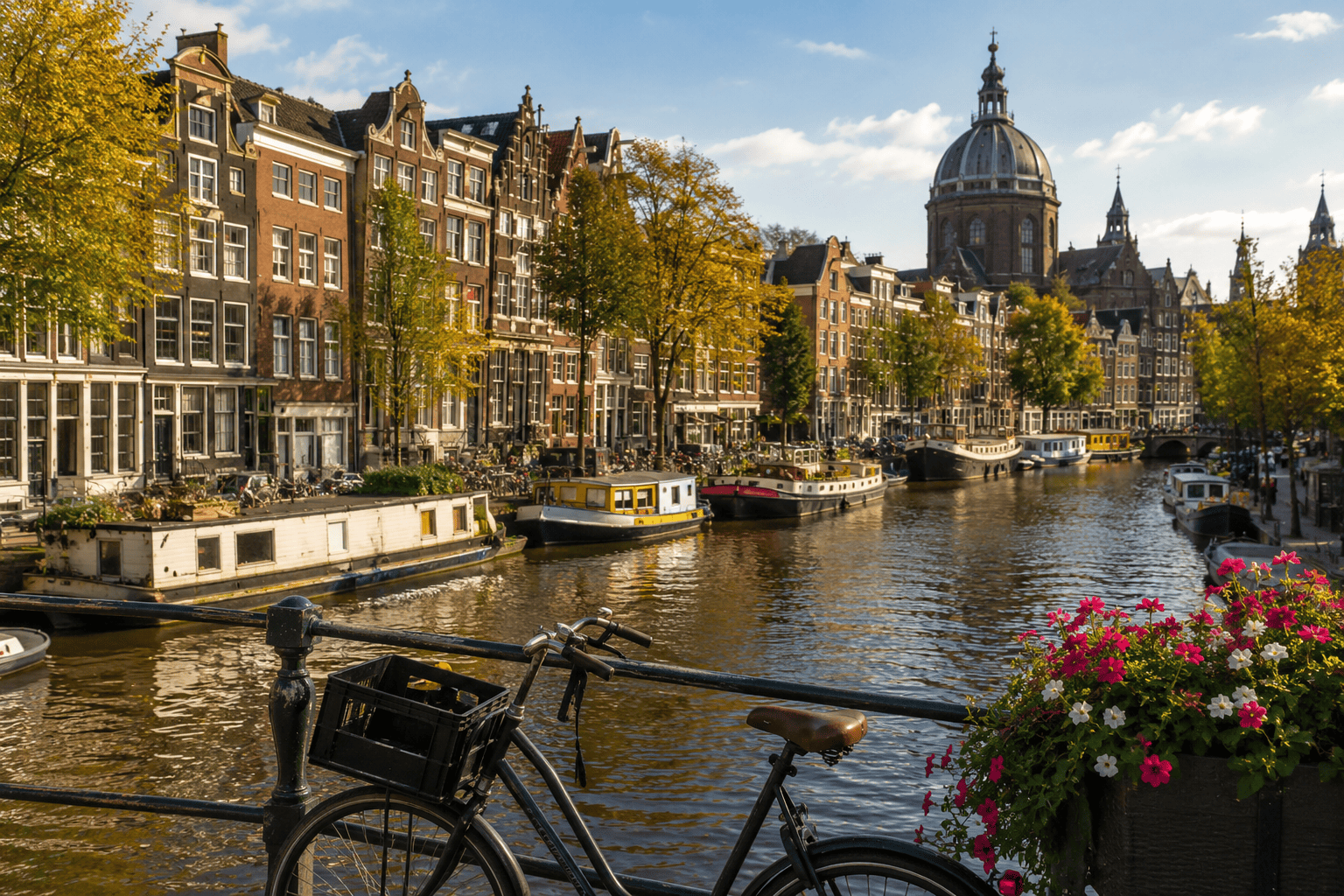
The Netherlands is one of Europe’s most rewarding destinations, compact enough to explore several cities in a single trip while still offering distinct local character. Amsterdam may draw most visitors first, but Rotterdam’s modern skyline, Utrecht’s canal cafés, and Delft’s medieval streets reveal different sides of Dutch life. This guide covers where to go, when to visit, how long to stay, what to budget, and how to travel around easily without a car.
Why the Netherlands Works for Almost Every Type of Traveler
Few countries make independent travel this straightforward. The rail network is fast and frequent, English is spoken almost universally, cities are flat and bikeable, and even smaller towns reward a few hours of wandering. What surprises many visitors is how much variety fits into such a small country.
- Compact cities with walkable historic centers
- One of Europe’s most reliable train networks
- Flat terrain that makes cycling genuinely practical
- World-class museums concentrated in a small area
- Strong regional identity outside the capital
- Relaxed café culture rooted in everyday Dutch life
- Easy rail connections to Belgium, Germany, and France
The biggest planning mistake is treating the Netherlands as an Amsterdam-only destination. The country is small enough that day trips and overnight stops in secondary cities require almost no extra effort.
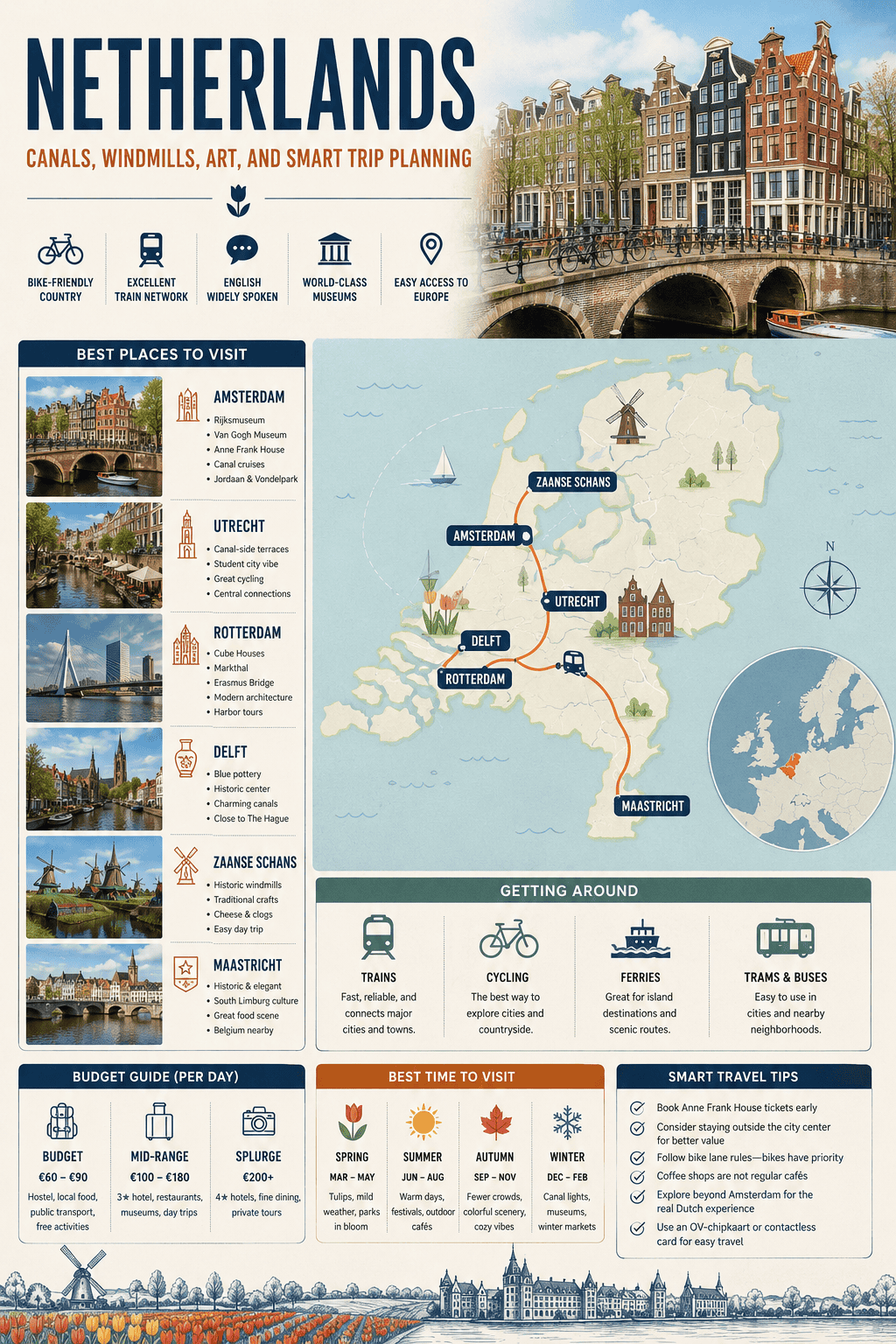
Best Places to Visit in the Netherlands
Amsterdam
Amsterdam earns its reputation as a starting point. The canal ring, the museum quarter, and neighborhoods like Jordaan and De Pijp each have a distinct personality, and the city rewards slower exploration as much as landmark visits.
Highlights most visitors prioritize:
- Rijksmuseum — Dutch Golden Age paintings, including Rembrandt and Vermeer
- Van Gogh Museum — the world’s largest collection of Van Gogh’s work
- Anne Frank House — advance booking is essential, often weeks ahead
- Jordaan neighborhood — independent shops, brown cafés, and quieter canals
- Canal cruises — useful for orientation and surprisingly good value
- Vondelpark — the city’s main green space, lively in warm weather
On accommodation: staying in or near the historic center saves time but significantly raises costs. Neighborhoods like De Pijp, Amsterdam Oost, and Amsterdam Noord offer better value and a more local feel, all within easy cycling or metro distance of the center.
Practical notes for Amsterdam:
- Book Anne Frank House tickets as early as possible — same-day availability is rare
- Bike lanes are active traffic zones, not recreational paths — stay alert
- Coffee shops and regular cafés are not the same thing
- The museum district and the canal ring are worth treating as separate visits rather than one rushed day
Utrecht
Utrecht sits 30 minutes from Amsterdam by train and consistently surprises travelers who expect a smaller version of the capital. The city has its own distinct canal system — unusual in that the quay terraces sit at water level rather than street level — along with a large university population that keeps the café and restaurant scene lively year-round.
What makes it worth a stop:
- Canal-side dining and drinking at water level
- Excellent cycling culture, including the world’s largest bike parking garage at Utrecht Centraal
- Smaller historic center that feels manageable rather than overwhelming
- Strong local restaurant and bar scene without heavy tourist pricing
For travelers who want authentic Dutch city life without Amsterdam’s crowds, Utrecht is the strongest choice in the country.
Rotterdam
Rotterdam feels like no other Dutch city because it essentially isn’t one — wartime bombing destroyed the historic center, and what rebuilt in its place is one of Europe’s most interesting collections of contemporary architecture.
Key draws:
- Cube Houses (Kubuswoningen) — a cluster of tilted, cube-shaped homes near Blaak station
- Markthal — a residential arch housing a covered food market with dramatic interior murals
- Erasmus Bridge — the city’s most photographed landmark, linking the north and south banks
- Museum Boijmans Van Beuningen — significant fine art collection (check current opening status before visiting)
- Harbor boat tours — Europe’s largest port, and the industrial scale is genuinely impressive
Travelers drawn to design, food culture, and urban development often rate Rotterdam higher than more traditionally picturesque Dutch cities.
Haarlem
Fifteen minutes from Amsterdam Central by direct train, Haarlem offers historic streets, an active restaurant scene, and Frans Hals Museum without the capital’s intensity. It works well either as a day trip or as a quieter base for travelers who want occasional Amsterdam access without paying Amsterdam hotel prices.
The town center is fully walkable, the dunes and North Sea coast are reachable by bike, and the main square around the Grote Kerk has a genuinely local atmosphere even in tourist season.
Delft
Delft is compact, photogenic, and best visited as a half-day or full-day stop rather than a multi-night base. The canal system, church towers, and blue-and-white ceramics tradition give it a classic Dutch quality that many larger cities no longer feel. It sits midway between Rotterdam and The Hague on the same rail line, making it easy to combine with either.
The Hague (Den Haag)
The Hague is the seat of Dutch government and home to several international courts and institutions, which gives it a more formal character than Amsterdam. It also happens to have one of the country’s best small museums — the Mauritshuis, which holds Vermeer’s Girl with a Pearl Earring and a tight collection of Dutch and Flemish masterworks — plus the nearby Scheveningen beach for a coastal half-day.
Travelers who overlook The Hague are often the ones who later wish they’d included it. The combination of world-class art, manageable size, and easy beach access is hard to find anywhere else in the country.
When to Visit the Netherlands
Spring (March–May)
Spring is the Netherlands’ most famous season, primarily because of tulips. Keukenhof Gardens opens annually from late March through mid-May, and the surrounding bulb fields along the route between Haarlem and Leiden are visible from the road and by bicycle. Peak bloom typically falls between mid-April and early May, though exact timing varies by year.
Tradeoffs: accommodation prices rise sharply from April, crowds at Keukenhof and Amsterdam increase significantly, and spring weather still includes frequent rain and cool temperatures.
Summer (June–August)
Summer brings long daylight hours, outdoor festivals, and the warmest cycling weather. Temperatures are generally moderate — hot days exist but aren’t the norm. The downside is cost: Amsterdam hotels in July and August are expensive, and popular museums require advance booking. Traveling to secondary cities like Utrecht or Rotterdam in summer often delivers a better experience at lower prices.
Autumn (September–November)
Autumn is underrated. September retains some summer warmth, crowds thin noticeably after the school holidays end, and accommodation prices drop. Canal scenery looks good in autumn light, and the museum and cultural calendar picks up. October and November bring more rain and wind but also significantly lower costs and a cozy café culture that suits the season.
Winter (December–February)
Winter works well for museum-focused trips. Holiday markets appear in most city centers through December, and the Netherlands’ brown cafés come into their own in cold weather. Daylight is limited — roughly eight hours in December — and the combination of wind and damp makes temperatures feel colder than the thermometer suggests. Hotel prices outside the holiday period are at their annual low.
How Many Days Do You Need?
3–4 days: Amsterdam plus one day trip. Suitable for first-time visitors with limited time who want to cover the major museums and canal neighborhoods without rushing.
7 days: The sweet spot for most travelers. Allows Amsterdam (2–3 nights), Utrecht or Haarlem (1–2 nights), and Rotterdam or The Hague (1–2 nights), with day trips built in.
10–14 days: Opens up the northern provinces, the Wadden Islands (Texel, Vlieland, Terschelling), extended cycling routes, and easy side trips into Belgium or Germany. Best for travelers who prefer depth over coverage.
Getting Around the Netherlands
Trains
Dutch trains (NS — Nederlandse Spoorwegen) are frequent, punctual by European standards, and straightforward to use. Most routes run every 15–30 minutes during the day. Approximate journey times between major cities:
- Amsterdam Centraal to Utrecht Centraal: ~30 minutes
- Amsterdam Centraal to Rotterdam Centraal: ~40 minutes
- Amsterdam Centraal to Den Haag Centraal: ~50 minutes
- Amsterdam Centraal to Haarlem: ~15 minutes
For payment, the easiest option for visitors is OVpay — tap in and out with a contactless debit or credit card at station gates and on buses and trams. The OV-chipkaart (a reloadable travel card) is the alternative if you prefer a dedicated card. Avoid buying single paper tickets where possible — they cost more and are being phased out.
Cycling
Cycling in the Netherlands is not a tourist activity — it’s the primary transport mode for millions of residents. This matters practically: bike lanes are treated as traffic, locals move quickly, and pedestrians who wander into them cause genuine problems.
For visitors new to Dutch cycling, starting in smaller cities like Utrecht, Haarlem, or Delft is more manageable than attempting Amsterdam immediately. Bike rental is available in virtually every town, and dedicated cycling routes between cities are clearly signed and mapped.
Cars
A car is unnecessary for most Netherlands itineraries. Parking in Amsterdam is among the most expensive in Europe (street parking in the center can exceed €7–8 per hour), and traffic in major cities moves no faster than a bicycle. A car becomes useful only for visiting rural Zeeland, parts of Friesland, national parks like De Hoge Veluwe, or very small villages without train connections.
Netherlands Budget Breakdown
The Netherlands is moderately expensive by Western European standards — notably costlier than Spain or Portugal, but cheaper than Switzerland or Scandinavia.
Budget travelers (€70–120/day): Hostels, supermarket meals, selective museum visits, and regional trains. Achievable in smaller cities; tight but possible in Amsterdam.
Mid-range travelers (€150–300/day): Comfortable hotels or well-reviewed guesthouses, one or two restaurant meals daily, museum tickets, and occasional taxis. This is the most realistic range for a week-long trip.
Higher-end travelers (€400+/day): Canal-house boutique hotels, Michelin-starred or high-end restaurant dining, private tours. Costs in this bracket accelerate sharply in Amsterdam and during summer.
Practical ways to reduce costs:
- Stay outside city centers — a 10-minute tram ride from the action can halve hotel prices
- Use supermarkets (Albert Heijn and Jumbo are the main chains) for breakfasts and lunches
- Book museum tickets online in advance — many offer small discounts and skip the queue
- Travel to secondary cities like Utrecht or The Hague, where restaurant prices are noticeably lower than Amsterdam
Dutch Food Worth Eating
Dutch cuisine is simpler than its neighbors’, but there are specific things worth seeking out rather than skipping in favor of international restaurants.
- Bitterballen — deep-fried ragout balls, standard bar snack, best ordered with mustard
- Stroopwafels — thin waffle cookies sandwiched with caramel syrup; buy from a market stall rather than a supermarket for the warm version
- Haring — raw herring, eaten with onion and pickles from street stalls; an acquired taste, but genuinely Dutch
- Poffertjes — small, fluffy pancakes made in a special cast-iron pan, served with butter and powdered sugar
- Dutch fries (patat) — thicker than Belgian frites, served with a choice of sauces including mayonnaise, satay peanut sauce, or the local favorite, oorlog (war sauce — a combination of all three)
- Rijsttafel — an Indonesian-Dutch tradition of many small shared dishes; a legacy of Dutch colonial history in Indonesia. The best versions are found in Amsterdam and The Hague
- Aged Gouda and Edam — buy from a proper cheese shop or market rather than a tourist shop for the actual flavor difference
Best Day Trips from Amsterdam
Zaanse Schans
A cluster of working windmills, traditional wooden houses, and craft workshops about 20 minutes from Amsterdam Centraal by regional train (change at Zaandijk Zaanse Schans station) or a short bus ride. It’s the easiest windmill experience from the capital and well-suited to first-time visitors. It does feel managed rather than organic, so travelers who find that distracting may prefer Kinderdijk.
Kinderdijk
Nineteen intact windmills along a canal in South Holland, listed as a UNESCO World Heritage Site. The setting is more genuinely rural than Zaanse Schans and better for cycling. Reached by waterbus from Rotterdam — check current schedules, as service is seasonal on some routes. Best visited on a weekday in shoulder season to avoid tour groups.
Keukenhof
One of the world’s largest flower gardens, open annually from late March to mid-May near Lisse. Reachable by shuttle bus from Amsterdam Schiphol, Haarlem, or Leiden. Book entry tickets online well in advance — the garden sells out on weekends in peak bloom. The surrounding bulb fields along the Bollenstreek route are worth cycling through independently even without entering the garden.
Giethoorn
A small village in Overijssel province where canals and punted boats replace roads. It photographs beautifully and has become significantly more crowded since gaining viral attention. Arriving early on a weekday or booking an overnight stay shifts the experience considerably. Reachable by train to Steenwijk, then local bus.
Suggested 7-Day Netherlands Itinerary
Days 1–3: Amsterdam
Use the first day for canal orientation — walk or cycle the ring, pick a neighborhood to explore in depth (Jordaan is the classic choice, De Pijp or Amsterdam Oost for something more local). Days two and three for museums: Rijksmuseum and Van Gogh Museum each deserve a full morning. Anne Frank House tickets must be booked in advance — check times at the start of your trip planning, not the week before.
Day 4: Haarlem or Zaanse Schans
A slower day. Haarlem rewards a few hours of wandering the old town, a visit to the Grote Kerk or Frans Hals Museum, and lunch on a terrace. Zaanse Schans suits travelers who want windmills earlier in the trip rather than later.
Days 5–6: Utrecht
Two nights in Utrecht gives enough time to cycle the canal ring, climb the Dom Tower, explore the university quarter, and eat well without rushing. The evening atmosphere around the Oudegracht is one of the most pleasant in the country.
Day 7: Rotterdam or The Hague
Rotterdam for architecture, design, and the Markthal. The Hague for the Mauritshuis and a possible afternoon at Scheveningen Beach. Both are 40–50 minutes from Utrecht by direct train.
Practical Tips and Safety
The Netherlands is among the safer European destinations for travelers. The main practical concerns are:
- Pickpocketing — concentrated around Amsterdam Centraal station, the Leidseplein area, and busy tram routes
- Bicycle accidents — the most common cause of injury for visitors; pay attention in bike lanes, and always look before stepping off a pavement
- Scams — unofficial “guides,” overcharging in tourist-facing shops near the Red Light District, and fake ticket sellers; book tickets directly through official museum websites
Other practical notes:
- Tap water is safe to drink throughout the country
- Card payment is preferred almost everywhere; many places no longer accept cash
- Tipping is appreciated but not obligatory — rounding up or leaving 5–10% is typical
- Emergency number: 112 (police, fire, ambulance)
Frequently Asked Questions
Do I need a visa to visit the Netherlands?
The Netherlands is part of the Schengen Area. Citizens of EU/EEA countries, the UK, the US, Canada, Australia, and many others can enter without a visa for short stays (up to 90 days in any 180-day period). Check current entry requirements for your specific passport with the Dutch government’s official immigration service before travel, as rules can change.
Is Amsterdam worth visiting despite the crowds?
Yes — but approach it strategically. Book museums in advance, stay at least two nights to avoid rushing, and spend time in neighborhoods beyond the museum quarter and Dam Square. The canal ring and Jordaan in particular remain genuinely enjoyable even in high season, especially early morning or in the evening.
Can I visit the Netherlands without a car?
Yes, and for most itineraries a car would be an inconvenience rather than an asset. The train network connects all major cities and many smaller towns efficiently. Cycling fills the gaps. A car only makes practical sense for visiting rural provinces or specific natural areas without rail access.
What is the best base for exploring the Netherlands?
Amsterdam is the practical default for first-time visitors due to transport connections and flight access. Utrecht makes an excellent secondary base — central location, lower accommodation costs, and direct trains to Amsterdam (30 min), Rotterdam (40 min), and The Hague (35 min). For a slower trip focused on southern cities, Rotterdam works as a base for day trips to Delft and The Hague.
When do the tulips bloom in the Netherlands?
Peak tulip season runs roughly from mid-April to early May, though the exact window shifts by a week or two depending on the year’s temperatures. Keukenhof Gardens is the most organized experience; the Bollenstreek bulb fields between Haarlem and Leiden offer a more open-air alternative. If tulips are a priority, build flexibility into your dates and check current bloom reports as you approach your travel window.
Is the Netherlands expensive compared to other European countries?
It is more expensive than southern and eastern Europe, roughly comparable to France or Germany, and cheaper than Scandinavia or Switzerland. Amsterdam specifically runs higher than the national average on accommodation and dining. Visiting secondary cities, eating at Dutch rather than tourist-facing restaurants, and traveling outside July–August all reduce costs meaningfully.
Useful official resources:
- Holland.com — Netherlands Tourism Board
- NS — Dutch Railways (train schedules and tickets)
- Keukenhof — official tickets and bloom calendar
By Mara Vale for Eurly
Last verified: May 2025. Prices, schedules, and entry requirements are subject to change — confirm details with official sources before travel.

Mara Vale
Mara Vale writes Eurly travel guides for first-time Europe visitors who want practical routes, realistic pacing, and fewer avoidable planning mistakes.
Eurly guides are written to help readers make confident travel decisions, but opening hours, ticket rules, transit disruptions, and local conditions can change. Always verify key reservations and official schedules before you travel.