
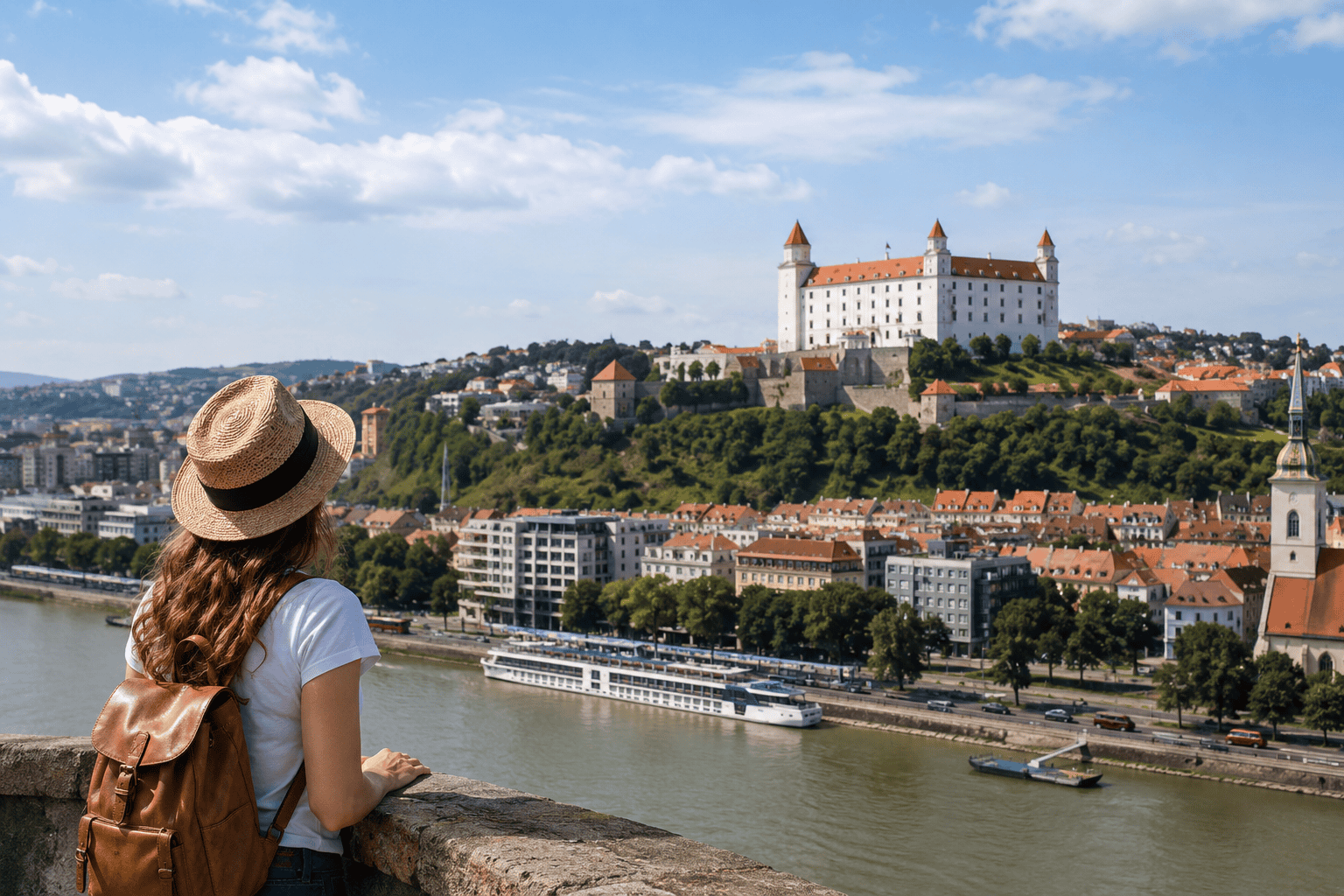
The Slovakia capital, Bratislava, is a compact and walkable city on the Danube River, uniquely positioned near both Austria and Hungary. Known for its historic old town, relaxed atmosphere, and easy accessibility, Bratislava offers a rewarding alternative to Central Europe’s busier destinations. If you're wondering whether it's worth visiting, the answer is a definite yes.
Bratislava sits at a curious intersection of Central European history: part medieval, part Soviet, part modern café city. It’s smaller and calmer than Prague, more affordable than Vienna, and less exhausting than Budapest. For travelers building a Central Europe route, it often becomes the unexpected highlight.
Quick Takeaways
Start here: The Slovakia capital, Bratislava, is a compact and walkable city on the Danube River, uniquely positioned near both Austria and Hungary.
Planning note: Bratislava sits at a curious intersection of Central European history: part medieval, part Soviet, part modern café city.
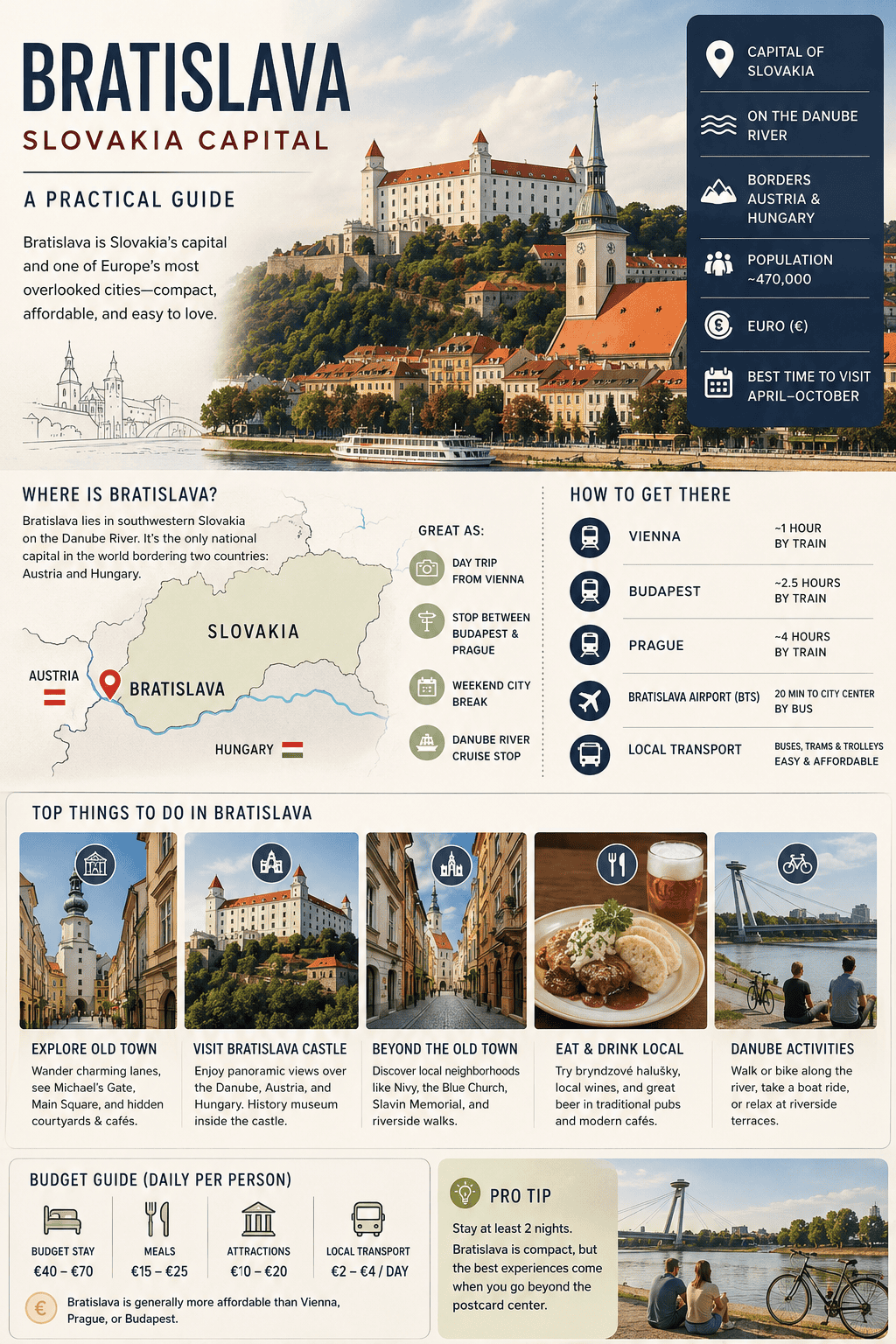
- Location: Southwestern Slovakia, on the Danube River
- Closest major cities: Vienna (~1 hour), Budapest (~2.5 hours), Prague (~4 hours)
- Best for: Slow travel, food, architecture, city breaks, regional connections
- Recommended stay: 2 nights for most travelers
- Daily budget range: €45–€250+ depending on travel style
- Currency: Euro (€)
Slovakia Capital: Where Is Bratislava?
Bratislava lies in the far southwest of Slovakia, pressed against the Austrian border and within easy reach of Hungary. It holds a geographic distinction shared by no other capital on earth: it borders two separate countries simultaneously.
That location shapes everything about how you’ll experience the city. Bratislava doesn’t need to compete for your attention — it benefits quietly from being en route between larger destinations. Many travelers visit as:
- a day trip from Vienna
- a stopover between Budapest and Prague
- a relaxed weekend city break
- a port of call on a Danube river cruise
Each of these works, but the city rewards travelers who stay at least two nights. Day-trippers rarely see Bratislava at its best — the calm evenings, the local restaurants, the slower rhythm that only reveals itself once the tour groups have gone home.
What Makes Bratislava Different
Travelers often arrive expecting a miniature Prague. That framing sets the wrong expectations.
Bratislava is less polished and less saturated with tourism, which is precisely its strength. You won’t encounter streets choked with souvenir shops or queues outside every restaurant. Instead, you get a city that still functions primarily for the people who live there:
- compact, walkable neighborhoods without heavy tourist infrastructure
- lower prices across food, drink, and accommodation
- an easy-going café culture without the premium markup
- riverside cycling paths and promenades that locals actually use
- bars and beer halls that cater to residents, not only visitors
The tradeoff is honest: Bratislava has fewer headline attractions than larger Central European capitals. If your goal is ticking off famous monuments, you’ll move through it quickly. But if the appeal of a city is its livability — the ability to sit in a courtyard café without being nudged toward the next photo opportunity — Bratislava delivers consistently.
Top Things to Do in Bratislava
Walk the Old Town
The historic center, known locally as Staré Mesto, is the natural starting point. It’s compact enough to cover in a single afternoon but layered enough to reward slower exploration across two mornings.
Key places to visit within the Old Town:
- Michael’s Gate (Michalská brána) — the only surviving medieval gate in the city, with a small museum inside
- Main Square (Hlavné námestie) — the social hub of the center, with the Old Town Hall on one side and outdoor terraces filling up from spring onward
- Roland’s Fountain — a 16th-century landmark at the center of the square
- Narrow side lanes — wandering off the main streets turns up hidden courtyards, independent bookshops, and quieter cafés
One practical advantage of Bratislava’s Old Town compared to its regional counterparts: you can wander without an itinerary and still find worthwhile places. It hasn’t been engineered purely for tourism.
Tip: Don’t confine your entire visit to the Old Town. The city’s personality becomes more interesting once you move beyond the postcard center — especially toward the riverside and up toward the castle hill.
Visit Bratislava Castle
The castle sits on a promontory above the Danube and is visible from most of the city center. It dominates the skyline in a way that makes it feel more significant from a distance than up close — but the visit is still worthwhile, primarily for the views.
The current white structure looks clean and almost new compared to more weathered Central European castles. That’s because it was heavily reconstructed after a fire in 1811 destroyed much of the original interior. The exterior restoration prioritized function over historical texture.
Reasons to make the uphill walk:
- panoramic views over the Danube and into Austria
- sunset photography, particularly toward the western horizon
- the Slovak National Museum inside for history context
- quiet castle gardens where locals walk in the early evening
The grounds are free to access even if you skip museum entry. The walk up is manageable but steep in sections — wear comfortable shoes, particularly in summer heat or on icy winter mornings.
The Danube Promenade
The riverfront is one of Bratislava’s most functional public spaces. Unlike some European riverfronts that exist mainly for tourist photos, Bratislava’s Danube promenade is actively used by residents for cycling, jogging, outdoor dining, and evening walks.
The UFO Bridge observation deck (Most SNP) offers one of the more unusual views of the city skyline. The bridge itself is a Soviet-era design that looks exactly as its nickname suggests. Entry to the observation deck costs around €7–8; the restaurant above charges considerably more.
During warmer months, riverside terraces become evening social hubs. If you’re visiting between May and September, plan at least one evening along the promenade.
Slavín Memorial
This Soviet-era war memorial sits on a hill above the residential neighborhoods northwest of the Old Town. Many visitors skip it entirely, which means those who do visit experience it almost in private.
It offers some of the best panoramic views in the city — arguably better than the castle in terms of perspective — and the surrounding area is quieter and more contemplative. The memorial itself commemorates Soviet soldiers who died in the liberation of Bratislava in 1945.
For travelers interested in understanding Central Europe’s layered 20th-century history, Slavín provides a counterpoint to the medieval Old Town that makes both feel more complete.
Slovak Food and Local Dining
Slovak cuisine is hearty and deeply influenced by neighboring culinary traditions — Austrian, Hungarian, and Czech — while maintaining its own identity through specific ingredients like sheep cheese and pickled cabbage.
Dishes worth ordering:
- Bryndzové halušky — soft potato dumplings with sharp sheep’s cheese (bryndza) and usually topped with fried bacon bits; the national dish
- Kapustnica — a rich sauerkraut soup, particularly common in winter
- Lokše — thin potato pancakes, served savory or sweet
- Schnitzel variations — widely available and reliably good
- Slovak craft beer — the domestic beer scene has expanded considerably in the past decade
Typical restaurant price ranges:
- Budget lunch: €8–12
- Mid-range dinner: €15–25 per person
- Local beer: €2–4
- Coffee: €2–3
Avoid defaulting to international restaurants in tourist-heavy areas near the Main Square. The best local food is usually found on streets just outside the immediate center, where prices are lower and the atmosphere is less staged.
For more on this part of the trip, also see our Milan Itinerary for 5 Days: Complete Travel Guide.
How Expensive Is Bratislava?
Bratislava remains more affordable than Vienna, Amsterdam, or Zurich, though prices have risen noticeably since 2019. Budget carefully if you’re visiting during peak summer weekends, when hotel rates can spike significantly.
Budget Traveler — €45–70 per day
- hostel bed or budget private room
- public transport for longer distances
- casual lunches and supermarket snacks
- one or two paid attractions
Mid-Range Traveler — €100–180 per day
- boutique hotel in or near the Old Town
- restaurant meals for lunch and dinner
- museums, castle entry, river deck
- occasional taxis and moderate drinks budget
Higher-End Travel — €250+ per day
- luxury riverside hotel
- fine dining and wine
- private guided tours
- premium nightlife
Accommodation costs vary heavily by season. Spring and autumn offer the best value. Summer weekends — particularly when there are festivals — push hotel prices toward Vienna-comparable rates.
Best Time to Visit Bratislava
Spring: April–May
One of the best periods to visit. Weather is mild, outdoor café terraces reopen, and the city isn’t yet crowded with summer tourists. Accommodation prices are generally reasonable.
Summer: June–August
Warm and active, with festivals, river events, and long evenings. The flip side: higher accommodation prices, occasional heat waves, and noticeably busier weekends. Visiting during weekdays rather than weekends makes a practical difference.
Autumn: September–October
An excellent window. Temperatures remain comfortable for sightseeing, the Small Carpathian wine harvest brings regional events, and the summer crowds have largely thinned. September in particular can feel like a second spring.
Winter: November–December
Bratislava’s Christmas markets run from late November through December and create a genuinely atmospheric backdrop in the Old Town. January and February are quieter, colder, and less compelling unless you specifically enjoy winter city breaks.
Getting to Bratislava
From Vienna
- Train (Wien Hauptbahnhof to Bratislava Hlavná Stanica): approximately 1 hour; runs frequently throughout the day
- Bus (FlixBus or RegioJet): 1–1.5 hours; often cheaper than the train
- Seasonal ferry: scenic Danube crossing available in warmer months; slower but enjoyable
From Budapest
- Train: approximately 2.5 hours
- Bus: 2.5–3 hours; multiple daily services
From Prague
- Train or bus: approximately 4 hours; RegioJet and FlixBus both serve the route regularly
By Air
Bratislava Airport (BTS) handles European routes but with limited frequency. Many travelers find it more practical to fly into Vienna International Airport (VIE) and take the direct train or bus connection into Bratislava, as Vienna has far broader international connections.
Getting Around Bratislava
The city center is compact enough that most visitors on a short trip rarely need public transport within the Old Town area. The castle, promenade, and main attractions are all within comfortable walking distance of central accommodation.
For longer distances, Bratislava operates:
- Trams — useful for connections between the center and outer neighborhoods
- Buses and trolleybuses — cover areas trams don’t reach
A single public transport ticket costs around €1.00–1.20 depending on duration. Day passes are available and worthwhile if you’re planning several trips. The network is efficient and easy to navigate even without Slovak language skills.
You won’t need a rental car unless you’re planning to explore rural Slovakia or the Small Carpathian wine region independently.
Where to Stay in Bratislava
Old Town (Staré Mesto)
The best base for first-time visitors. Walking distance to all major sights, the best restaurant options, and the liveliest evening atmosphere. Expect higher prices than outer districts, but the practical value of being central on a short trip is significant.
Riverside District
Modern hotels closer to the Danube promenade, often with better facilities and views. Good choice if you prefer contemporary accommodation over historic surroundings, or if nightlife access matters.
Near Bratislava Hlavná Stanica (Main Train Station)
Practical for arrivals and departures but a less atmospheric base. Worth considering only if you’re arriving late or leaving early and want convenience over experience.
For stays of two nights or fewer, prioritize being central. The price difference versus staying outside the core rarely justifies the extra walking or transport time.
How Many Days Do You Need?
1 Day
Enough to cover the Old Town, Bratislava Castle, a walk along the Danube promenade, and a sit-down Slovak meal. A solid introduction, but you’ll leave with the feeling you’ve only scratched the surface.
2 Days
The ideal amount for most travelers. Day one covers the main sights at a relaxed pace. Day two allows for Slavín, deeper exploration beyond the center, a market visit, better restaurant choices, and an evening that doesn’t feel rushed.
3+ Days
Works well if you’re using Bratislava as a base for regional excursions — Devín Castle (about 12km west, accessible by bus), the Small Carpathian wine villages, Danube cycling routes toward Vienna, or day trips into western Hungary.
Common Mistakes to Avoid
- Treating it like a smaller Prague: Bratislava is less attraction-dense by design. Appreciate it for atmosphere and livability, not nonstop sightseeing.
- Staying too far from the Old Town: Even a 20-minute walk from the center changes how you experience a short trip.
- Defaulting to tourist-area restaurants: Local cuisine is one of the city’s genuine draws. Seek out restaurants where the menus are also in Slovak.
- Only visiting during the day: Evenings after 7pm — once day-trippers have returned to Vienna — are often the most enjoyable time to be in Bratislava.
- Skipping day trips entirely: Devín Castle ruins, the Carpathian wine region, and riverside cycling paths all reward those with an extra half-day.
Frequently Asked Questions
What is the capital of Slovakia?
The capital of Slovakia is Bratislava. It is the country’s largest city, political capital, and main international transport hub, located in the far southwest of the country on the Danube River.
Is Bratislava worth visiting or just a day trip?
Bratislava is worth at least one overnight stay, ideally two. Day trips from Vienna are popular and feasible, but they rarely allow enough time to experience the city beyond its most obvious tourist circuit. Evenings in Bratislava — after day-trippers have left — tend to be the most enjoyable.
How safe is Bratislava for travelers?
Bratislava is considered one of the safer capital cities in Central Europe. Petty theft in crowded tourist areas is the most common concern, as in any European city. The Old Town is well-lit and active in the evenings. Standard travel precautions apply.
Is English widely spoken in Bratislava?
English is widely spoken in the Old Town, at hotels, and in most restaurants and cafés catering to visitors. In outer neighborhoods and among older residents, German is sometimes more useful than English given the city’s historical Austrian connections. Basic Slovak phrases are appreciated but not expected.
What currency does Bratislava use?
Bratislava uses the Euro (€). Slovakia joined the eurozone in 2009, so there’s no currency exchange needed if you’re arriving from Austria, Germany, or other eurozone countries. Card payments are accepted widely across the city.
Can you visit both Vienna and Bratislava on the same trip?
Yes — this is one of the most practical pairings in Central Europe. The two cities are under an hour apart by train, and combining them into a single trip adds very little logistical complexity. Many travelers split 4–5 days between the two, using each city as a base for the other.
For further travel planning, the official Bratislava tourism website maintains updated event listings and practical visitor information. The Slovak National Museum offers context on the country’s broader history beyond what the castle itself provides.
By Mara Vale for Eurly
Last verified: May 2025
Mara Vale
Mara Vale writes Eurly travel guides for first-time Europe visitors who want practical routes, realistic pacing, and fewer avoidable planning mistakes.
Eurly guides are written to help readers make confident travel decisions, but opening hours, ticket rules, transit disruptions, and local conditions can change. Always verify key reservations and official schedules before you travel.