

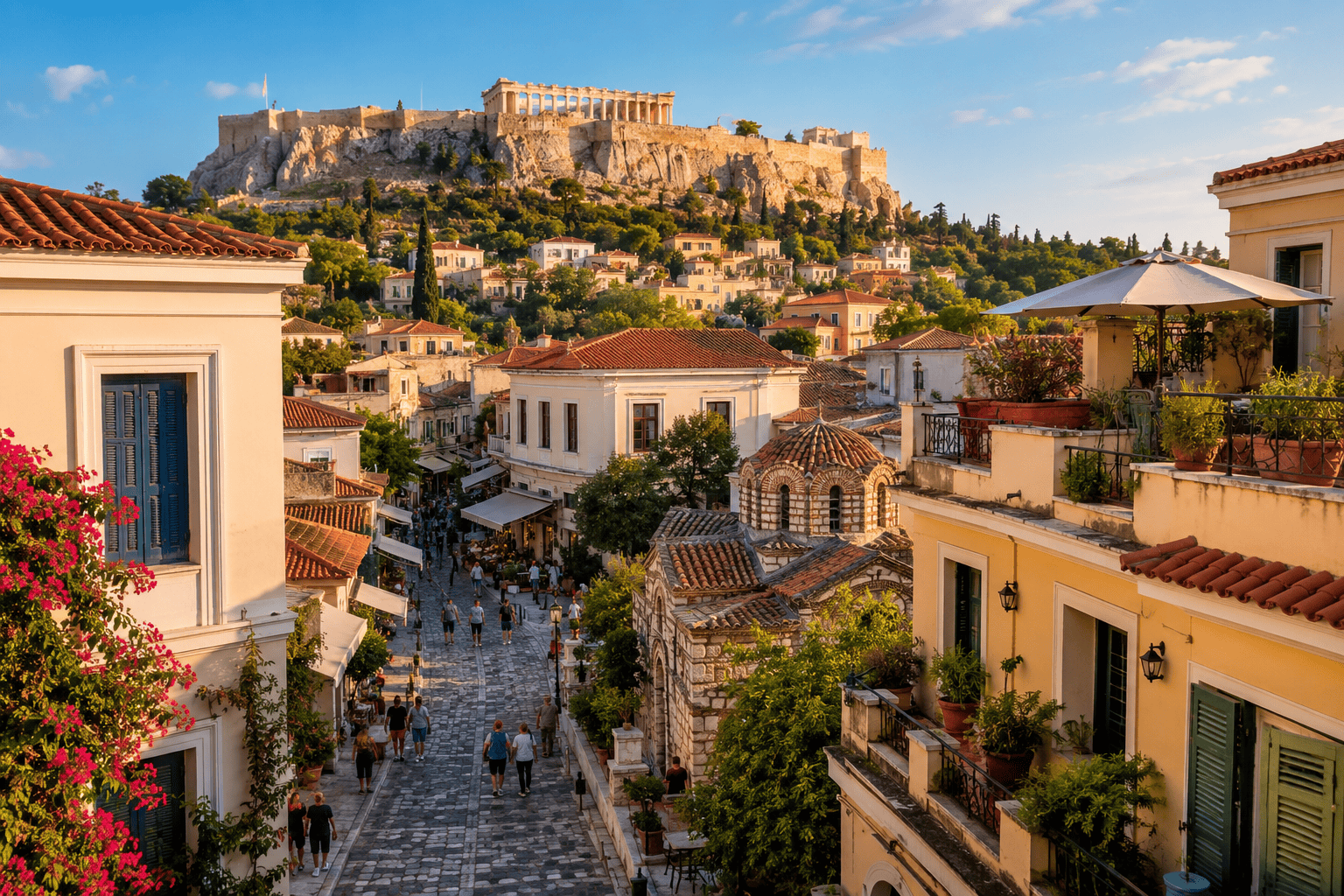
Wondering where to stay in Athens for your first trip? Plaka, Koukaki, Syntagma, and Monastiraki form the best central cluster for easy access to ancient ruins, metro connections, and reliable restaurants. Stay in this walkable zone and Athens feels manageable without a car.
The city looks chaotic at first glance — ancient ruins beside busy avenues, rooftop bars above century-old bakeries, and neighborhoods that shift from polished to gritty within a few blocks. But terrain and hotel location matter more here than in many European capitals. Get it right and Athens rewards you with one of the most atmospheric city-break experiences in Europe.
Quick Takeaways
Start here: Wondering where to stay in Athens for your first trip?
Planning note: The city looks chaotic at first glance — ancient ruins beside busy avenues, rooftop bars above century-old bakeries, and neighborhoods that shift from polished to gritty within a...
This guide covers the best neighborhoods to stay in Athens for sightseeing, nightlife, and local atmosphere, with honest tradeoffs, metro access notes, and budget expectations for each area.
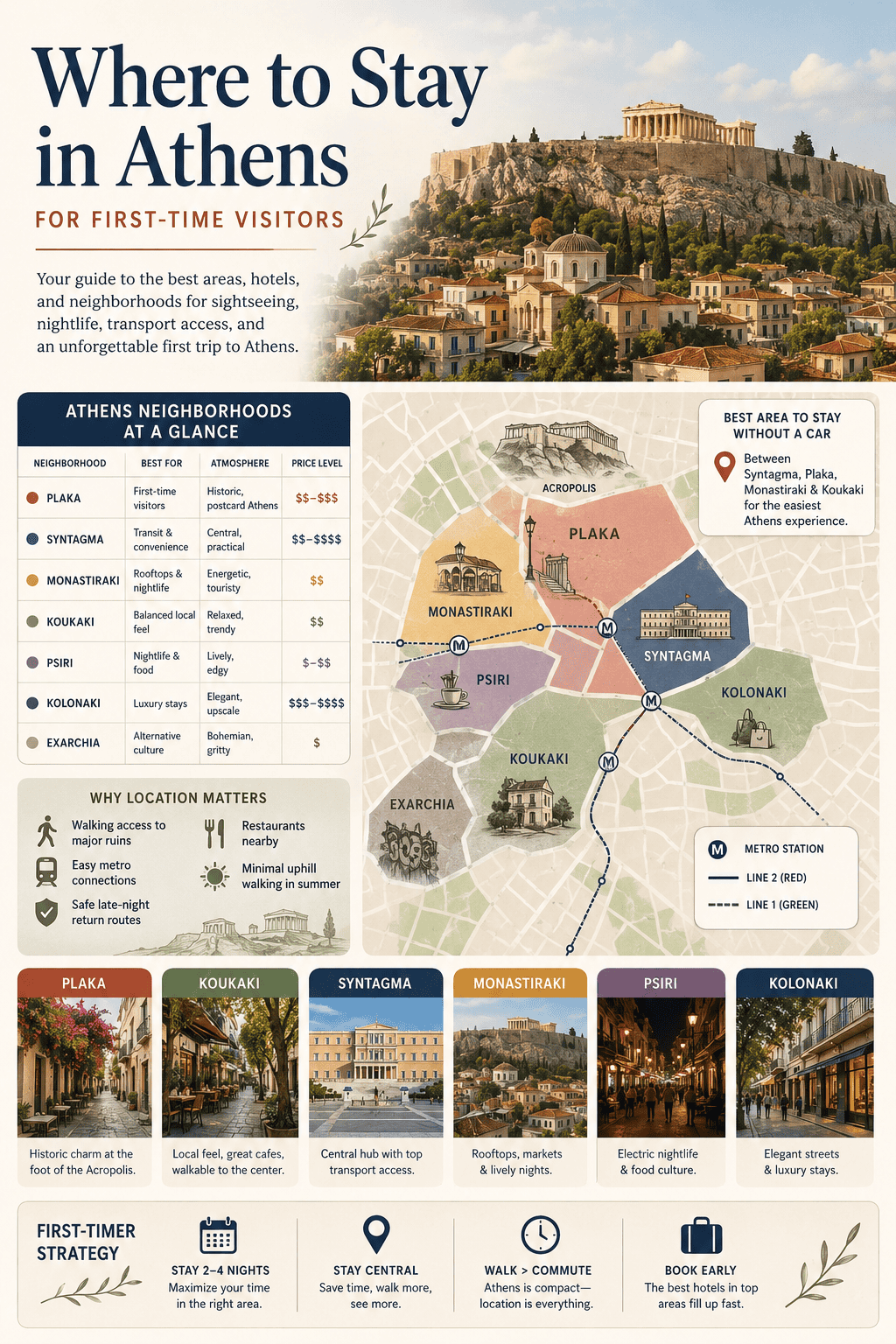
Where To Stay In Athens: Athens Neighborhoods at a Glance
| Neighborhood | Best For | Atmosphere | Price Level |
|---|---|---|---|
| Plaka | First-time visitors | Historic, postcard Athens | $$–$$$ |
| Syntagma | Transit & convenience | Central, practical | $$–$$$$ |
| Monastiraki | Rooftops & nightlife | Energetic, touristy | $$ |
| Koukaki | Balanced local feel | Relaxed, trendy | $$ |
| Psiri | Nightlife & food | Lively, edgy | $–$$ |
| Kolonaki | Luxury stays | Elegant, upscale | $$$–$$$$ |
| Exarchia | Alternative culture | Bohemian, gritty | $ |
For more on this part of the trip, also see our Athens City Guide for First-Time Visitors.
Why Location Matters More in Athens Than You’d Expect
Athens isn’t a large city, but a few factors make neighborhood choice unusually important for first-timers.
Terrain: Several central neighborhoods sit on or near hills. Walking uphill in summer heat after a long sightseeing day — especially with luggage — gets old fast. A hotel that looks close on a map can feel much farther on foot in July or August.
Noise: Athens nightlife runs late. Streets around Monastiraki, Psiri, and parts of Plaka stay active until 2–3 AM in peak season. If you don’t check noise reviews, you may end up regretting it.
Short stays: Most first-time visitors only spend 2–4 nights in Athens. Staying even 20 minutes outside the centre burns meaningful sightseeing time and money on taxis.
A well-located hotel in Athens ideally offers: walking access to major ruins, a metro station nearby, late-night return routes that feel comfortable, and restaurants within a short stroll — all without an uphill slog at the end of each day.
Plaka: Best Neighborhood to Stay in Athens for First-Timers
Plaka sits directly beneath the Acropolis and is the neighborhood most first-time visitors picture when they imagine Athens: stone alleyways, neoclassical houses, tavernas shaded by bougainvillea, and Acropolis views appearing around corners without warning. It’s the most immediately rewarding area to base yourself for a first Greece trip.
What you can walk to from Plaka
- Acropolis and Acropolis Museum
- Ancient Agora and Roman Agora
- Monastiraki Square and flea market
- Syntagma Square
That’s essentially the entire historic core on foot, which is hard to beat for a 2–3 night stay focused on sightseeing.
Downsides of Plaka
It’s the most tourist-heavy neighborhood in Athens — crowded during cruise ship hours and noticeably more expensive than Koukaki or Psiri. Nightlife is quieter here, which suits some visitors but disappoints others. Some hotels also sit on steep cobbled streets that become genuinely difficult with wheeled luggage.
Who Plaka suits best
- Couples on a short first trip
- Travelers prioritising sightseeing above all else
- Anyone who wants the classic Athens experience without compromise
Plaka budget expectations
- Budget hotels: €90–140/night
- Mid-range boutique: €150–250/night
- Acropolis-view hotels: €250+/night
Hotel tip: Look for properties with an Acropolis-facing rooftop terrace and confirm walking time to the nearest metro station (Acropoli on Line 2 or Monastiraki on Lines 1/3). Avoid streets immediately adjacent to the busiest souvenir corridors if a quiet night’s sleep matters.
Syntagma: Best Area to Stay in Athens Without a Car
Syntagma is Athens’ administrative and transport hub — home to the parliament, Syntagma metro station, and a web of bus and tram connections. It’s the practical choice for first-timers who care most about getting around efficiently rather than maximising atmosphere.
Why Syntagma works well for car-free travel
Syntagma station sits on both metro lines and provides a direct connection to Athens International Airport (Eleftherios Venizelos) — no transfers, roughly 40 minutes. Arriving late, leaving early, or catching a ferry from Piraeus all become straightforward. From here, nearly every major neighborhood is reachable on foot or by metro within 15 minutes.
Who Syntagma suits best
- Travellers on 1–2 night Athens stops en route elsewhere
- Families and older travellers who prioritise flat, easy walking
- Anyone relying entirely on public transport
Downsides of Syntagma
The trade-off is atmosphere. Parts of Syntagma feel commercial and traffic-heavy, closer in feel to a European CBD than a historic quarter. You’re staying for convenience, not charm.
Practical tip: Booking slightly south of Syntagma Square, toward the Plaka border, gives a noticeably better balance of convenience and character without adding meaningful distance to the metro.
Syntagma budget expectations
- Budget hotels: €80–130/night
- Mid-range: €140–220/night
- Luxury international brands: €300+/night
Koukaki: Best Overall Balance for Most Visitors
Koukaki has become the most consistently recommended Athens neighborhood for independent travellers who’ve done some research — and once you understand why, it’s hard to argue with. It sits immediately south of the Acropolis district, close enough to walk everywhere that matters but far enough from the tourist core to feel genuinely Athenian.
What makes Koukaki work
Prices run lower than Plaka while the food and café scene runs better. Evenings feel calmer and more residential. You can still walk easily to the Acropolis Museum, Filopappou Hill, Plaka, and Monastiraki — but returning to your accommodation at the end of the day involves quieter streets and less noise.
It’s also the best neighborhood for apartment rentals, which makes it popular with travellers staying 3–5 nights or combining Athens with wider Greece trips.
Who Koukaki suits best
- Repeat Europe travellers wanting authenticity over tourist polish
- Food-focused itineraries
- Digital nomads and remote workers
- Anyone staying more than three nights
Koukaki budget expectations
- Apartments: €70–150/night
- Boutique hotels: €120–220/night
Common mistake: Some visitors book too far south in Koukaki and end up farther from both the metro and the Acropolis than expected. Always check actual walking times to Acropoli station (Line 2) before booking.
Monastiraki: Best for Rooftops, Markets, and Energy
Monastiraki is loud, lively, and genuinely chaotic — and for the right traveller, that’s exactly the point. This is tourist Athens at its most concentrated: flea markets, rooftop bars with direct Acropolis views, street musicians, late-night souvlaki, and a metro station connecting Lines 1 and 3 (including airport service).
Why travellers choose Monastiraki
If your Athens plans revolve around sunset cocktails with Acropolis views, late dinners, and a city-break atmosphere that stays energetic until midnight, Monastiraki delivers that more reliably than anywhere else. You can walk to Plaka, Psiri, the Ancient Agora, and Syntagma with no transport needed.
Downsides of Monastiraki
Noise is the primary concern. Streets immediately around the square and flea market area can stay active until 2–3 AM in peak season. Light sleepers should read recent hotel reviews specifically mentioning soundproofing before booking.
Who Monastiraki suits best
- Younger travellers and friend groups
- Nightlife-focused city breaks
- Anyone who wants rooftop Acropolis views without paying Plaka prices
Monastiraki budget expectations
- Budget stays: €70–120/night
- Mid-range rooftop hotels: €150–250/night
Psiri: Best Neighborhood for Food Culture and Nightlife
Psiri sits just northwest of Monastiraki and has evolved from a gritty wholesale district into one of Athens’ most interesting evenings-out neighbourhoods. It’s known for live music venues, cocktail bars, late-night dining, and a creative edge that Plaka doesn’t have.
If your Athens plans centre on bars, restaurants, social atmosphere, and cultural energy rather than ruins access, Psiri may suit you better than the more polished tourist zones — and hotel value here tends to be better than Plaka.
Downsides of Psiri
Not every street feels equally comfortable at 1 AM. Some travellers find parts of Psiri rough around the edges, especially compared to Plaka or Koukaki. Noise is also significant, particularly on weekends.
Who Psiri suits best
- Solo travellers and food-focused visitors
- Budget-conscious younger travellers
- Anyone prioritising nightlife and local dining over sightseeing proximity
Kolonaki: Best Upscale Neighborhood in Athens
Kolonaki occupies an entirely different register from central tourist Athens. It’s elegant, residential, and refined — luxury boutiques, polished cafés, fine dining, and upscale hotels on tree-lined streets east of Syntagma. If Athens is one stop on a broader European luxury itinerary, this is where the stay makes sense.
You avoid most of the tourist congestion while remaining close enough to reach major sights by metro or taxi. Hotels in Kolonaki tend to be quieter and more consistently polished than those closer to Monastiraki.
Downsides of Kolonaki
The neighbourhood is hilly, and immediate Acropolis access is less convenient than from Plaka or Koukaki. The atmosphere, while pleasant, lacks the historic character of the older districts.
Kolonaki budget expectations
- Luxury boutique hotels: €250–500+/night
- Upscale apartments: €180+/night
Neighborhoods to Think Carefully About
Omonia
Omonia has improved significantly and some newer hotels there offer genuine value. But the area still feels less comfortable at night than Plaka, Koukaki, or Syntagma for many first-time visitors. It can work well for budget travellers on very short stays near transit, but it’s generally not the best first choice for families or first-timers without a specific reason to be there.
Exarchia
Exarchia is culturally fascinating — bohemian, politically charged, popular with alternative travellers — but it’s better suited to repeat visitors than first-timers wanting easy sightseeing access and low-stress navigation.
Athens Hotel Strategy for First-Time Visitors
Stay close to a metro station
Even if you plan to walk everywhere, proximity to a metro station matters for airport transfers, ferry departures from Piraeus, and the inevitable afternoon when summer heat makes walking feel impossible. The best-connected stations for first-timers are Syntagma (Lines 2 and 3), Monastiraki (Lines 1 and 3), and Acropoli (Line 2).
Book rooftop hotels early
The most sought-after athens hotels for first timers — those with Acropolis-view rooftop terraces — sell out months in advance from May through September, around Easter, and during the October shoulder season. If rooftop views matter to you, book as early as your plans allow.
Don’t trade walkability for savings
Budget travellers sometimes book 30–40 minutes outside the centre to save €30–50 per night. In most cases it isn’t worth it. Central Athens is compact, and staying in the right location saves both time and money on taxis, while adding considerably to the experience. If budget is tight, Koukaki and Psiri offer the best value without sacrificing position.
Always check recent noise reviews
Athens nightlife runs genuinely late. Before booking in Monastiraki or Psiri especially, read recent guest reviews that specifically mention soundproofing, street noise, and rooftop bar activity nearby. A single noisy night can overshadow an entire short trip.
Best Athens Hotels for First-Timers by Budget
Budget (€70–120/night)
Best areas: Koukaki apartments, small Monastiraki hotels, Psiri boutique stays. You can find clean, well-located properties in this range — but check metro walking times carefully before booking.
Mid-range (€130–250/night)
This is Athens’ sweet spot. Plaka, Koukaki, and Syntagma all offer strong mid-range options with rooftop terraces, boutique design, Acropolis-view rooms, and genuinely excellent locations. If you can stretch to this range, the difference in experience is significant.
Luxury (€300+/night)
Top luxury properties cluster around Syntagma, Kolonaki, and Acropolis-facing avenues in Plaka. Expect rooftop pools, fine dining, international luxury brands, and Acropolis suites. Most major international hotel groups have Athens properties in this tier.
Quick Reference: Which Neighborhood for Which Traveller
- Plaka → classic first-time Athens; best for sightseeing, couples, short stays
- Koukaki → best overall balance; local atmosphere, good food, fair prices
- Syntagma → easiest without a car; best for transit connections and airport access
- Monastiraki → rooftop energy and nightlife; lively, busy, noisier
- Psiri → food culture and bar scene; best value for nightlife-focused travellers
- Kolonaki → quiet, upscale, refined; best for luxury stays away from tourist crowds
If you want the simplest decision: stay in Plaka for atmosphere, Koukaki for balance, or Syntagma for pure convenience. All three keep you within walking distance of the Acropolis and connected to everything else the city offers.
Useful Resources
- Athens Metro — official route map and fare information
- Acropolis Museum — official site with opening hours and tickets
- Athens International Airport — public transport options to the city
FAQ
Where should first-time visitors stay in Athens?
Most first-time visitors should stay in Plaka, Koukaki, Syntagma, or Monastiraki. These four neighborhoods offer the best combination of sightseeing access, metro connections, walkability, and restaurant options. Plaka is the most atmospheric; Koukaki offers the best balance of local feel and convenience; Syntagma is best for transit; Monastiraki suits nightlife-focused trips.
What is the best area to stay in Athens without a car?
Syntagma is the top choice for car-free travellers, with direct metro access to the airport and connections across the city. Plaka, Monastiraki, and Koukaki are all strong alternatives — and in practice, most visitors find Athens significantly easier to navigate without a car. Traffic is difficult, parking is frustrating, and the main attractions are all walkable from central neighborhoods.
Which neighborhoods in Athens are best for sightseeing access?
Plaka, Monastiraki, Koukaki, and Syntagma all allow you to walk to the Acropolis, Ancient Agora, Acropolis Museum, and Roman Agora without needing the metro. Plaka and Monastiraki are closest; Koukaki adds a short walk south of the Acropolis district; Syntagma is slightly further east but still very manageable on foot.
Is Athens walkable for tourists?
Yes, if you stay centrally. The main historic sites are concentrated in a relatively compact area around the Acropolis, and the central neighborhoods are well connected by pedestrianised streets. The main exceptions are summer heat (which makes longer walks harder) and some hilly terrain around Plaka, Kolonaki, and parts of Koukaki.
How many nights should first-time visitors spend in Athens?
Most first-time visitors need 2–4 nights to cover the major sites comfortably. Two nights is enough for the Acropolis, Acropolis Museum, Ancient Agora, and a neighbourhood walk; three or four nights allows for the National Archaeological Museum, Syntagma area, Kolonaki, and a day trip to Cape Sounion or the Saronic Islands.
Do Athens hotels book out early for peak season?
Yes — especially mid-range boutique hotels with Acropolis-view rooftops, which are in high demand from May through September and around Easter. Booking 3–6 months in advance is reasonable for peak summer. Shoulder season (April and October) offers more flexibility and noticeably lower rates.
By Mara Vale for Eurly
Last verified: June 2025

Mara Vale
Mara Vale writes Eurly travel guides for first-time Europe visitors who want practical routes, realistic pacing, and fewer avoidable planning mistakes.
Eurly guides are written to help readers make confident travel decisions, but opening hours, ticket rules, transit disruptions, and local conditions can change. Always verify key reservations and official schedules before you travel.