
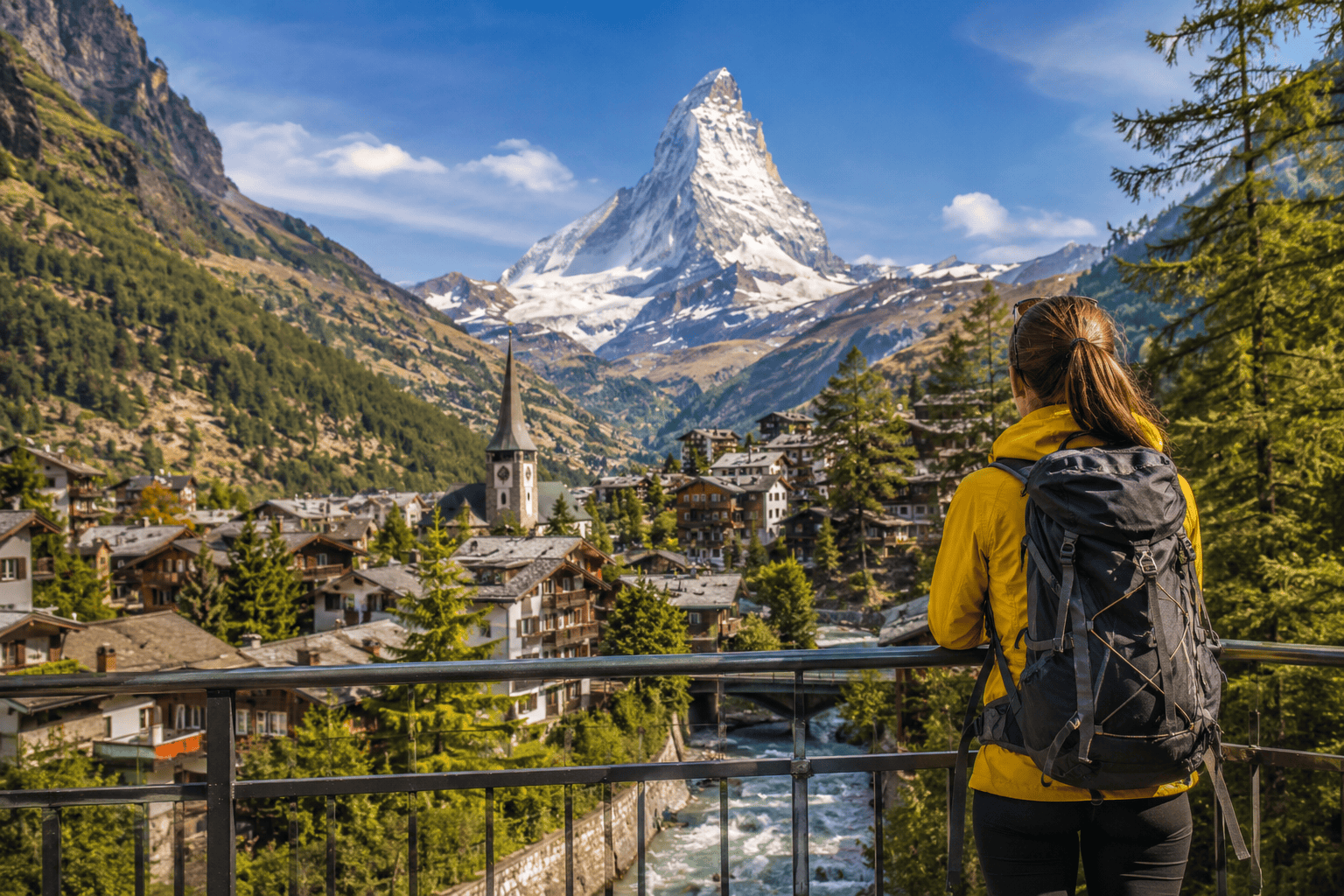
Matterhorn from Zermatt is one of Switzerland’s most iconic alpine experiences, with unforgettable views from viewpoints, hiking trails, and scenic rail journeys. The car-free village sits directly beneath the peak, making it the ideal base for visiting Gornergrat, Riffelsee, and the Five Lakes Walk. Plan at least two nights to maximize your chances of clear skies and the best early-morning light.
Why See the Matterhorn From Zermatt?
The Matterhorn rises to 4,478 metres (14,692 ft) on the Swiss-Italian border and is one of the most photographed peaks on earth. What makes Zermatt exceptional is proximity: the village sits directly below the north face, meaning you see the mountain’s most dramatic profile the moment you step off the train.
Unlike many famous Alpine destinations, Zermatt is entirely car-free. Electric taxis and horse-drawn carriages move luggage; the streets stay quiet. That atmosphere — no engine noise, clean mountain air, the pyramid of the Matterhorn filling the southern skyline — is a significant part of why the destination feels so different from ordinary Swiss resort towns.
Visitors come for:
- Iconic Matterhorn views from the village itself, free of charge
- Cogwheel railways and cable cars that lift non-hikers to serious elevation
- Well-marked hiking trails at every difficulty level
- Reflection lakes that produce Switzerland’s most shared photographs
- Year-round mountain railways (skiing in winter, hiking in summer)
Getting to Zermatt
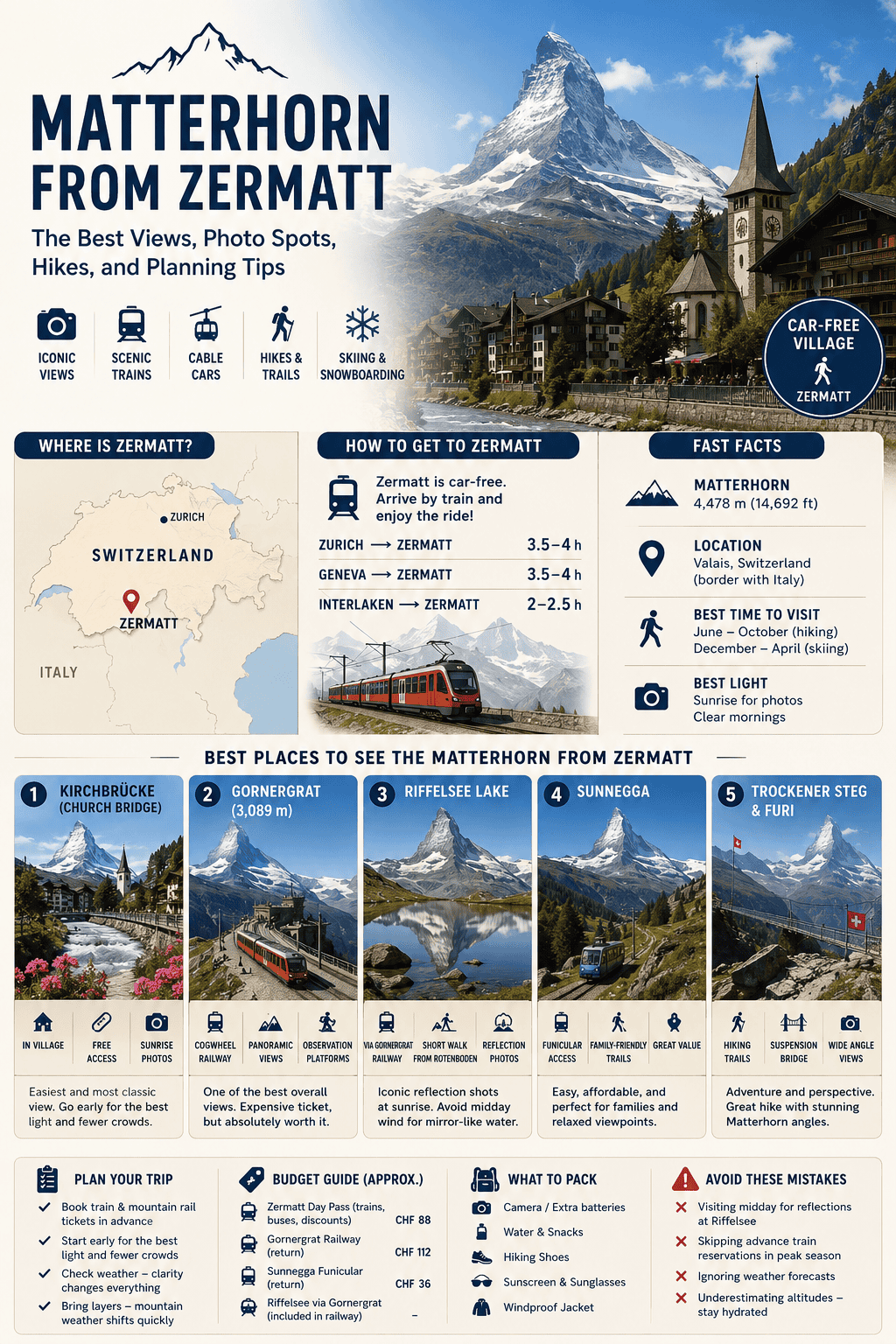
Private vehicles are not permitted in Zermatt. The only way in is by train, which suits the experience well — the final stretch through the Mattertal valley is scenic in its own right.
| Departure City | Typical Journey Time | Route |
|---|---|---|
| Zurich | 3.5–4 hours | Train to Visp or Brig, then Matterhorn Gotthard Bahn |
| Geneva | 3.5–4 hours | Train to Visp, then Matterhorn Gotthard Bahn |
| Interlaken | 2–2.5 hours | Train via Visp |
| Bern | 2.5–3 hours | Train via Visp or Brig |
If you hold a Swiss Travel Pass, the train to Zermatt is fully covered and the Gornergrat Railway receives a 50% discount — a meaningful saving if you’re already rail-touring Switzerland. Book seats on busy summer trains in advance via SBB Swiss Federal Railways.
Book your Zermatt accommodation before your train. Summer weekends and the December–March ski season fill up months ahead. Arriving without a reservation in peak periods is a genuine risk.
Best Places to See the Matterhorn From Zermatt
Viewpoints range from free village spots to elevated platforms reached by mountain railways. The right choice depends on your budget, fitness level, and how much time you have.
1. Kirchbrücke (Church Bridge)
For most visitors, Kirchbrücke is the first and most rewarding stop — it costs nothing and is a five-minute walk from the village centre. The bridge frames the Matterhorn directly above the Vispa river, producing the classic postcard composition you’ve likely already seen.
- Free access, no ticket required
- Best at sunrise before clouds build around the summit
- Ideal for photographers staying overnight in Zermatt
2. Gornergrat — The Highest Viewpoint
Gornergrat at 3,089 metres is the standout elevated viewpoint and the one most visitors prioritise. The Gornergrat Railway departs directly from Zermatt station and is one of Europe’s highest open-air cogwheel railways. At the top, observation terraces look out over the Matterhorn, the Gorner Glacier, and more than two dozen surrounding peaks.
- Round-trip railway ticket: approximately CHF 88–100 (check current pricing at gornergrat.ch; Swiss Travel Pass holders receive 50% off)
- Journey time: about 33 minutes each way
- Restaurant and terrace at the summit
Many experienced visitors ride up at sunrise and descend on foot — the trail from Gornergrat to Rotenboden and Riffelsee is well-marked and manageable.
3. Riffelsee Lake
Riffelsee is where the iconic Matterhorn reflection photograph is taken. On calm mornings, the peak appears mirrored in the lake surface with extraordinary clarity. Arrive early — by midday, wind almost always disturbs the water and the reflection disappears.
- Reached via Gornergrat Railway to Rotenboden station, then a short downhill walk
- Best in summer and early autumn
- Sunrise timing is the single biggest factor in getting the shot
4. Sunnegga
Sunnegga at 2,288 metres is accessed by an underground funicular from the village in under four minutes, making it the quickest elevated viewpoint from Zermatt. It’s well-suited to families and visitors with limited time. There are restaurants, a children’s play area near the small Leisee lake, and connecting paths to Stellisee.
5. Stellisee
Stellisee is a second reflection lake, typically quieter than Riffelsee and often ranked higher by landscape photographers for its composition. It requires about 45 minutes of walking from Sunnegga, which filters out casual visitors. Early morning, particularly in late summer and September, produces exceptional reflection conditions.
| Viewpoint | Elevation | Access | Cost | Best For |
|---|---|---|---|---|
| Kirchbrücke | Village level | Walk | Free | Best Quick classic view |
| Gornergrat | 3,089 m | Cogwheel railway | ~CHF 88–100 | Best Panoramic views |
| Riffelsee | ~2,757 m | Train + short walk | Included in Gornergrat ticket | Best Reflection photos |
| Sunnegga | 2,288 m | Underground funicular | ~CHF 20–25 return | Good Families, limited time |
| Stellisee | ~2,537 m | Funicular + 45-min walk | Funicular ticket only | Good Photography, fewer crowds |
Best Hikes With Matterhorn Views
Five Lakes Walk (5-Seenweg) — Best Day Hike for First-Timers
Distance: ~9.8 km | Difficulty: Moderate | Elevation gain: ~300 m
The Five Lakes Walk links Stellisee, Grindjisee, Grünsee, Moosjisee, and Leisee — each offering a different Matterhorn reflection. It’s consistently recommended as the single best day hike for visitors doing Zermatt for the first time. Start from Sunnegga (funicular from the village) and walk back down to Zermatt at the end.
- Allow 4–5 hours at a relaxed pace including photography stops
- Trail is well-marked and mostly wide; suitable for fit beginners
- Several mountain restaurants en route for lunch breaks
Riffelsee to Gornergrat Trail — Easiest Mountain Hike
Distance: ~3 km | Difficulty: Easy | Elevation gain: ~330 m
Take the Gornergrat Railway up to Rotenboden, walk down to Riffelsee for the reflection, then hike up to Gornergrat summit. A great option if you want mountain scenery without committing to a full day. The trail is never far from the railway, so you can descend by train at any point.
Höhbalmen Trail — Best for Experienced Hikers
Distance: ~18 km | Difficulty: Challenging | Elevation gain: ~1,100 m
The Höhbalmen trail passes high above the valley on Zermatt’s west side, giving close-up views of the Matterhorn’s north and west faces that most visitors never see. Crowds are rare. Expect a full day on the mountain and carry adequate food, water, and layers — conditions can change quickly at this elevation.
Trail conditions vary significantly by season. Snow can remain on higher trails into late June, and some paths close or become difficult in early November. Check current conditions with Zermatt Tourism before setting out on any high-altitude route.
Best Time to Visit the Matterhorn From Zermatt
| Season | Pros | Cons | Verdict |
|---|---|---|---|
| Summer (Jun–Sep) | All trails open, long days, warmest temps | Peak prices, largest crowds | Best for hiking |
| Autumn (Sep–Oct) | Clear views, fewer tourists, autumn colours | Cooler, some facilities close late Oct | Good for photos |
| Winter (Dec–Mar) | Snow scenery, skiing, festive atmosphere | Higher accommodation costs, short days | Good for skiing |
| Shoulder (May, Nov) | Lower prices possible | Unpredictable weather, some services closed | Optional |
Late September is the sweet spot for most visitors — trails are still open, crowds thin noticeably after the school-holiday peak, and the mountain light in early autumn is exceptional for photography.
How Much Does a Matterhorn Trip Cost?
Switzerland is expensive, and Zermatt sits at the higher end of Swiss pricing. All figures below are in Swiss Francs (CHF); roughly equivalent to USD and EUR at most current exchange rates.
Budget formula: Accommodation + Food + Mountain transport = Daily spend
The Gornergrat Railway ticket is typically the single largest one-off sightseeing cost. A Swiss Travel Pass significantly reduces transport costs if you’re visiting Zermatt as part of a wider Switzerland trip.
| Traveller Type | Accommodation | Food | Activities/Transport | Est. Daily Total |
|---|---|---|---|---|
| Budget | CHF 50–100 (hostel/guesthouse) | CHF 20–40 (self-catering, snacks) | CHF 20–50 | CHF 90–190 |
| Mid-range | CHF 150–300 (3-star hotel) | CHF 50–80 (restaurant meals) | CHF 50–150 | CHF 250–530 |
| Luxury | CHF 400+ (boutique/5-star) | CHF 100+ (fine dining) | CHF 150+ | CHF 650+ |
Budget travellers can keep costs down by picnicking at viewpoints, using the free Kirchbrücke viewpoint, and limiting mountain railway tickets to one day (Gornergrat is the priority pick).
Suggested 2-Day Matterhorn Itinerary
Two nights in Zermatt gives you weather flexibility and lets you experience the mountain at different times of day without feeling rushed.
Day 1 — Arrive and Orientate
Morning: Arrive by train from Zurich, Geneva, or Bern. Check in and walk to Kirchbrücke for your first Matterhorn view. The bridge is a five-minute walk from the station.
Afternoon: Ride the Gornergrat Railway to the summit. Spend an hour on the observation terraces, then walk down to Rotenboden station via the Riffelsee reflection lake (check water conditions — midday is often windy).
Evening: Return to Zermatt by train from Rotenboden or Riffelberg. Dinner in the village.
Getting Around
Zermatt is compact and walkable. The Gornergrat Railway station is directly adjacent to the main train station — you cannot miss it.
Backup Plan
If clouds cover Gornergrat, descend earlier and visit Sunnegga (funicular near the village) for a different angle on the mountain.
Day 2 — Hike and Photography
Morning: Early start (before 7am) for Stellisee reflection photography. Take the Sunnegga funicular and walk 45 minutes to the lake. Calm, clear mornings in this window give the best reflection conditions.
Afternoon: Continue the Five Lakes Walk from Stellisee, linking all five reflection lakes back down to Zermatt. Allow 4–5 hours total. Lunch at a mountain restaurant mid-route.
Evening: Optional sunset at Kirchbrücke before an evening train departure, or overnight if your schedule allows a third morning.
Getting Around
The Five Lakes Walk ends back in Zermatt village — no additional transport needed. Sunnegga funicular departs from the east side of the village near the Gemsweg.
Backup Plan
If morning clouds prevent the Stellisee reflection, walk the Five Lakes route anyway for the scenery, or use the morning to visit the Matterhorn Museum Zermatlantis in the village.
Common Mistakes to Avoid
- Assuming the Matterhorn will be visible: Cloud cover regularly obscures the summit, especially in the afternoon. Check mountain weather forecasts (the Zermatt Tourism website posts daily updates) and prioritise early mornings.
- Visiting reflection lakes after 9am: Wind builds across Riffelsee and Stellisee as the morning progresses. Midday arrivals almost always miss the reflection entirely.
- Booking only one night: A single night leaves no buffer for cloud cover. Two nights is the practical minimum; three gives genuine flexibility.
- Skipping the Gornergrat Railway to save money: It is expensive, but no other viewpoint in Zermatt matches the panoramic perspective at 3,089 metres. If budget is tight, cut spending elsewhere rather than skipping this.
- Not booking accommodation early: Zermatt sells out — sometimes months ahead — in July, August, and December through February. Last-minute availability exists but is limited and expensive.
- Underestimating altitude: Even arriving at Zermatt (1,608 m) can cause mild breathlessness for some visitors. Take it easy on day one, especially before ascending further on mountain railways.
Frequently Asked Questions
Can you see the Matterhorn from Zermatt village without paying for a mountain railway?
Yes. Kirchbrücke (Church Bridge) in the village centre gives you a direct, unobstructed view of the Matterhorn at zero cost. It is one of the best free viewpoints in Switzerland. The village streets and the main square also offer clear sightlines to the peak on fair-weather days.
How long should you spend in Zermatt to see the Matterhorn properly?
The practical minimum is two nights. This gives you one full day for Gornergrat and village exploration, plus a second morning for early reflection photography. Three nights is ideal if you want to complete the Five Lakes Walk, experience a sunrise, and have a weather buffer.
Is the Gornergrat Railway worth the cost?
For most visitors, yes. The Gornergrat Railway is expensive (approximately CHF 88–100 round trip), but it delivers the highest and most comprehensive Matterhorn panorama accessible without hiking skill. Swiss Travel Pass holders receive a 50% discount, which makes the value calculation easier. If you’re visiting Switzerland on a rail pass, this is one of the strongest arguments for getting one.
What is the best time of day to photograph the Matterhorn?
Sunrise is consistently the best window — clearer skies, calm winds at the reflection lakes, and dramatic alpenglow light on the north face. From Kirchbrücke, golden hour begins shortly after 6am in summer. Stellisee and Riffelsee both reward very early arrivals (before 7am) with the calmest reflection conditions. Midday and afternoon photography is possible but far less reliable due to cloud build-up and wind.
Can you do Zermatt as a day trip?
Technically yes — Zermatt is reachable by train from Zurich or Geneva in under four hours. A long day trip allows you to visit Kirchbrücke, ride to Gornergrat, and walk the village. However, overnight visitors consistently get better experiences because they can access early-morning views, wait out afternoon clouds, and experience the village when day-trippers have left.
Are dogs or prams allowed on the Gornergrat Railway and hiking trails?
Dogs are permitted on the Gornergrat Railway (a ticket may be required; check with the operator). Most Zermatt hiking trails are accessible to fit adults with standard walking gear. Pushchairs are not suitable for most mountain trails, though Sunnegga has relatively flat paths near Leisee lake suitable for families with young children.
Seeing the Matterhorn from Zermatt is among the most rewarding mountain experiences in Europe — and one of the few where world-class alpine scenery is accessible to non-climbers. Spend at least two nights, ride the Gornergrat Railway on your first full day, and set an alarm for sunrise at Kirchbrücke or Stellisee. Those two decisions alone will make the trip.
Last verified: June 2026. Mountain railway prices, trail conditions, and seasonal services change — always confirm current details with Zermatt Tourism before you travel.

Mara Vale
Mara Vale writes Eurly travel guides for first-time Europe visitors who want practical routes, realistic pacing, and fewer avoidable planning mistakes.
Eurly guides help readers make confident travel decisions, but opening hours, ticket rules, transit disruptions, and local conditions can change. Always verify key reservations and official schedules before you travel.
By Mara Vale for Eurly
Mara Vale
Mara Vale writes Eurly travel guides for first-time Europe visitors who want practical routes, realistic pacing, and fewer avoidable planning mistakes.
Eurly guides are written to help readers make confident travel decisions, but opening hours, ticket rules, transit disruptions, and local conditions can change. Always verify key reservations and official schedules before you travel.