
Where to Stay in Rome: Quick Facts
If you are deciding where to stay in Rome, expect hotel prices in 2026 to range from €25–40 per night for a hostel dorm bed, €80–130 for a budget private room, and €140–220 for a mid-range hotel in a central location. Boutique hotels in the historic centre often exceed €300 per night, while many first-time visitors find the best balance at €140–180 per night in a well-connected, walkable neighbourhood.
The single biggest factor when booking accommodation in Rome is exact location. Two hotels both described as being in the “historic centre” can have completely different experiences on the ground. One may sit on a quiet lane three minutes from the Pantheon, while another could require a 20-minute walk to reach major sights. Always check the exact address on Google Maps and verify walking times to landmarks like the Colosseum, Pantheon, Trevi Fountain, and the nearest Metro station.
The area around Stazione Termini is Rome’s main budget accommodation hub. It offers the city’s highest concentration of hostels, cheap hotels, and guesthouses, plus excellent transport links. However, it lacks the atmosphere many first-time visitors expect from Rome. If waking up in a scenic neighbourhood matters to you, staying elsewhere is usually worth the extra money.
A common mistake is booking a hotel advertised as “near the Vatican” or “near the Colosseum” without checking the map. Large residential districts surrounding both landmarks can leave you dependent on buses or taxis. Areas such as Aurelio, Gianicolense, and outer Esquilino are not ideal bases for a first visit focused on sightseeing efficiency.
For more Italy planning ideas, browse the Italy
travel guides. For official visitor information, see Turismo Roma.
Rome Neighbourhood Cheat Sheet
| Area | Vibe | Budget Hotel | Mid-Range Hotel | Best For |
|---|---|---|---|---|
| Centro Storico | Historic core, busy, highly walkable | €100–130 | €140–220 | First-time visitors and sightseeing |
| Trastevere | Atmospheric, lively nightlife, cobblestone streets | €85–110 | €110–180 | Food, nightlife, and local atmosphere |
| Prati | Quiet, residential, near the Vatican | €80–110 | €100–160 | Best value for central stays |
| Termini / Esquilino | Transport-focused, budget-friendly | €70–100 | €90–130 | Budget travel and rail connections |
| Testaccio | Authentic, food-focused, local feel | €80–100 | €90–150 | Food lovers and longer stays |
| Aventine / Celio | Quiet, leafy, residential | €90–120 | €130–180 | Couples and quieter stays |
Best Areas to Stay in Rome
Rome does not have a single best neighbourhood for every traveller. The ideal area depends on your budget, trip length, walking tolerance, and travel style. The neighbourhoods below are the best options for most first-time visitors to Rome.
Centro Storico

The Centro Storico is Rome’s medieval and Renaissance heart, stretching between the Pantheon, Piazza Navona, Campo de’ Fiori, and the Tiber River. For first-time visitors, it offers the best overall sightseeing location in the city. Most major attractions are reachable on foot, including the Trevi Fountain, Spanish Steps, and the Roman Forum.
This is the Rome many travellers picture before arriving: narrow stone streets, baroque churches, lively piazzas, and restaurants spilling onto outdoor terraces. The atmosphere is unbeatable, especially in the evenings when the city glows under warm streetlights.
The downside is price. Budget rooms are limited, and mid-range hotels regularly exceed €180 per night during peak season. Noise is also common, especially around Campo de’ Fiori and Piazza Navona. If possible, choose rooms facing internal courtyards instead of busy streets.
Best for: first-time visitors, short stays, sightseeing, and travellers who want to walk almost everywhere.
Not ideal for: strict budgets, light sleepers, and travellers who prefer a quieter residential base.
Trastevere
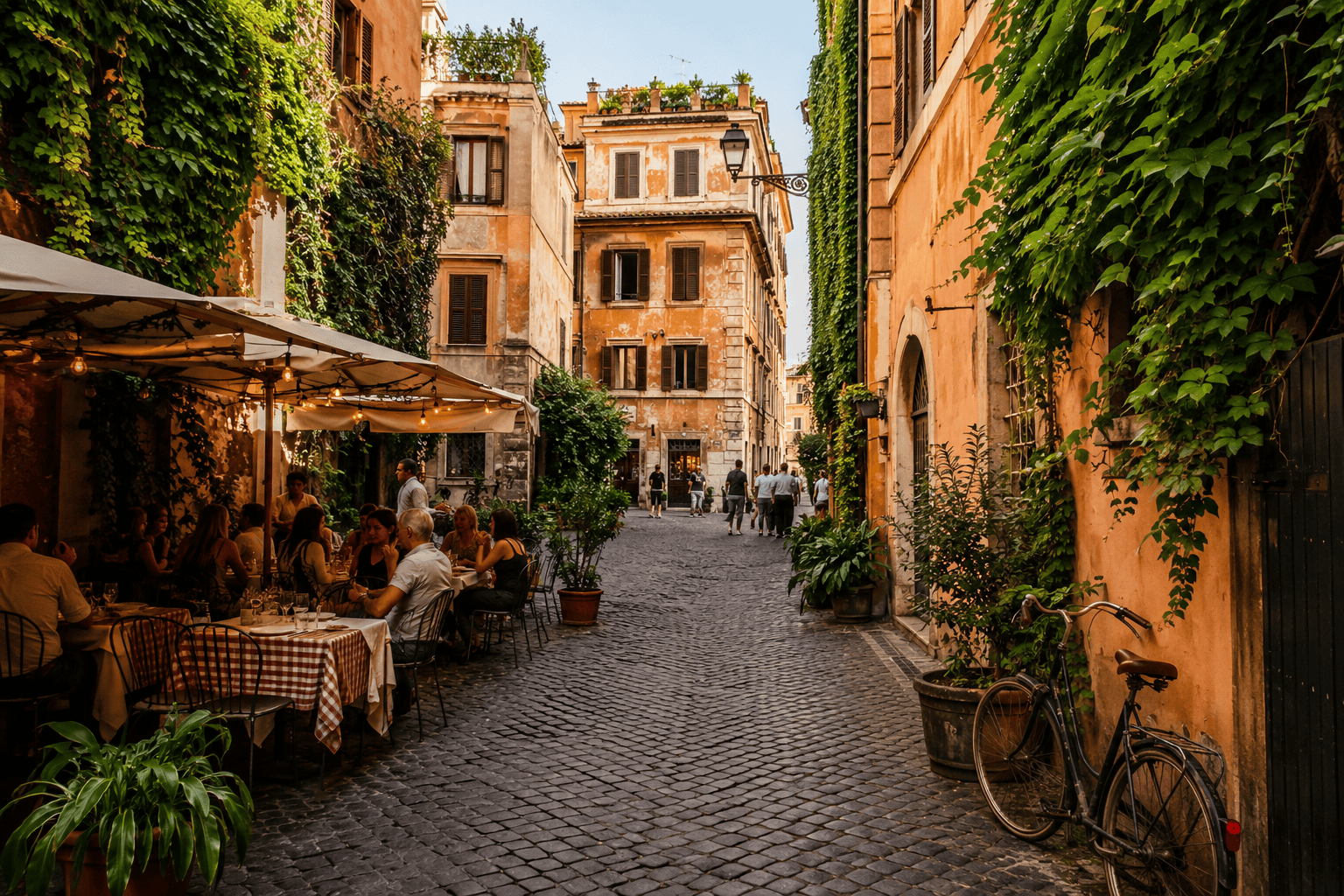
Trastevere sits across the Tiber River from the historic centre and is one of Rome’s most atmospheric neighbourhoods. It is famous for ivy-covered buildings, cobblestone alleys, outdoor dining, and a nightlife scene that stays busy late into the evening.
The neighbourhood feels more local and less polished than Centro Storico. Many accommodations are boutique guesthouses, apartments, or family-run hotels rather than large chains. This gives the area a more personal and authentic feel.
Trastevere is ideal for travellers who care as much about food and ambience as sightseeing. Excellent trattorias, wine bars, and cafes are everywhere, and the area remains lively well into the night.
Most major attractions remain walkable. Campo de’ Fiori is about 15 minutes away on foot, while the Vatican and Colosseum are reachable in roughly 25–30 minutes.
The main drawback is nighttime noise near the busiest piazzas. Light sleepers should avoid staying directly beside Piazza di Santa Maria in Trastevere.
Best for: food, nightlife, atmosphere, couples, and travellers who want a lively evening scene.
Prati

Prati is one of the smartest choices for first-time visitors who want a quieter and better-value alternative to the historic centre. Located near the Vatican, it combines residential calm with excellent access to central Rome.
The streets are wider and cleaner than in the medieval core, with elegant apartment buildings, good supermarkets, and strong local dining options. Unlike the heavily touristed centre, Prati feels like a functioning Roman neighbourhood.
Hotels here are often significantly better value than equivalent properties in Centro Storico. Mid-range hotels commonly range from €100–160 per night while still offering excellent transport and walkability.
The Vatican Museums and St. Peter’s Basilica are within easy walking distance, while the Pantheon and Piazza Navona are about 20–25 minutes away on foot.
Prati lacks the nightlife energy of Trastevere, but for comfort, convenience, and value, it is one of the best places to stay in Rome.
Best for: Vatican access, quieter nights, value, families, and travellers who still want a central base.
Termini and Esquilino
Termini is Rome’s main train station and the city’s best area for budget accommodation. The district surrounding the station contains countless hostels, cheap hotels, and guesthouses, making it popular with backpackers and short-stay visitors.
The transport connections are excellent. Both Metro lines intersect at Termini, and the Leonardo Express train provides direct airport access to Fiumicino Airport in about 30 minutes.
Accommodation prices are noticeably lower than in the historic centre. Hostel dorms can cost as little as €25–40 per night, while basic private rooms often start around €70.
The trade-off is atmosphere. The immediate station area feels busy and functional rather than scenic. While generally safe, it can feel uncomfortable late at night around the station entrances.
Termini works best for travellers on a strict budget, people arriving late or departing early by train, and visitors comfortable relying on public transport rather than walking everywhere.
Best for: low budgets, airport transfers, train connections, and short practical stays.
Testaccio
Testaccio is one of Rome’s best neighbourhoods for food lovers. Historically a working-class district, it is now known for authentic Roman cuisine, local markets, and a relaxed residential atmosphere.
The Mercato Testaccio is one of the city’s best food markets, offering fresh pasta, cured meats, produce, street food, and classic Roman snacks like supplì.
Accommodation options are more limited than in central tourist areas, but prices are generally reasonable. The area is connected to the centre by Metro Line B and several tram routes.
Testaccio is better suited to longer stays or repeat visitors rather than first-time travellers trying to maximise sightseeing efficiency. However, for food-focused trips, it is one of the most rewarding neighbourhoods in Rome.
Best for: food lovers, repeat visitors, longer stays, and travellers who prefer a more local Roman base.
Aventine and Celio
Aventine and Celio are quieter residential areas close to ancient Rome. They work well for travellers who want a calmer stay while remaining within reach of the Colosseum, Roman Forum, and Circus Maximus.
These neighbourhoods are less nightlife-focused than Trastevere and less central than the Pantheon area, but they offer leafy streets, historic churches, and a slower pace. They can be especially appealing for couples and travellers who prefer peaceful evenings.
Best for: couples, quieter stays, repeat visitors, and travellers who want easy access to ancient Rome without staying in the busiest tourist streets.
Areas to Avoid for a First Visit
The immediate surroundings of Termini station can feel chaotic and unpleasant late at night. While not especially dangerous by big-city standards, the atmosphere around the station is not ideal for travellers seeking a relaxed Roman experience.
Be cautious with hotels described vaguely as “near the Vatican” or “just outside the historic centre.” Outer residential districts such as Aurelio or Parioli may require lengthy bus rides to reach the main attractions.
The EUR district, south of central Rome, is sometimes advertised as a business-friendly accommodation area. While modern and well-connected by Metro, it is far from the historic centre and not recommended for first-time visitors focused on sightseeing.
Common Hotel Booking Mistakes in Rome
The most common mistake is booking without checking the exact address. Rome’s neighbourhood labels on booking platforms are often misleading. Always verify walking distances to the places you actually plan to visit.
Another frequent mistake is ignoring hotel reviews about noise. Rome is loud, especially in summer. Streets around Campo de’ Fiori, Piazza Navona, and Trastevere can remain busy until well after midnight.
Travellers also underestimate distances within the historic centre. Rome is highly walkable, but “historic centre” covers a huge area. A hotel near Piazza del Popolo is very different from one near the Pantheon or Colosseum.
Final Recommendation: Where Should You Stay in Rome?
For most first-time visitors, Centro Storico is the best area to stay in Rome because it keeps the major sights close and makes the city easy to explore on foot. Choose Trastevere if you want nightlife, food, and atmosphere. Choose Prati if you want better value, quieter streets, and convenient access to the Vatican.
Budget travellers and train users should consider Termini or Esquilino, while food-focused travellers with more time may prefer Testaccio. For a quieter stay near ancient Rome, Aventine and Celio are strong alternatives.
FAQ
What is the best area to stay in Rome for first-time visitors?
Centro Storico is the best overall area for first-time visitors because it offers the highest level of walkability to Rome’s main attractions. Prati is the best-value alternative, while Trastevere is ideal for nightlife and atmosphere.
Is Trastevere a good place to stay in Rome?
Yes. Trastevere is one of Rome’s most charming neighbourhoods and is especially popular with travellers interested in food, nightlife, and local atmosphere. The only major downside is nighttime noise in busy areas.
Is it safe to stay near Termini Station?
Yes, most visitors stay near Termini without problems. However, the immediate station surroundings can feel uncomfortable late at night, and the area lacks the charm of Rome’s more historic neighbourhoods.
How many days should first-time visitors stay in Rome?
Most first-time visitors should spend at least three to four full days in Rome. This allows enough time to see the major sights, explore different neighbourhoods, and enjoy the city at a slower pace.
What is the best area to stay in Rome on a budget?
Termini and Esquilino usually offer the lowest accommodation prices and the best transport links. Prati is often a better-value choice for travellers who want a quieter and more comfortable central stay.
Last verified: 2026-04-27
For more destination comparisons and trip ideas, browse more travel guides on this site.
For broader trip-planning context, you can also check additional travel background on Wikivoyage.