
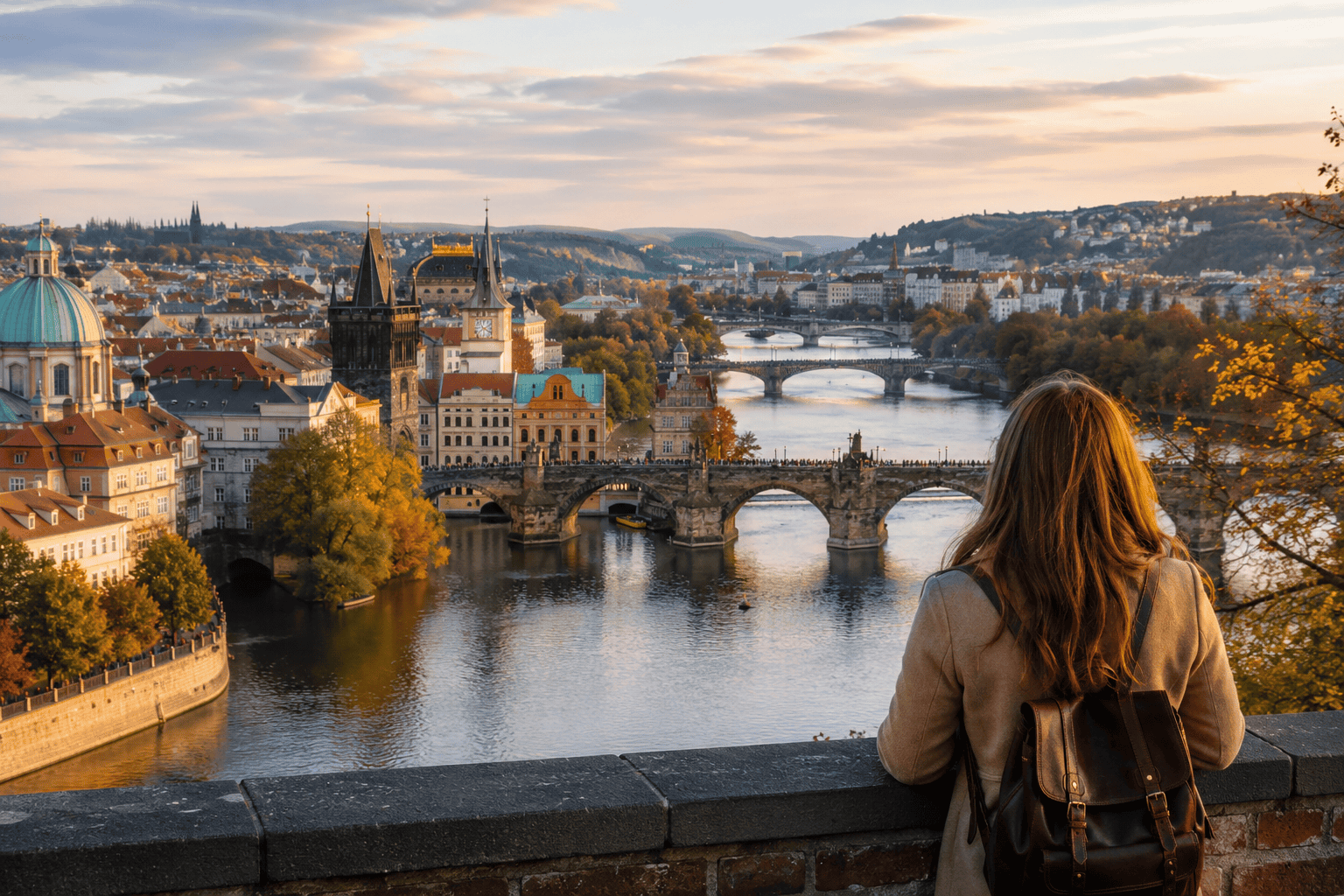
Prague is one of Europe’s easiest cities to fall for, with Gothic towers, cobbled lanes, and trams rolling past Art Nouveau facades. A half-litre of Czech lager often costs less than bottled water, but Prague’s popularity comes with tradeoffs. The historic centre gets crowded fast, prices vary sharply between tourist areas and local neighbourhoods, and many visitors underestimate how much walking the city demands.
The good news: with a bit of planning, Prague offers one of Europe’s best-value city breaks at almost any budget tier. Whether you have two days or a full week, the city rewards those who venture beyond Old Town Square, linger after the day-trippers leave, and resist the pull of the postcard-perfect centre long enough to explore the neighbourhoods on either side of it.
Quick Takeaways
Start here: Prague is one of Europe’s easiest cities to fall for, with Gothic towers, cobbled lanes, and trams rolling past Art Nouveau facades.
Planning note: The good news: with a bit of planning, Prague offers one of Europe’s best-value city breaks at almost any budget tier.
This guide covers Prague practically — where to stay, what to prioritise, what to avoid, how to get around, and what a realistic trip costs.
Why Visit Prague?
Few European cities punch as consistently across travel styles. Prague combines a remarkably preserved historic core with excellent public transport, affordable food and drink by Western European standards, and walkable neighbourhoods each with a distinct character. The city works well for budget backpackers, couples on a romantic short break, history-focused travellers, solo explorers, architecture enthusiasts, and families with older children.
Unlike some European capitals, Prague also feels compact enough for short visits. You can move across much of the central city on foot, and first-time visitors tend to get their bearings quickly — the Vltava River, Prague Castle on the hill, and the red rooftops of Old Town are reliable orientation anchors.
Best Time to Visit Prague
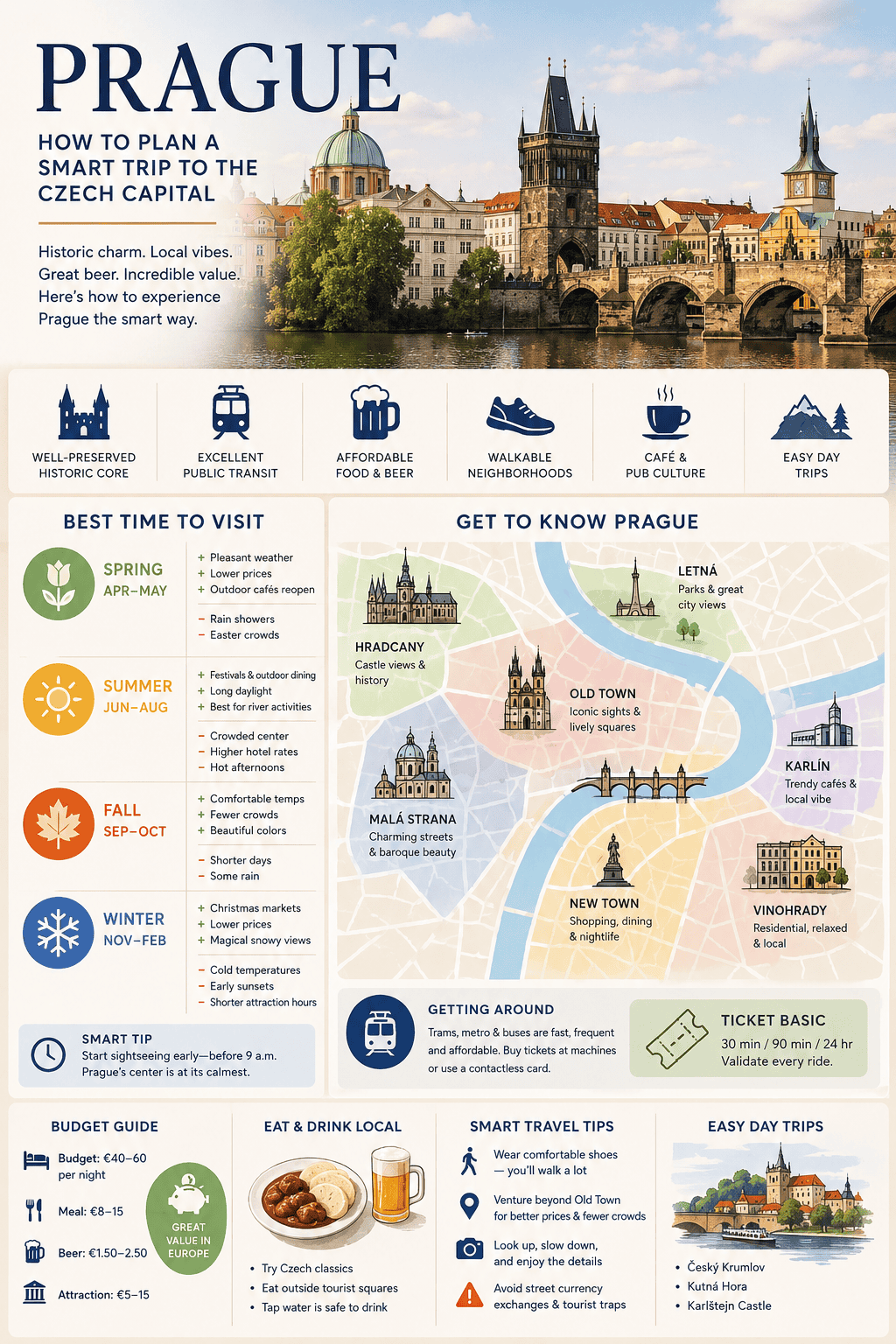
Spring (April–May)
Spring is widely considered one of the best windows to visit. Temperatures are mild, gardens reopen, and tourist numbers remain manageable compared to peak summer. Hotel prices tend to be lower than in July or August. The downsides: rain showers are common, and Easter long weekends bring large domestic and international crowds.
Summer (June–August)
Long days, outdoor dining, festivals, and river activities make summer lively — but the historic centre, and especially Charles Bridge, can feel oppressively crowded by mid-morning. Hotel rates are at their highest. If you visit in summer, start sightseeing before 9 a.m. Prague’s centre feels dramatically calmer in the early hours.
Autumn (September–October)
For many travellers, autumn is Prague’s sweet spot. Comfortable temperatures, fewer tour groups, and autumn colours in Riegrovy Sady and Stromovka park all make September and October particularly appealing. Days are shorter than summer, and some rainy periods are normal, but overall conditions tend to be favourable.
Winter (November–February)
Winter turns Prague into a moody, atmospheric city. Christmas markets on Old Town Square and Wenceslas Square draw large crowds in December, and hotel prices rise accordingly around the holidays. January and February are quieter and cheaper, with the chance of photogenic snowfall. Pack warm layers — temperatures regularly drop below freezing — and note that some attractions operate shorter winter hours.
How Many Days Do You Need in Prague?
2 Days
Two days is enough for a solid first impression: Old Town Square, Charles Bridge, Prague Castle, one neighbourhood beyond the centre, and a proper Czech beer hall meal. It works well for travellers combining Prague with Vienna, Budapest, or Berlin on a longer Central European route.
3–4 Days
The ideal length for most visitors. A 3–4 day stay lets you explore at a slower pace, add museums, discover less-visited districts like Vinohrady or Holešovice, take a river cruise or brewery visit, and fit in a half-day excursion.
5+ Days
Prague sustains longer stays comfortably. The city has enough cafés, parks, galleries, and neighbourhood character to reward slow travellers who want to experience it rather than tick it off. A week gives space for at least one or two day trips as well.
Where to Stay in Prague
Neighbourhood choice matters more than many travellers realise. Each area has a different feel, price point, and set of tradeoffs.
Old Town (Staré Město)
The most convenient location for first-time visitors on short stays. You’ll be within walking distance of nearly every major sight. Expect higher hotel prices and constant tourist foot traffic. Good if convenience matters more than local atmosphere.
Malá Strana (Lesser Town)
The quarter below Prague Castle is one of the city’s most beautiful and atmospheric areas. It quietens down noticeably after tour groups leave in the evening, making it appealing for couples or anyone prioritising ambience over budget. Fewer affordable options exist here compared to other districts.
New Town (Nové Město)
Despite the name, this is a historic and central district — built in the 14th century but with a broader, less medieval street plan than Old Town. It offers better hotel value, strong restaurant and nightlife options, and easy metro and tram access. A solid choice for travellers wanting central convenience without constant tourist congestion.
Vinohrady
A favourite with expats and longer-term visitors, Vinohrady is an elegant residential district southeast of the centre with tree-lined streets, good parks, a strong café and restaurant scene, and a genuinely local feel. You’ll rely on trams and metro to reach the main sights, but Prague’s transit makes this easy and cheap.
Žižkov
Rougher around the edges and proudly so, Žižkov is Prague’s historic working-class quarter. It has a dense pub culture, budget accommodation, and an alternative atmosphere. Best suited to travellers who prioritise nightlife, local character, and low prices over polished surroundings.
Getting Around Prague
Prague’s public transport network is reliable, well-integrated, and inexpensive. A single short-journey ticket costs around CZK 30 (roughly €1.20), and 24-hour passes are available for around CZK 120 (approximately €5). Tickets cover metro, trams, and buses interchangeably — validate paper tickets before your first journey.
Metro
Three lines (A, B, C) cover most areas visitors use. Fast and efficient for longer cross-city journeys. Line A (green) is particularly useful for tourists, connecting the airport bus terminal at Dejvická to the Old Town area at Staroměstská.
Trams
For many visitors, trams are the best way to experience Prague. They reach areas the metro misses, offer scenic rides through historic streets, run frequently throughout the day, and continue late into the night. Tram 22 is the most visitor-friendly route, passing Malá Strana, Prague Castle, and several other landmarks.
Walking
The historic centre is best explored on foot, but visitors regularly underestimate the terrain. The district around Prague Castle involves significant uphill walking, cobblestones are uneven throughout the old city, and some scenic routes involve staircases. Comfortable, supportive footwear is not optional.
Top Things to Do in Prague
Cross Charles Bridge Before 8 a.m.
Charles Bridge is Prague’s most visited landmark for good reason — the medieval stone bridge lined with Baroque statues connects Old Town with Malá Strana and frames one of Europe’s finest urban skylines. By late morning it’s packed with tour groups, portrait artists, and selfie sticks. Before 8 a.m., it’s a different place entirely. The early light and the relative quiet make for a far more memorable experience. If you can only manage one early start in Prague, make it this one.
Spend Time in Old Town Square — Then Leave It
Old Town Square (Staroměstské náměstí) is one of Europe’s great historic urban spaces, and it’s worth visiting properly. The Gothic Týn Church, the Baroque St. Nicholas Church, and the medieval Astronomical Clock are all legitimately impressive. Watch the clock’s hourly chime mechanism, admire the surrounding facades, then branch out into the quieter lanes immediately nearby. The square rewards a 45-minute visit; lingering longer mainly means overpaying for coffee.
Explore Prague Castle
Prague Castle is the largest ancient castle complex in the world by area — a hilltop compound rather than a single building. Key sites within the complex include St. Vitus Cathedral, the Old Royal Palace, Golden Lane (a row of miniature medieval cottages once occupied by castle staff), and several galleries. Budget at least half a day. Entry to the castle grounds is free; individual sites have separate ticket prices. Arriving early or in the late afternoon significantly improves the experience compared to visiting during the midday rush.
Walk or Ride to Petřín Hill
For panoramic city views without the largest crowds, Petřín Hill is worth the climb. You can walk up through the Petřín gardens or take the historic funicular from Újezd station (covered by a standard transit ticket). At the top, a small observation tower modelled loosely on the Eiffel Tower offers elevated views across the city. The whole area feels surprisingly peaceful compared to the tourist intensity of Old Town.
Eat and Drink Like a Local
Czech pub culture is central to daily life, not a tourist gimmick. Traditional hospoda (pub) culture emphasises freshly tapped pilsner, filling food, and unhurried evenings. The big national brands — Pilsner Urquell, Kozel, Budvar — are drinkable and cheap. Smaller neighbourhood pubs away from the tourist circuit often provide better experiences and noticeably lower prices than well-marketed beer halls. Classic dishes to try: svíčková (braised beef with creamy sauce and bread dumplings), beef goulash, roast pork with cabbage, and bramboračka (potato soup).
Cruise the Vltava River
River cruises range from crowded dinner boats with live music to quieter one-hour sightseeing rides. Worth considering if you want a different perspective on the city, particularly in warmer months. Not an essential itinerary item, but a pleasant evening option.
Neighbourhoods Worth Exploring Beyond the Tourist Centre
Vinohrady
Elegant Art Nouveau apartment blocks, Riegrovy Sady park, and a dense concentration of independent cafés and restaurants make Vinohrady one of Prague’s most liveable and visitor-friendly neighbourhoods. Far less tourist pressure, genuinely better dining value, and an atmosphere that feels like a city people actually live in.
Holešovice
A former industrial district north of the centre that has quietly become one of Prague’s most interesting neighbourhoods. The DOX Centre for Contemporary Art, street art, design studios, and a growing food scene sit alongside older warehouses and river views. This is where Prague feels contemporary rather than medieval.
Karlín
Heavily damaged in the 2002 floods and subsequently rebuilt, Karlín has become one of Prague’s most improved areas. Modern restaurants, a young professional crowd, and solid transport connections make it a strong choice for food-focused travellers wanting to eat well outside the tourist corridor.
Prague Budget Guide
Prague remains cheaper than most Western European capitals, though prices have risen noticeably in recent years. The Czech Republic uses the Czech koruna (CZK) rather than the euro, which means prices fluctuate slightly with exchange rates.
Budget Traveller
- Approximate daily spend: €50–90
- Includes: hostel or basic private room, public transport, casual restaurant meals, basic sightseeing
Mid-Range Traveller
- Approximate daily spend: €120–220
- Includes: comfortable hotel, sit-down restaurant meals, museum entries, occasional taxi or guided tour
Higher-End Travel
- Approximate daily spend: €300+
- Luxury hotels in Prague frequently cost less than comparable properties in Paris, London, or Amsterdam, making it an appealing destination for travellers who want high-end accommodation without Western European pricing
Common Mistakes to Avoid in Prague
Staying Only in the Tourist Core
The area immediately around Old Town Square and Charles Bridge is genuinely beautiful, but Prague becomes far more rewarding once you leave those streets. Even a single tram ride south to Vinohrady or east to Žižkov reveals better restaurants, lower prices, and a version of the city that feels real rather than performed.
Underestimating the Walking Conditions
Cobblestones and hills add up. Many visitors overplan their days and find themselves worn out by early afternoon. Pack supportive shoes, build rest time into your schedule, and expect full sightseeing days to feel more physically demanding than they look on a map.
Eating Directly on the Main Squares
Restaurants immediately surrounding major tourist sites often charge significantly more for lower-quality meals. The rule is simple: walk two or three streets away from any major landmark before choosing a place to eat.
Using Airport Exchange Booths or Street Exchange Offices
Prague has a long-standing reputation for poor tourist exchange rates, particularly at airport counters and kiosks in high-traffic tourist zones. Use bank ATMs or pay by card wherever possible.
Easy Day Trips from Prague
Kutná Hora
Around 70 km southeast of Prague, Kutná Hora is most famous for the Sedlec Ossuary — a medieval chapel decorated with human bones — but the broader town is a well-preserved Gothic silver-mining settlement worth a few hours of exploration. Direct trains run regularly from Prague’s main station (Praha Hlavní Nádraží), with a journey time of around one hour.
Český Krumlov
A beautifully preserved small town in southern Bohemia with a dramatic castle, river scenery, and medieval streets. It’s around 3 hours from Prague by bus, which makes it better suited to an overnight stay than a rushed day trip — though day trips are popular.
Karlovy Vary
The grand spa town of Karlovy Vary, about 2 hours west of Prague by bus, is known for its colonnaded promenades, thermal springs, and 19th-century grand hotels. It attracts both domestic visitors and international travellers looking for a quieter, slower-paced excursion.
Is Prague Worth Visiting?
Without qualification, yes — but expectations matter. Prague works best for travellers who enjoy walking cities, appreciate atmosphere alongside architecture, and are willing to step slightly outside the beaten path. The tourist zone around Old Town Square can feel aggressively commercial in peak season. But just beyond it, Prague remains genuinely enjoyable, affordable, and atmospheric in a way that few European cities of its fame still manage.
The travellers who leave underwhelmed are usually the ones who stayed too close to the postcard. Ride a tram into Vinohrady. Find a pub without an English menu. Walk across Charles Bridge before the city wakes up. That version of Prague is less marketed and considerably more memorable.
Frequently Asked Questions About Prague
Is Prague expensive compared to other European cities?
Prague is moderately priced by European standards — considerably cheaper than London, Paris, Amsterdam, or Zurich, and broadly comparable to Budapest or Krakow. It is no longer the extreme bargain it was a decade ago, particularly for accommodation in the historic centre, but it remains one of the better-value city breaks in Central Europe.
Is Prague safe for travellers?
Yes, Prague is generally very safe. Violent crime against tourists is rare. The main risks are petty theft and pickpocketing in crowded areas such as Charles Bridge, Old Town Square, and busy metro stations, and overcharging scams — particularly unofficial taxis and street exchange offices. Use licensed taxis or rideshare apps, and book transport in advance where possible.
Do people speak English in Prague?
In hotels, restaurants, tourist attractions, and central Prague generally, English is widely spoken and communication is rarely a problem. In outer residential neighbourhoods and smaller local businesses, English fluency is less consistent — though basic interactions are usually manageable. Learning a few words of Czech (prosím for please, děkuji for thank you) is appreciated.
What currency is used in Prague?
The Czech Republic uses the Czech koruna (CZK), not the euro. Most hotels and larger restaurants accept card payment, but smaller pubs, markets, and some transport services prefer cash. Withdraw koruna from bank ATMs rather than using exchange kiosks, which frequently offer poor rates.
How walkable is Prague?
The historic centre is highly walkable and many visitors cover it entirely on foot. However, the castle district involves sustained uphill walking, cobblestones are uneven in many areas, and some routes between neighbourhoods involve staircases. Comfortable, supportive footwear is strongly recommended. Prague’s tram network fills the gaps efficiently when walking becomes tiring.
What are the best free things to do in Prague?
Wandering the castle grounds (exterior areas are free), crossing Charles Bridge, exploring Petřín Hill, walking through Vinohrady, watching the Astronomical Clock chime, and visiting Vyšehrad fortress and cemetery all cost nothing. Prague’s public spaces and architecture are among the city’s best attractions — many of the most memorable experiences here don’t require a ticket.
Useful resources:
- Prague City Tourism — official visitor information
- Prague Integrated Transport (PID) — public transport routes and tickets
- Prague Castle — official site with current ticket prices and opening hours
By Mara Vale for Eurly
Last verified: June 2025. Transport prices, entry fees, and hotel rates are subject to change. Always confirm current costs directly with providers before travel.

Mara Vale
Mara Vale writes Eurly travel guides for first-time Europe visitors who want practical routes, realistic pacing, and fewer avoidable planning mistakes.
Eurly guides are written to help readers make confident travel decisions, but opening hours, ticket rules, transit disruptions, and local conditions can change. Always verify key reservations and official schedules before you travel.