
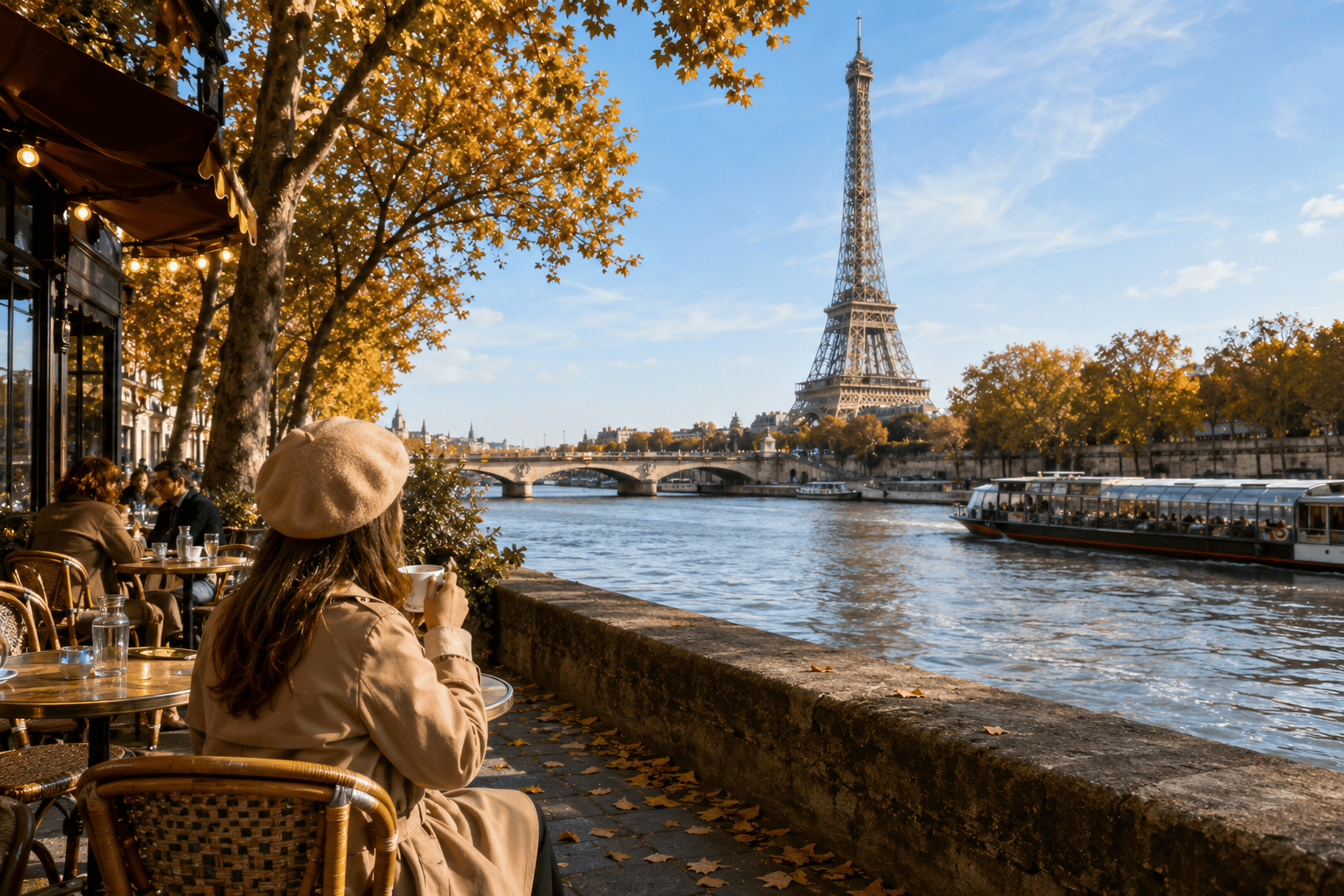
The best of Paris in 7 days tour gives you enough time to see iconic landmarks, explore local neighborhoods, and enjoy at least one memorable day trip without rushing. This itinerary groups attractions by area to reduce transit time, highlights where advance booking matters, and explains practical tradeoffs so you can plan a trip that fits your travel style.
- Duration: 7 days / 6 nights
- Base city: Paris, France
- Day trip included: Versailles (Day 5)
- Budget range: €100–€160/day (budget) · €220–€400/day (mid-range) · €600+/day (luxury)
- Best seasons: Late April–May and September–early October
Why 7 Days Works Well for Paris
Three or four days in Paris is doable, but rushed. A full week lets you move at a pace that actually suits the city:
- Explore neighborhoods beyond the main tourist circuit
- Recover from jet lag without sacrificing sightseeing days
- Take a full day trip to Versailles or Giverny
- Spend unhurried time in cafés, markets, and along the Seine
- Visit major museums on separate days to avoid fatigue
Seven days also gives you space for the slower experiences — long lunches, riverside walks, browsing a covered passage — that most visitors remember most clearly after they get home.
Best Time to Visit Paris
Paris is a year-round destination, but the season shapes your experience considerably.
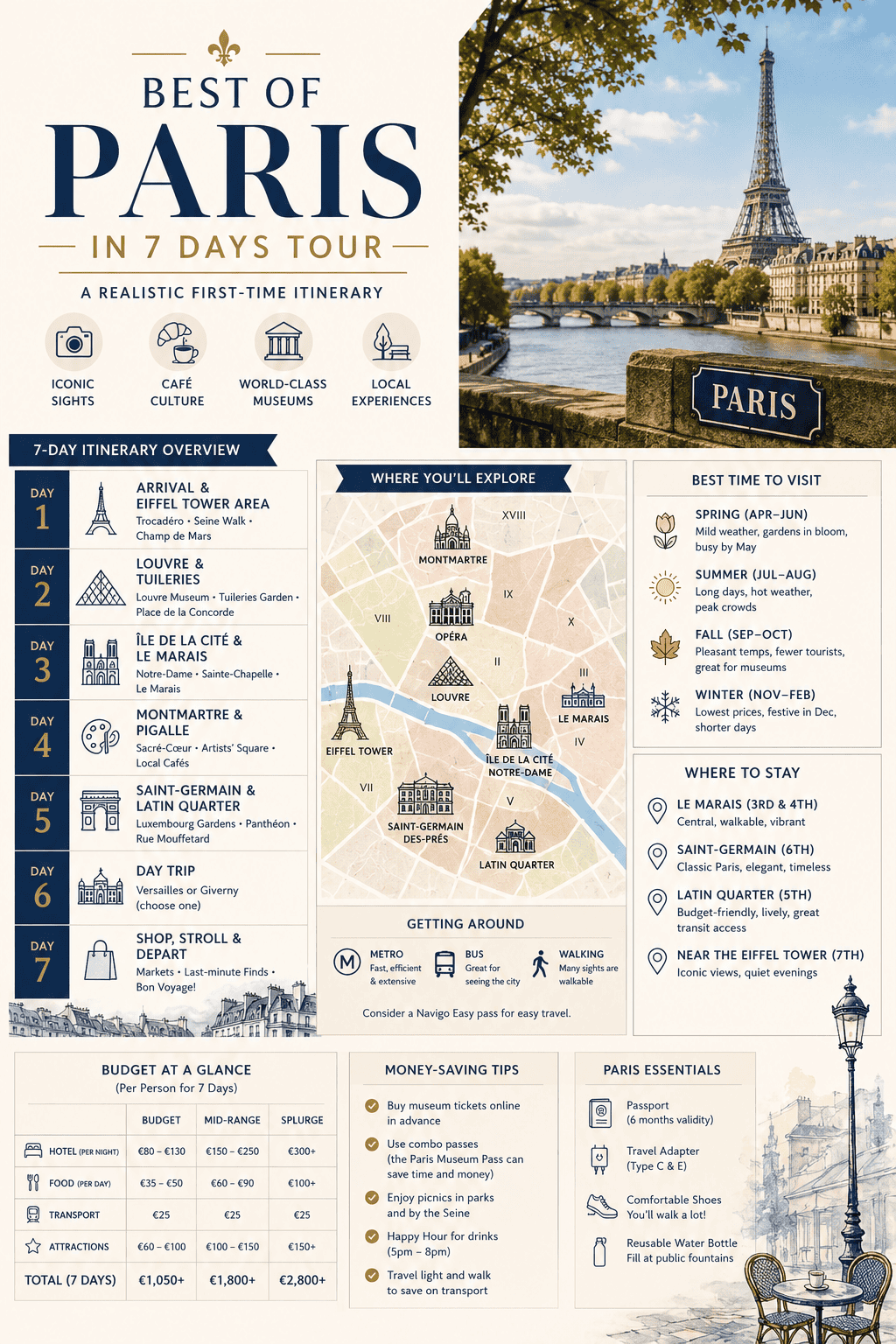
Spring (April–June) brings mild weather, outdoor terraces, and gardens in bloom. Crowds build through May and peak in June, so expect queues at major attractions.
Summer (July–August) offers long daylight hours but also peak crowds and heat. Some smaller local businesses close for August. Book everything further in advance than usual.
Autumn (September–October) is widely considered the sweet spot — pleasant temperatures, thinner crowds than summer, and an excellent museum season.
Winter (November–February) brings the lowest hotel rates and a festive atmosphere in December. Days are short and cold, but indoor sights are far less crowded.
For most first-time visitors, late April, May, September, and early October offer the best all-round conditions.
Where to Stay: Best Neighborhoods for a Week in Paris
Location matters more than almost any other accommodation decision. A cheaper hotel a long Metro ride outside the centre will cost you time every single day.
Le Marais (3rd & 4th arrondissements) is the most practical base for first-timers. It’s walkable, historically rich, well-connected, and has one of the city’s best food scenes. Hotels here tend toward the higher end of mid-range.
Saint-Germain-des-Prés (6th) delivers the classic Paris atmosphere — literary cafés, elegant streets, independent bookshops — at a premium price. Worth it if that mood is your priority.
Latin Quarter (5th) is the most budget-accessible central option with easy Metro access and a lively, youthful energy. It can feel heavily touristed around the main streets, but side streets are quieter.
Near the Eiffel Tower (7th) is quieter in the evenings and ideal if waking up near the tower matters to you. The dining and nightlife scene is thinner than Le Marais or Saint-Germain.
As a rule: stay central enough that walking to several key sights is a realistic option on any given morning.
Paris Budget Guide: What a Week Realistically Costs
| Travel Style | Daily Budget (Per Person) |
|---|---|
| Budget | €100–€160 |
| Mid-range | €220–€400 |
| Luxury | €600+ |
Typical mid-range costs to plan around:
- Hotel: €180–€300 per night
- Museum entry: €15–€25 per attraction
- Weekly Metro pass (Navigo): €35–€45
- Casual café lunch: €15–€25
- Bistro dinner: €45–€80 with wine
The most common budgeting mistake is underestimating food costs. One well-chosen bistro meal beats three overpriced tourist traps near a major landmark every time. Walk two streets away from any famous sight and you’ll almost always find better food at lower prices.
Day 1: Arrival, Île de la Cité, and a Seine Cruise
Resist the urge to pack Day 1 with museums. Use it to orient yourself and feel the city rather than consume it.
If your room isn’t ready on arrival, leave bags at the hotel and walk to the nearest café for coffee and a croissant. Stay awake until a reasonable local bedtime to beat jet lag.
In the afternoon, head to Île de la Cité — the island in the Seine where Paris began. Even with Notre-Dame’s ongoing post-fire restoration, the area remains essential. Walk along the riverbanks, cross Pont Neuf, browse the flower market, and stop into Shakespeare and Company bookstore on the Left Bank.
For the evening, a sunset Seine river cruise is genuinely worth doing once, and Day 1 is the ideal moment: low effort, beautiful light, and an excellent orientation to the city’s layout. Skip dinner cruises unless fine dining on water is a priority — a standard sightseeing cruise offers far better value.
Day 2: The Louvre, Tuileries, and Arc de Triomphe
This is your main museum day. The Louvre is enormous — approaching it without a strategy leads to exhaustion and disappointment.
Book a timed entry ticket in advance and allocate three to four hours maximum. Focus on a short list rather than trying to cover the whole building: the Mona Lisa, Winged Victory of Samothrace, Venus de Milo, and either the Egyptian antiquities or the French Romantic painting galleries depending on your preference. Everything beyond that is a bonus.
After the Louvre, walk through the Tuileries Garden toward Place de la Concorde. Stop for coffee in the garden. If the Musée de l’Orangerie appeals to you, it sits right at the western end of the Tuileries and houses Monet’s enormous Water Lilies panels — a 45-minute visit that pairs naturally with this afternoon.
In the evening, walk the Champs-Élysées toward the Arc de Triomphe. The boulevard itself is overrated for shopping, but the rooftop view from the Arc is one of the best free-ish panoramas in the city. Arrive about an hour before sunset and watch Paris light up as the sun goes down.
Day 3: Eiffel Tower, Rue Cler, and Musée d’Orsay
No best of Paris in 7 days tour skips the Eiffel Tower — but doing it well requires booking ahead and arriving early.
Secure the earliest morning time slot available. First-timers should opt for summit access; if heights are an issue, the second floor still delivers an excellent view with shorter waits. Book tickets on the official Eiffel Tower website at least a few weeks out during peak season — last-minute tickets disappear fast.
After the tower, walk to Rue Cler, a market street in the 7th arrondissement ideal for assembling a picnic lunch: cheese, charcuterie, pastries, and a baguette from any of the independent shops along it. Eat on the grass near the Champ de Mars if the weather cooperates.
The afternoon belongs to the Musée d’Orsay, housed in a stunning former railway station on the Left Bank. Many visitors find it more satisfying than the Louvre: smaller, more focused, and packed with Impressionist masterpieces — Monet, Van Gogh, Degas, and Renoir all in one building. Allow two to three hours.
End the day in Saint-Germain-des-Prés: café hopping, browsing independent bookshops, and a long dinner at a traditional bistro. Avoid restaurants with aggressive sidewalk staff or laminated menus in five languages — both are reliable indicators of tourist-trap territory.
Day 4: Montmartre and Canal Saint-Martin
Today is about atmosphere more than monuments.
Arrive in Montmartre early, before tour groups fill the streets. Climb to Sacré-Cœur Basilica for the views over Paris, then spend time wandering the side streets beyond Place du Tertre — the hidden staircases, the Vineyard of Montmartre, and the quieter lanes that most visitors never reach. The real appeal of Montmartre is what you discover by getting slightly lost.
For the afternoon, head to Canal Saint-Martin in the 10th arrondissement. This neighbourhood offers a sharply different side of Paris: independent boutiques, specialty coffee shops, and a younger local crowd. It’s a useful counterpoint to the grand historical centre and feels genuinely lived-in.
For the evening, the Moulin Rouge is an option — iconic, expensive, and heavily oriented toward tourists. If that kind of spectacle appeals, book well in advance. If not, the 18th arrondissement has good wine bars, small jazz clubs, and neighbourhood bistros that will give you a more relaxed final memory of the day.
Day 5: Versailles Day Trip
Versailles is the most worthwhile single day trip from Paris and fits naturally into a seven-day itinerary.
Take the RER C train from central Paris directly to Versailles-Château-Rive Gauche station. The journey takes roughly one hour each way. Depart as early as practical — tour groups arrive in force by mid-morning and the queues at the palace entrance are far longer than they need to be if you arrive late.
Inside the palace, prioritise the Hall of Mirrors, the Royal Apartments, and the Royal Chapel. These are the architectural highlights and worth unhurried time.
The grounds are vast — far larger than most visitors expect. Renting a bike or using the Petit Train shuttle is a practical way to reach the Grand Trianon and the gardens without spending the entire day on foot. Don’t try to cover everything: focus on the palace, spend relaxed time in one section of the gardens, and skip lesser-visited areas if energy starts to fade.
Plan on a full day. Return to Paris by early evening and keep dinner simple — something close to your hotel after a day of walking.
Day 6: Le Marais in Depth
Day 6 is your most flexible day — the one where you follow interests rather than an agenda.
Spend the morning walking Le Marais properly. This neighbourhood rewards slow exploration: medieval streets, a strong Jewish heritage centred around Rue des Rosiers (the falafel here is genuinely excellent), acclaimed pastry shops, and small wine bars. Buy nothing in a hurry.
For the afternoon, choose based on what draws you most:
- Art: Picasso Museum or Centre Pompidou (modern and contemporary art in an extraordinary building)
- History: Carnavalet Museum (Paris history, free entry) or the Mémorial de la Shoah
- Shopping: Vintage boutiques and independent designer shops throughout the 3rd arrondissement
For the evening, Le Marais has some of the city’s best rooftop bars and late-night venues. Alternatively, take a slow evening walk along the illuminated Seine — crossing several bridges, watching the city after dark, and ending the night at a neighbourhood restaurant without a reservation. This is often the evening Paris visitors remember most clearly.
Day 7: Markets, Covered Passages, and a Farewell Dinner
Your final day should feel unhurried. Don’t overplan it.
Depending on the day of the week, visit one of Paris’s outdoor food markets in the morning: Marché Bastille (Thursday and Sunday), Marché d’Aligre (daily except Monday), or Rue Mouffetard in the 5th arrondissement. These are among the best places to buy final gifts — French butter biscuits, good chocolate, specialty mustard, or loose-leaf tea travel far better than ceramic Eiffel Tower miniatures.
In the afternoon, choose something unhurried: Luxembourg Gardens, one of the city’s grand covered passages (Galerie Vivienne or Passage des Panoramas are both beautiful), or a smaller museum you didn’t reach earlier in the week. A long café lunch is an equally valid option.
End the trip with a proper farewell dinner. A classic bistro, a multi-course meal with wine, no rushing. Paris rewards that approach more than any checklist of sights you managed to squeeze in.
Getting Around Paris: Practical Transport Tips
The Paris Metro is fast, affordable, and covers virtually every area you’ll want to reach. For a full week, a Navigo weekly pass (valid Monday to Sunday, covering Zones 1–5) costs approximately €35–€45 and is by far the most convenient option. Load it onto a Navigo Easy card, available from any staffed station. Google Maps works reliably for Paris Metro navigation.
For the areas covered in this itinerary, walking is often faster than the Metro:
- Le Marais to the Latin Quarter: around 20 minutes on foot
- Musée d’Orsay to Saint-Germain-des-Prés: around 10 minutes
- Louvre to Tuileries to Concorde: a single straight walk
Wear comfortable shoes and expect long days on your feet. Cobblestones are attractive but unforgiving over a full week.
What to Book in Advance
| Attraction | Recommended Booking Window |
|---|---|
| Eiffel Tower (summit) | 6–8 weeks in peak season |
| Louvre (timed entry) | 2–4 weeks |
| Versailles (palace entry) | 2–4 weeks |
| Musée d’Orsay | 1–2 weeks |
| Popular restaurants | 2–4 weeks |
| Seine sightseeing cruise | A few days or same week |
Last-minute travelers can still have an excellent week in Paris, but will need flexibility around timings and occasionally miss first-choice options at the most popular sites.
Common First-Timer Mistakes to Avoid
Two major museums in one day. Museum fatigue is real. One substantial museum per day is enough — anything more and the later hours become a blur.
Eating immediately next to famous sights. Restaurants within sight of the Eiffel Tower, Louvre, or Notre-Dame charge landmark prices for mediocre food. Walk two streets further in any direction.
Booking accommodation far outside the centre. A hotel that saves you €40/night but adds 90 minutes of commuting per day is almost never worth it over a full week.
Ignoring basic French courtesies. Parisian service can feel more reserved than some visitors expect, particularly in comparison to American hospitality norms. It’s cultural, not personal. A simple Bonjour when entering any shop or café, and Merci and Bonsoir as you leave, makes a meaningful difference in how interactions feel.
Overscheduling the final day. The temptation to cram extra sights into Day 7 is almost always a mistake. A relaxed last morning is a better memory than a rushed one.
Should You Book a Guided Tour?
Paris is one of the more accessible major cities for independent travel: Metro navigation is straightforward, English is widely understood in tourist areas, and most major sights have well-designed ticket systems.
That said, a hybrid approach works well for many travelers. Keep the overall itinerary self-guided, but consider booking two or three specific guided experiences — a walking tour of Le Marais, a guided visit inside the Louvre to get context on the key works, or a Versailles tour that includes skip-the-line access. These add structure and knowledge exactly where it’s most useful, without surrendering the flexibility that makes independent travel satisfying.
Organised multi-day tour packages covering the best of Paris in 7 days exist from several reputable operators and can make sense for travelers who want logistics handled entirely. They tend to be worth the cost for those with limited time to research or a preference for a structured group experience.
Useful Official Resources
- Official Eiffel Tower website — book timed entry tickets directly here to avoid third-party markups
- Louvre Museum official site — timed entry reservations and current exhibition information
- Palace of Versailles official site — tickets, garden fountain show schedules, and transport guidance
Frequently Asked Questions
Is 7 days enough to see Paris properly?
Seven days is genuinely enough to cover the major landmarks, explore several distinct neighborhoods, take a day trip to Versailles, and still have time for slower experiences like markets and café culture. It won’t cover everything — no amount of time will — but it’s enough to leave with a well-rounded sense of the city rather than a highlight reel.
What is the best neighborhood to stay in Paris for first-time visitors?
Le Marais (3rd and 4th arrondissements) is the most practical overall base: central, walkable, well-connected by Metro, and surrounded by excellent food options at various price points. Saint-Germain-des-Prés is an excellent alternative if classic Parisian atmosphere is the priority and budget allows. Avoid staying in outer arrondissements just to save on accommodation — the daily commute cost in time and energy adds up significantly over a week.
How far in advance should I book Eiffel Tower tickets?
During peak season (May through September), book summit tickets six to eight weeks ahead. They sell out consistently. The official Eiffel Tower website is the correct place to buy — third-party sellers charge markups for the same access. If you miss your window, same-day tickets are occasionally available at very early hours, but this requires flexibility.
Is the Versailles day trip worth a full day?
Yes. The palace alone justifies the trip, and the gardens are vast enough to absorb several additional hours without feeling rushed. A half-day visit to Versailles tends to leave travelers feeling they barely scratched the surface. Plan to leave Paris early, spend the full day on site, and return in the evening.
What is the cheapest way to get around Paris for a week?
A Navigo weekly pass covering Zones 1–5 is the most cost-effective option for a full seven-day stay, costing approximately €35–€45. It covers unlimited Metro, RER, and bus travel within those zones — including the RER C to Versailles. Load it onto a Navigo Easy card from any staffed Metro station. For short distances within central Paris, walking is often faster than waiting for the Metro.
Can I do Paris in 7 days without a guided tour?
Absolutely. Paris is one of the more independent-traveler-friendly cities in Europe. Metro navigation is intuitive, major sights have clear ticketing systems, and English is commonly understood in tourist areas. Many visitors find a hybrid approach most satisfying: self-guided overall, with one or two specific guided experiences (a Marais walking tour, a Louvre highlights tour) added for context at the moments where expert knowledge adds the most value.
By Mara Vale for Eurly
Last verified: May 2025. Entry prices, transport pass costs, and booking requirements are subject to change. Always confirm current details on official attraction websites before travel.

Mara Vale
Mara Vale writes Eurly travel guides for first-time Europe visitors who want practical routes, realistic pacing, and fewer avoidable planning mistakes.
Eurly guides are written to help readers make confident travel decisions, but opening hours, ticket rules, transit disruptions, and local conditions can change. Always verify key reservations and official schedules before you travel.