
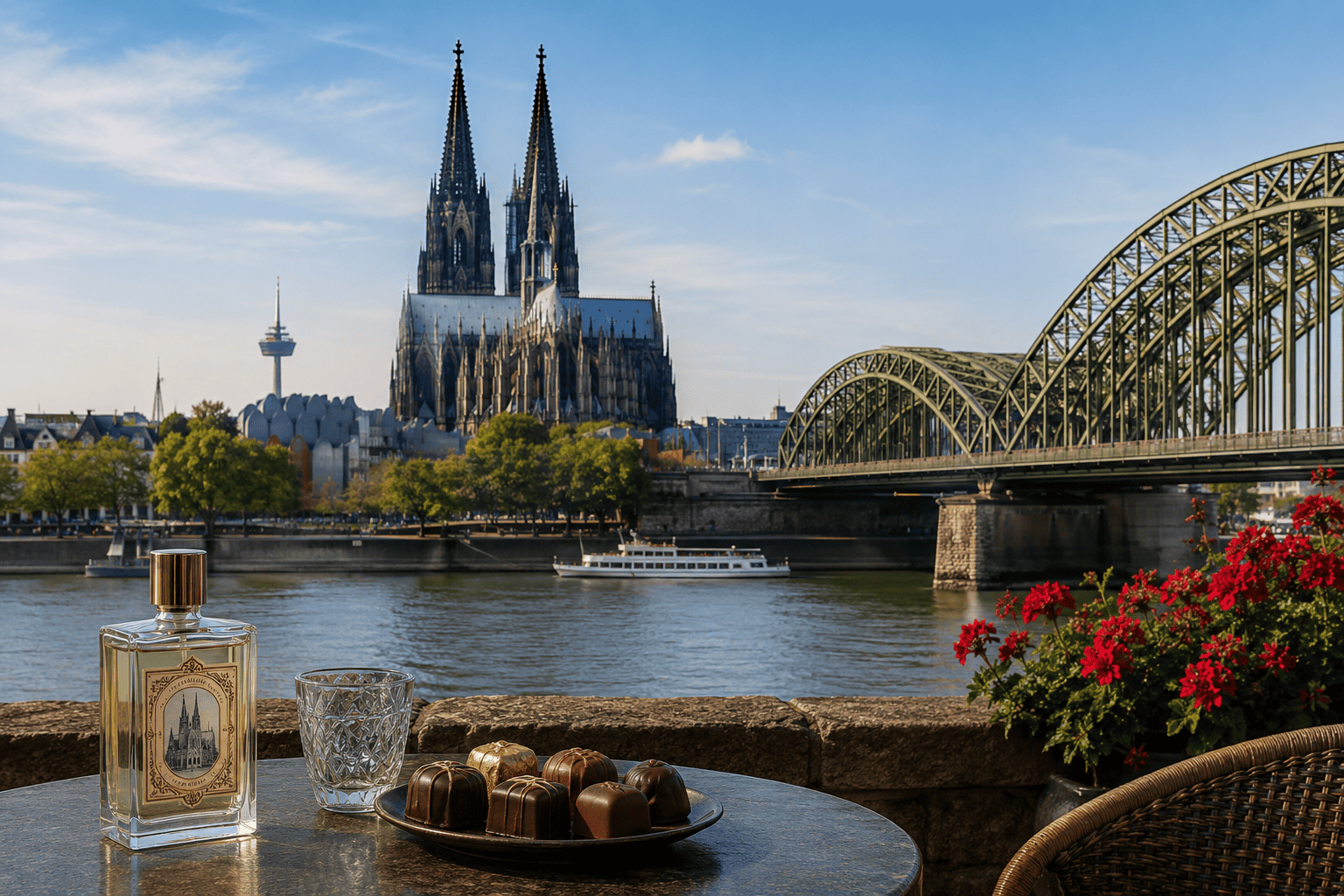
Cologne Germany S mix of perfume chocolate and God reveals itself before you’ve even left the train station. Step onto the platform at Köln Hauptbahnhof and the twin black spires of Cologne Cathedral dominate the skyline, while the city’s perfume heritage and chocolate culture quickly pull you in. Few cities in Europe make such an immediate argument for staying longer than planned.
What makes Cologne genuinely interesting, though, is everything that surrounds that cathedral. Germany’s fourth-largest city carries a layered identity built from Roman foundations, a surprisingly global perfume legacy, a riverside chocolate museum, a highly specific beer culture governed by unwritten social rules, and a string of Romanesque churches that most visitors walk straight past. Sacred, sweet, fragrant, and deeply local — Cologne rewards travelers who treat it as a destination rather than a stop.
Quick Takeaways
Start here: Cologne Germany S mix of perfume chocolate and God reveals itself before you’ve even left the train station.
Planning note: What makes Cologne genuinely interesting, though, is everything that surrounds that cathedral.
This guide covers what to see, how long to stay, how much to budget, and what most itineraries miss.
Why Cologne Deserves More Than a Day Trip
The instinct to use Cologne as a half-day detour between Amsterdam, Frankfurt, or the Rhine Valley is understandable — the rail connections make it easy and the cathedral is visible from the station. But that approach sells the city short.
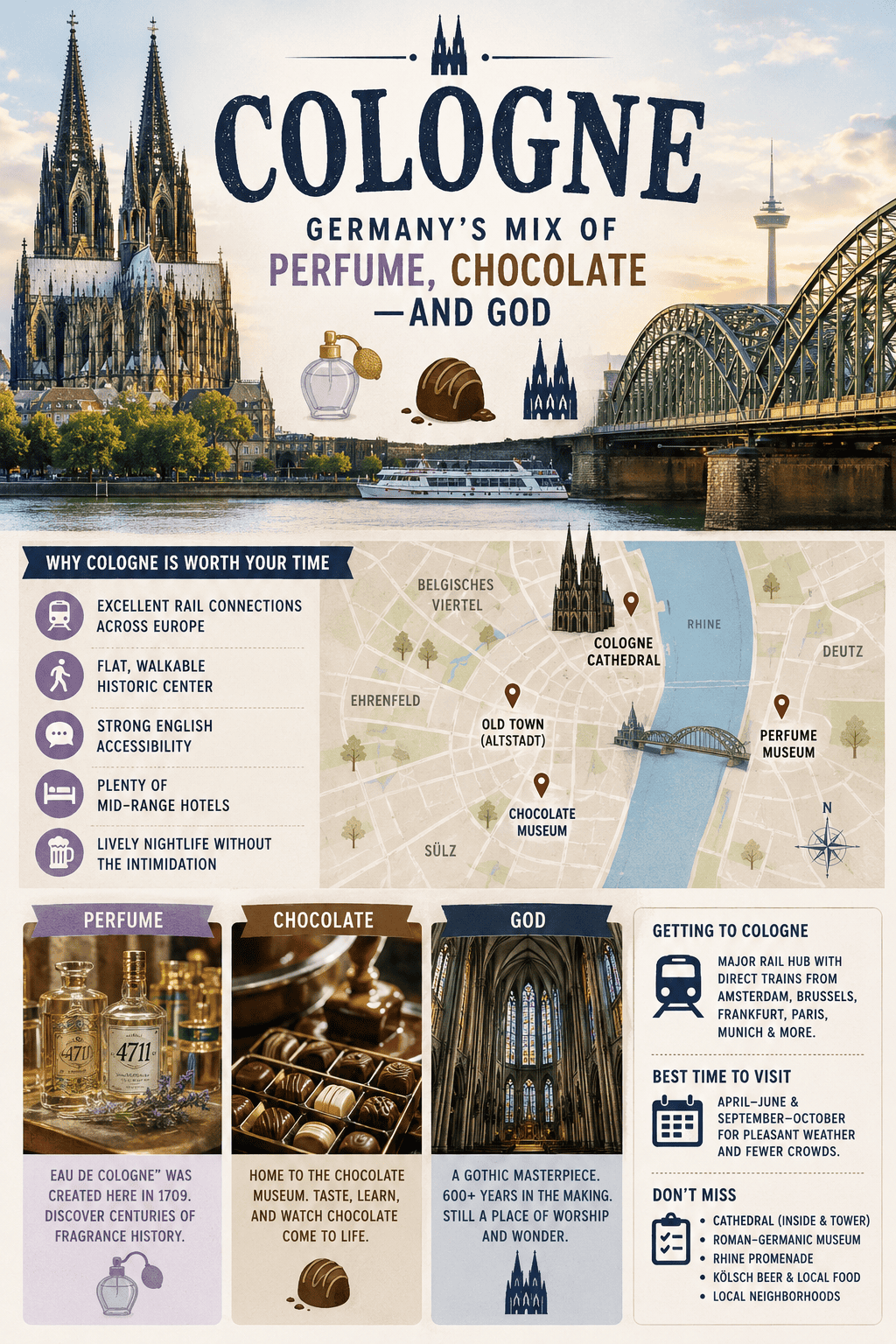
Cologne is compact and genuinely walkable. The cathedral, Old Town, perfume museums, Rhine promenade, and most of the major churches all fall within a comfortable 20-minute walk of the Hauptbahnhof. There are no complicated logistics, no mandatory transit transfers, and no districts that require planning to reach. That accessibility is one of Cologne’s real strengths for first-time visitors.
Staying at least two nights allows you to:
- Explore the cathedral properly, including the tower climb and treasury
- Visit either the Farina Fragrance Museum or 4711 House without rushing
- Spend a proper afternoon at the Lindt Chocolate Museum
- Walk the Rhine promenade and cross the Hohenzollern Bridge
- Eat and drink in a traditional Kölsch hall without watching the clock
Cologne also travels well as a regional base. Bonn, Aachen, and the Rhine Valley are all within an hour by train, which makes the city practical for travelers who want a mix of urban exploring and day-trip excursions.
Cologne Cathedral: Germany’s Most Overwhelming Church
The Kölner Dom — Cologne Cathedral — is the kind of building that makes architecture feel like a physical force. Construction began in 1248, stalled for centuries, and wasn’t completed until 1880. The result is one of the largest Gothic cathedrals ever built and a UNESCO World Heritage Site that still functions as an active place of worship.
What sets the cathedral apart from comparable churches in Europe is the combination of scale and ongoing life. Tourists photograph the stained glass windows from one aisle while worshippers light candles in another. The building doesn’t feel like a monument preserved behind glass — it feels inhabited.
What to See Inside
- The Shrine of the Three Kings — a gilded reliquary behind the high altar, one of the most important medieval goldsmith works in existence
- The stained glass windows — including the massive south transept window designed by Gerhard Richter, which produces extraordinary light effects on clear mornings
- The central nave — the sheer height alone is worth a few minutes of quiet standing
- The cathedral treasury — a separate admission, but genuinely worthwhile for medieval religious art and artifacts
- The south tower climb — more than 500 spiral steps, not suitable for everyone, but the Rhine views from the top on a clear day are exceptional
Practical Tips for Visiting
Entry to the cathedral nave is free. The tower climb costs around €6 for adults and the treasury has a separate admission of approximately €8. Combined tickets are available.
If your schedule allows, visit twice: once early in the morning when the interior is quieter and the light through the east windows is at its best, and again in the evening when the exterior lighting gives the spires a completely different atmosphere. Midday visits during summer can feel overcrowded and rushed.
Official site: koelner-dom.de
Cologne’s Perfume Legacy: The City That Invented Eau de Cologne
The word “cologne” in fragrance isn’t a generic term — it’s a place name. Eau de Cologne originated in this city in the early 18th century, and Cologne’s perfume heritage has remained a genuine part of its identity ever since.
Farina Fragrance Museum
This is the historically significant stop. Giovanni Maria Farina, an Italian perfumer who had settled in Cologne, created the original Eau de Cologne formula in 1709 and named it after the city he’d made his home. The museum on Obenmarspforten tells that story with guided tours that cover how the fragrance was produced, how it spread across European courts, and what distinguishes authentic Eau de Cologne from modern interpretations of the style.
The museum is small — tours typically last around 30–45 minutes — but it’s one of the more unusual and genuinely informative experiences in the city. It suits travelers with an interest in design history, luxury goods, or simply places that offer something outside the standard sightseeing circuit.
4711 House
The turquoise-and-gold shopfront on Glockengasse is Cologne’s most recognizable perfume address. 4711 has been selling its own Eau de Cologne since the early 19th century, and the shop itself is deliberately theatrical — fragrance counters, decorative interiors, and bottles designed for gifting.
It’s openly tourist-facing, but it’s also genuinely iconic. If you’re choosing between the two stops: visit Farina for history and context, visit 4711 for atmosphere and something to take home.
The Lindt Chocolate Museum: Worth It or Overrated?
Worth it — with some caveats about timing.
The Lindt Chocolate Museum sits directly on the Rhine riverfront and covers everything from cocoa cultivation in West Africa to European chocolate production history to the modern manufacturing process. The exhibits are well-designed, the layout is easy to navigate, and the famous chocolate fountain in the center of the building delivers exactly the kind of cheerful excess the museum’s reputation suggests.
The museum is particularly good for families, rainy-day visits, and travelers who prefer interactive exhibits over static displays. It’s less suited to anyone who wants a serious food-history experience — this is firmly on the accessible and fun end of the museum spectrum.
The main caveat: weekend afternoons from late spring through early autumn can pack the museum with school groups and families, which significantly changes the experience. Morning visits on weekdays are noticeably calmer. Admission runs approximately €15 for adults, with reduced prices for children and students.
Official site: chocolatemuseum-cologne.com
Cologne’s Old Town: What’s Actually Worth Your Time
Cologne’s Altstadt is not Rothenburg or Bruges. The city was heavily bombed during World War II, and much of what you see today is thoughtful reconstruction rather than original fabric. Travelers who arrive expecting a perfectly preserved medieval streetscape may feel initially underwhelmed.
The more useful framing is atmosphere rather than authenticity. The old town works — it’s lively, sociable, and genuinely pleasant to wander — it just doesn’t work as a visual time capsule.
Alter Markt and Heumarkt
These two adjoining squares form the social center of the Altstadt. Beer halls, outdoor cafés, and seasonal events cluster here. Prices are higher than in other parts of the city, but the energy is worth experiencing at least once — especially in the evening when the squares fill up.
Rhine Promenade and the Hohenzollern Bridge
One of Cologne’s best free experiences is walking the Rhine promenade south from the cathedral toward the Chocolate Museum. The river views are wide and calming, the path is flat and easy, and the rhythm of the waterfront — joggers, cyclists, café-sitters, the occasional tourist boat — gives a good sense of how Cologne actually functions as a city.
Crossing the Hohenzollern Bridge gives you the classic view of the cathedral from across the river. The bridge railings are covered in thousands of love locks, which has become its own kind of minor attraction.
The Romanesque Churches
This is Cologne’s most underappreciated category of sight. The city contains twelve Romanesque churches built between the 10th and 13th centuries, most of which receive only a fraction of the cathedral’s foot traffic. They tend to be quieter, more intimate, and — once you’re standing inside one — more historically affecting than the overwhelmingly grand cathedral.
Worth seeking out specifically:
- Great St. Martin — visible from the river, its tower is part of Cologne’s classic skyline
- St. Maria im Kapitol — one of the oldest churches in the city, with an unusual trefoil floor plan
- St. Gereon — built over a late Roman memorial, with a decagonal nave unlike anything else in the region
Kölsch: Cologne’s Beer Culture, Explained
Cologne has one beer and considerable pride about it. Kölsch is pale, lightly bitter, and traditionally served in a Stange — a narrow cylindrical glass holding just 0.2 litres. The glass is small by design; the idea is that beer stays cold and fresh while you drink it, and the server (called a Köbes) keeps replacing empty glasses automatically. To stop the cycle, place a coaster on top of your glass.
Kölsch is also, technically, a protected designation of origin. Under an agreement called the Kölsch Konvention, only breweries within the Cologne metropolitan area are permitted to call their beer Kölsch. The locals take this seriously.
Traditional Beer Halls Worth Visiting
- Früh am Dom — directly beside the cathedral, highly tourist-friendly, reliable for a first Kölsch experience
- Peters Brauhaus — classic Rhineland atmosphere with hearty food; popular but not as crowded as Früh
- Brauerei zur Malzmühle — slightly more local in feel, good traditional dishes, worth the short walk from the cathedral area
Expect to pay around €2.50–€4 per Stange depending on the venue.
What to Eat in Cologne
Rhineland cuisine is built for cold weather and generous appetites. It’s not the most elegant regional food tradition in Germany, but it’s satisfying and genuinely regional — you won’t find these dishes done as well anywhere else.
- Himmel un Ääd (“Heaven and Earth”) — mashed potatoes with applesauce and black pudding; the combination of sweet and savory is characteristic of Rhineland cooking
- Halver Hahn — despite the name (it means “half a chicken”), this is a rye roll served with aged Gouda, mustard, and onions; a traditional beer hall snack
- Sauerbraten — marinated pot roast served with dumplings and red cabbage; Rhineland versions often include a slightly sweeter marinade than other German regional interpretations
- Reibekuchen — potato pancakes typically served with applesauce, common at markets and casual street stalls
How Many Days Do You Need in Cologne?
One day is enough to see the cathedral, walk through the Old Town, and have a beer hall dinner. The visit will feel slightly rushed, but it’s manageable if your schedule is fixed.
Two days is the sweet spot for most travelers. You can move at a comfortable pace, add the Chocolate Museum and a perfume stop, walk the Rhine promenade properly, and spend an evening eating and drinking without watching the clock.
Three or more days makes sense if you want to explore Cologne’s art museums (the Museum Ludwig for 20th-century art and the Wallraf-Richartz for Old Masters are both excellent), spend time in neighborhoods like the Belgian Quarter, or use Cologne as a base for regional day trips.
Best Day Trips from Cologne
Bonn (20 minutes by regional train)
Beethoven’s birthplace and a former West German capital, Bonn has a relaxed riverside atmosphere and a cluster of good museums around the Museumsmeile. It’s compact enough to cover in half a day and pairs well with an afternoon back in Cologne.
The Rhine Valley (from 45 minutes by train)
The Middle Rhine — the stretch from Bingen to Koblenz — is listed as a UNESCO World Heritage landscape for its concentration of castles, vineyards, and medieval towns. Bacharach and Rüdesheim are the most visited stops. The train journey along the river is itself scenic enough to justify the trip.
Aachen (45–60 minutes by train)
Close to both the Belgian and Dutch borders, Aachen carries the legacy of Charlemagne — the Palatine Chapel inside Aachen Cathedral was his personal place of worship in the 9th century. The city also has a functioning thermal spa culture centered around its historic hot springs.
Where to Stay in Cologne
Altstadt-Nord: Best for First-Time Visitors
The neighborhood immediately surrounding the cathedral and the Hauptbahnhof puts every major sight within walking distance. Hotels here carry a premium, and some of the blocks closest to the station feel gritty after dark, so it’s worth reading specific hotel locations carefully rather than just booking by neighborhood name.
Belgian Quarter: Best for Local Atmosphere
West of the old town, the Belgian Quarter is Cologne’s most design-conscious neighborhood — independent cafés, bars, boutiques, and a genuinely local feel that the Altstadt can’t always deliver. It’s about a 20-minute walk to the cathedral or a short tram ride.
Deutz: Best for Value
Directly across the Rhine from the cathedral, Deutz offers lower hotel prices with easy access via the Hohenzollern Bridge (on foot) or the S-Bahn. The trade-off is a slightly less atmospheric immediate surroundings, but the commute to the Old Town is genuinely short.
Realistic Cologne Travel Costs
Cologne sits in the mid-range of European city costs — more expensive than Prague or Lisbon, comparable to Amsterdam for food and accommodation, and noticeably cheaper than Zurich or Paris.
- Budget (hostel, transit, casual meals): €70–120 per day
- Mid-range (comfortable hotel, museums, beer halls, riverside dining): €150–250 per day
- Higher-end (boutique hotels, fine dining, premium shopping): €300+ per day
Museum admissions typically fall between €8–15. The cathedral nave is free; the tower and treasury each carry a small additional charge. The Cologne Card (available for 24 or 48 hours) provides free public transit and discounts at selected museums — worth considering if you plan to visit several paid attractions in quick succession.
Best Time to Visit Cologne
April–June and September–October offer the best balance of pleasant weather, manageable crowds, and outdoor dining. Spring also brings the Rhine to life after winter.
December is Cologne’s most atmospheric month. The city hosts several Christmas markets, including one directly in front of the cathedral that is widely considered among the best in Germany. Expect higher hotel prices and genuine crowds — but also mulled wine, illuminated spires, and a festive energy that’s hard to replicate at other times of year.
July and August are lively but warmer and busier, particularly along the Rhine riverfront. The Chocolate Museum gets crowded, and hotel prices rise.
February brings Karneval (Cologne’s version of carnival), which transforms the city into one of Germany’s most exuberant street parties. It’s a spectacular time to visit if you want that specific experience — but book accommodation months in advance.
Common Cologne Travel Mistakes
- Visiting only the cathedral and leaving — the city has much more texture than a single building, even that building
- Booking a hotel purely by proximity to the station without checking reviews — some immediately surrounding blocks are fine; others feel uncomfortable late at night
- Skipping the Romanesque churches — St. Gereon and St. Maria im Kapitol in particular are genuinely extraordinary and almost always quiet
- Visiting the Chocolate Museum on a Saturday afternoon in summer — the difference between a weekend afternoon and a weekday morning visit is significant
- Underestimating how long the cathedral takes — if you want the tower, the treasury, and a proper look at the interior, allow at least two to three hours
Frequently Asked Questions About Visiting Cologne
Is Cologne worth visiting, or is it just a cathedral stop?
Cologne is genuinely worth an overnight stay or longer. The cathedral is extraordinary, but it’s the combination of things — perfume history, the Chocolate Museum, Romanesque churches, Kölsch beer culture, and the Rhine promenade — that makes the city more than a single-sight destination. Travelers who spend at least two nights consistently find it more rewarding than they expected.
How much does it cost to visit the Cologne Cathedral?
Entry to the cathedral nave is free and always has been. Climbing the south tower costs approximately €6 for adults. The cathedral treasury, which houses medieval religious art and artifacts including the Shrine of the Three Kings, charges around €8 for adults. Combined tickets are available at the cathedral entrance.
What is Kölsch beer and how do you order it?
Kölsch is Cologne’s protected regional beer — pale, lightly bitter, and served in a narrow 0.2-litre glass called a Stange. In traditional Kölsch halls, servers called Köbes will automatically bring a fresh glass when yours is empty. To stop, place your coaster on top of the glass. Ordering is simple: sit down, make eye contact, and the beer will appear. Prices are typically €2.50–€4 per glass depending on the venue.
What’s the difference between the Farina Fragrance Museum and 4711?
The Farina Fragrance Museum is the historically significant stop — it’s located in the building where Giovanni Maria Farina created the original Eau de Cologne in 1709, and guided tours explain the formula’s history and production in detail. 4711 is a 19th-century brand with an iconic shop on Glockengasse; it’s more atmosphere and retail than deep history. If you only have time for one, choose Farina for context and education, or 4711 if you want a more sensory and shopping-focused experience.
Is Cologne suitable for children?
Yes — Cologne works well for families. The Lindt Chocolate Museum is well-suited to children, the Rhine promenade is easy to walk, and the flat city center requires minimal transit. The cathedral is impressive for children even if they’re not interested in religious history. Karneval in February is a particularly child-friendly time to visit, with street processions and costumes throughout the city.
How do you get to Cologne by train?
Cologne is one of western Europe’s most accessible cities by rail. High-speed ICE trains connect Cologne Hauptbahnhof to Frankfurt in approximately 60–75 minutes, Brussels in around 1h45, Amsterdam in approximately 2h15, and Paris in around 3h15 via Thalys or Eurostar connections. The station sits directly beneath the cathedral, which means you can walk from your train to the nave in under five minutes.
Official Cologne tourism information: cologne-tourism.com
By Mara Vale for Eurly
Last verified: June 2025. Admission prices and transport times are subject to change; check official sources before visiting.

Mara Vale
Mara Vale writes Eurly travel guides for first-time Europe visitors who want practical routes, realistic pacing, and fewer avoidable planning mistakes.
Eurly guides are written to help readers make confident travel decisions, but opening hours, ticket rules, transit disruptions, and local conditions can change. Always verify key reservations and official schedules before you travel.