
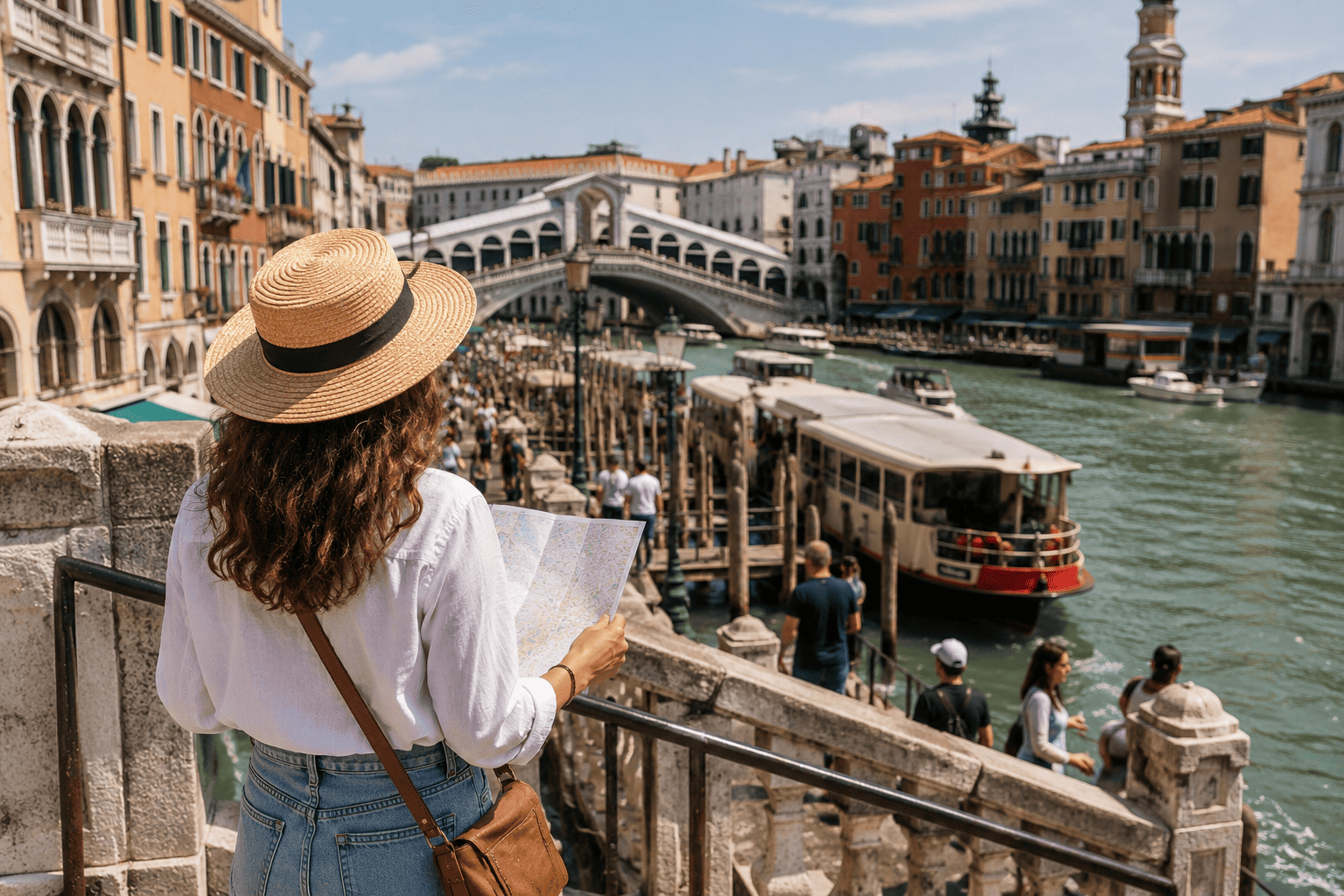
Is Venice safe for tourists? In general, yes — Venice is one of the safest cities in Italy for visitors, with very little violent crime aimed at tourists. The historic center stays busy at most hours, and most trips are trouble-free, but pickpockets, scams, and late-night navigation issues can still cause problems.
The real concerns in Venice are different from what many travelers expect: pickpocketing on crowded water buses, overcharging at restaurants near major landmarks, confusion around late-night transport, flooding during acqua alta season, and navigating quiet alleyways after dark.
Quick Takeaways
Start here: Is Venice safe for tourists?
Planning note: The real concerns in Venice are different from what many travelers expect: pickpocketing on crowded water buses, overcharging at restaurants near major landmarks, confusion around late-night transport, flooding...
If you’re asking is Venice safe, the short answer is yes — especially compared to Rome, Naples, or most large European capitals. But smart preparation makes a meaningful difference. This guide covers everything you need to know about Venice safety for tourists in 2026.
Venice Safety for Tourists: The Overall Picture
Venice’s historic center has a combination of factors that make it unusually low-risk compared to other major Italian cities:
- Low rates of violent crime
- Heavy foot traffic throughout the day
- Strong tourism infrastructure and visible police presence near major landmarks
- A local economy built almost entirely around visitors, which means most interactions are transactional rather than threatening
Most travelers find Venice noticeably calmer than Rome or Milan. That said, the city has its own distinct risk profile:
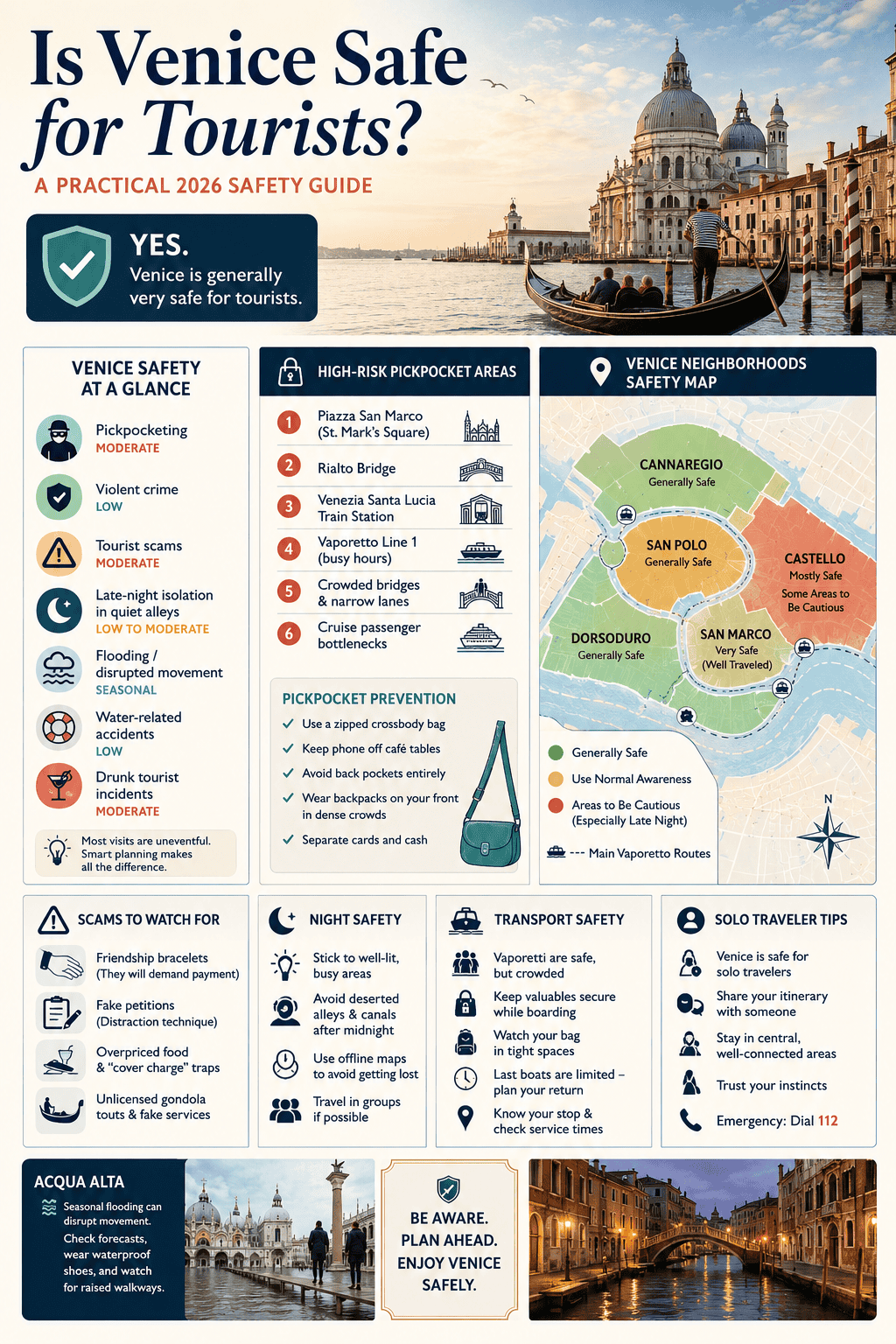
| Safety Concern | Risk Level |
|---|---|
| Pickpocketing | Moderate in crowded areas |
| Violent crime | Low |
| Tourist scams and overcharging | Moderate |
| Late-night isolation in quiet alleys | Low to moderate |
| Flooding (acqua alta) | Seasonal, autumn–winter |
| Water-related accidents | Low but real |
| Drunk tourist incidents near nightlife | Moderate |
The biggest mistakes visitors make are usually practical rather than dangerous: carrying valuables loosely on vaporetti, getting lost after midnight without offline maps, walking deserted canals while intoxicated, and falling for overpriced tourist traps near San Marco.
What to Actually Watch For: Venice Safety Breakdown
1. Pickpocketing Around Major Attractions
Like most high-tourism European cities, Venice attracts professional pickpockets who work dense crowds. The highest-risk spots are predictable:
- Piazza San Marco (St. Mark’s Square)
- Rialto Bridge and the surrounding market area
- Venezia Santa Lucia train station
- Vaporetto Line 1 during peak hours
- Narrow lanes near cruise passenger disembarkation points
A common misconception is that canals make theft harder to escape. In reality, tight tourist crowds create perfect distraction opportunities. Basic prevention covers most of the risk:
- Use a zipped crossbody bag worn in front in dense areas
- Keep your phone off café tables and in a pocket or bag
- Avoid back pockets entirely
- Separate cards and cash — keep a small amount accessible and the rest stored separately
2. Vaporetto Theft and Transit Crowding
Venice’s public water buses (vaporetti) are safe and widely used, but peak-season crowding creates opportunities for opportunistic theft. During busy periods, tourists squeeze together on boarding, luggage stacks up, and phones or wallets can disappear in the chaos.
Safer transit habits on the vaporetto:
- Stand away from the doors where boarding chaos concentrates
- Keep bags zipped and positioned in front of your body
- Hold your phone firmly — especially near open water
- Avoid displaying expensive camera equipment while boarding
Late at night, vaporetto frequency drops significantly. Missing the last useful route can mean a long walk through quiet, poorly signed alleyways — plan your return journey before it becomes urgent.
3. Restaurant Overcharging and Pricing Traps
Venice has fewer aggressive scams than Paris or Barcelona, but tourist pricing traps around major landmarks are common. Watch for:
- Service charges not explained upfront
- Seafood or fish sold “by weight” without a clear price per 100g
- Surprise seating fees (coperto) added to bills without prior mention
- Expensive bottled water charged without offering tap water as an option
- Menus without prices displayed, especially outside the restaurant
A useful rule of thumb: walk at least ten minutes away from St. Mark’s Square and the quality-to-price ratio improves dramatically. Restaurants in Cannaregio, Dorsoduro, and Santa Croce tend to be more honest with their pricing and more frequented by locals.
What Scams Should Tourists Watch for in Venice?
Venice scams are generally low-pressure but financially costly. Here are the ones worth knowing before you arrive.
Bracelet and “Free Gift” Scams
Someone approaches and offers a bracelet, bird feed, roses, or a small souvenir — presented as free. Once you accept it, they demand payment and can become persistent. The response is simple: say “No grazie” firmly and keep walking without engaging further.
Unofficial Water Taxi Offers
Unlicensed operators sometimes approach tourists near Venezia Santa Lucia station or Piazzale Roma. They may overcharge significantly, refuse the price they originally quoted, or imply they are official transport.
Use official taxi docks, book through ACTV’s vaporetto network, or arrange pre-booked airport or station transfers to avoid this entirely. Official water taxi fares from the airport run roughly €70–€150 depending on route and time — any offer significantly below that deserves scrutiny.
The “Closed Hotel” Redirect
A driver or street tout claims your hotel is closed, flooded, or inaccessible, then offers to take you to an alternative (for a commission). Always contact your hotel directly before changing any plans — this scam relies entirely on the tourist not verifying independently.
ATM Dynamic Currency Conversion
When withdrawing cash or paying by card, ATMs and some payment terminals offer to charge you in your home currency rather than euros. This “dynamic currency conversion” almost always applies a worse exchange rate. Always choose to pay in euros.
Is Venice Safe for Solo Travelers?
Yes — Venice is one of Europe’s more comfortable destinations for solo travel, including first-time solo travelers. The city is walkable, nightlife is calmer than most Italian cities, and the risk of harassment is comparatively low.
Solo female travelers generally find Venice manageable, though a few realities are worth noting:
- Quiet alleyways empty out quickly after midnight
- Navigation becomes genuinely confusing at night, especially in less-visited sestieri
- Some outer residential areas feel isolated after dark
The biggest solo travel risk in Venice is usually disorientation rather than being targeted. Practical habits that help:
- Stay near major vaporetto routes, especially if you plan to be out late
- Download offline maps before you arrive — phone signal can be inconsistent in narrow alleys
- Avoid walking alone while intoxicated near canal edges at night
- Share your accommodation details and rough itinerary with someone
- Avoid extremely cheap, isolated accommodation far from transport links
Best Areas for Solo Travelers to Stay
Safest and most convenient: San Marco, Cannaregio, Dorsoduro
Best balance of safety and affordability: Cannaregio, Santa Croce
Best nightlife atmosphere: Dorsoduro (around Campo Santa Margherita)
Cannaregio is particularly popular with solo travelers. It sits close to the train station, feels more residential and local than San Marco, and has a mix of budget and mid-range accommodation without the tourist chaos of the city’s most photographed corners.
Areas to Avoid in Venice — or Approach With More Awareness
Venice does not have truly dangerous neighborhoods in the way some large European cities do. There are no no-go zones. But a few areas warrant more awareness, particularly after dark.
Venezia Mestre (the Mainland)
Mestre is the mainland city across the bridge from the historic island. Many budget hotels are located here — accommodation is significantly cheaper, parking is easier, and chain hotels are more common.
The trade-off: Mestre is a regular urban environment with occasional petty crime near the train station, and it feels very different from Venice’s tourist-polished historic center. If you’re returning to Mestre late at night, use a taxi rather than walking from the station, and stay aware around underpasses and quieter streets.
Santa Lucia Train Station After Midnight
The station area is busy and safe during the day and early evening. After midnight, crowds thin out, intoxicated tourists congregate, and petty theft risk rises. Avoid lingering unnecessarily and keep your bags close if you’re waiting for a late train.
Empty Back Alleys After Midnight
Venice becomes surprisingly quiet late at night outside its small pockets of nightlife. Some narrow calli (alleyways) are poorly lit, nearly empty, and easy to get disoriented in. This is more uncomfortable than genuinely dangerous — but solo travelers may prefer sticking to wider canalside routes and signed main walkways when heading back late.
Is Venice Safe at Night?
Mostly yes. Venice after dark is considerably calmer than many European tourist cities of similar visitor volume. The historic center remains active into the evening with restaurants open late, couples walking, and a steady ferry schedule.
The practical nighttime risks are:
- Losing your bearings in the alleyway maze
- Slipping on wet stone steps or bridges after rain
- Walking too close to unguarded canal edges
- Intoxicated crowds in areas around Campo Santa Margherita or near Rialto
Night safety habits worth building:
- Wear shoes with grip — stone paving and bridge steps get slippery in the wet
- Keep distance from canal edges, especially where barriers are minimal
- Know your vaporetto route home before you start drinking
- Use Google Maps or Maps.me in offline mode — don’t rely on data signal
- Avoid staring at your phone screen while walking in dark alleys
Transport Safety in Venice
Are ACTV Water Buses (Vaporetti) Safe?
Yes. ACTV vaporetti are the standard way to get around Venice and are reliable and widely used by tourists and locals alike. Common traveler frustrations — overcrowding, delays, luggage handling, and route confusion — are comfort issues rather than safety concerns. The boats themselves are well-maintained and staffed.
Are Water Taxis Safe?
Official, licensed water taxis are safe but expensive. Expect to pay roughly €70–€150 or more depending on your route and time of day. Many first-time visitors are caught off guard by Venice transport costs — factor this into your budget in advance.
Walking Safety
Venice is fundamentally a walking city. The main physical hazards are environmental rather than criminal: bridges become slippery in rain, stone stairs are uneven in older areas, and canals have minimal barriers in many places. Falls and slips account for more tourist incidents than crime.
Seasonal Safety: Flooding and Summer Heat
Acqua Alta (High Water Flooding)
Between October and January, Venice periodically experiences acqua alta — tidal flooding that raises water levels across parts of the city. This usually means temporary raised walkways (passerelle), wet streets, slower pedestrian movement, and some areas of the city temporarily inaccessible on foot.
It’s inconvenient far more often than it’s dangerous. Come prepared with waterproof shoes or rubber boots, layered clothing, and flexibility in your day’s plans. The city’s official acqua alta monitoring centre publishes tide forecasts at comune.venezia.it.
Summer Heat and Dehydration
July and August in Venice are intensely humid. Air circulation is limited by the dense building fabric, crowds are at their peak, and shade is inconsistent across the city. Dehydration and heat exhaustion are genuine risks that tourists regularly underestimate.
Carry water constantly, schedule outdoor sightseeing for morning or evening hours, and don’t push through fatigue in high temperatures.
Practical Mistakes That Catch Tourists Off Guard
Staying too close to San Marco. The area is beautiful but expensive, crowded, and noisy. Cannaregio, Dorsoduro, and Santa Croce offer a more relaxed Venice experience at lower cost.
Overpacking. Venice has no cars — only bridges, stairs, and narrow lanes. Dragging a large wheeled suitcase across cobblestones and up stepped bridges becomes exhausting quickly. Travel lighter than you normally would.
Not booking a vaporetto pass. Single rides cost around €9.50 each. A multi-day ACTV travel card almost always saves money if you’re using water transport regularly. Check current pass options on the ACTV official website.
Arriving without offline maps. Venice navigation is genuinely confusing even for experienced travellers. The alleyway grid is dense, signage is inconsistent, and mobile data can drop in narrow lanes. Download an offline map before you arrive — it’s one of the most practical things you can do.
Emergency Numbers and Practical Safety Information
| Service | Number |
|---|---|
| General emergency (police, fire, ambulance) | 112 |
| Ambulance only | 118 |
| Police (Polizia di Stato) | 113 |
Most areas heavily visited by tourists have multilingual assistance available. The tourist police office (Polizia Turistica) near Piazza San Marco can assist with reporting theft or lost documents. For travel insurance purposes, always get a formal police report (denuncia) if anything is stolen.
The Italian government’s official travel safety guidance for visitors is published at esteri.it.
Final Verdict: Is Venice Safe?
Yes — Venice is safe for the vast majority of tourists, including solo travelers and first-time visitors. Violent crime is uncommon, and most visitors feel comfortable walking the historic center even after dark.
The city’s real risks are practical: pickpocketing in crowded transport and landmark areas, financial scams near major tourist sites, late-night navigation confusion, and seasonal flooding. None of these require avoiding Venice — they just require knowing they exist.
Approach Venice with normal urban awareness, carry your valuables carefully, have offline maps loaded before you arrive, and understand that the city operates very differently from a standard European destination. Do that, and Venice is not just safe — it’s one of the most rewarding cities on the continent to explore slowly.
Frequently Asked Questions
Is Venice safe for solo travelers?
Yes. Venice solo travel safety is generally excellent, particularly in central sestieri like Cannaregio, Dorsoduro, and San Marco. Solo travelers should mainly be aware of navigation challenges late at night, pickpocketing in crowded areas, and staying near reliable vaporetto routes. The city’s biggest solo risk is disorientation, not being targeted.
What scams should tourists watch for in Venice?
The most common Venice tourist scams include bracelet or “free gift” approaches, unofficial water taxi operators near stations, restaurant overcharging or hidden service fees near major landmarks, and ATM dynamic currency conversion traps. Most scams are financial rather than physical — staying informed is the best defence.
Are there any areas to avoid in Venice?
Venice has no truly dangerous neighbourhoods, but some areas warrant more awareness. Mestre train station surroundings feel less safe late at night. Santa Lucia station gets quieter and riskier after midnight. Poorly lit back alleys across the historic centre are better avoided when walking alone after 1am. None of these are zones to avoid entirely — just areas where extra awareness helps.
Is Venice safe at night?
Yes, especially in the historic centre. Venice is calmer than many comparable European tourist cities after dark. The main nighttime risks are navigational — getting lost, slipping on wet bridges, or walking too close to unguarded canal edges. Wear shoes with grip, use offline maps, and know your vaporetto route home before you go out.
Is Venice safer than Rome or Milan?
Most travellers find Venice noticeably safer and calmer than Rome or Milan, particularly in terms of violent crime, aggressive street scams, and general urban tension. The specific risks in Venice — pickpocketing, transport scams, and tourist overcharging — are different in character but generally lower in severity than those in Italy’s larger mainland cities.
By Mara Vale for Eurly
Last verified: May 2026
Mara Vale
Mara Vale writes Eurly travel guides for first-time Europe visitors who want practical routes, realistic pacing, and fewer avoidable planning mistakes.
Eurly guides are written to help readers make confident travel decisions, but opening hours, ticket rules, transit disruptions, and local conditions can change. Always verify key reservations and official schedules before you travel.