
If you're wondering how much does it cost to backpack Europe, the answer depends on your route, travel style, and spending habits. Backpacking Europe can cost less than a resort vacation — or more than a month's rent back home. The biggest factors are where you go, how you move around, and the tradeoffs you're willing to make.
For most travelers in 2026, a realistic backpacking budget falls somewhere between €70 and €130 per day, covering accommodation, transport, food, sightseeing, and a small cushion for the unexpected. That range shifts dramatically depending on whether you’re sleeping in Balkan dorm rooms or hotel beds in Zurich.
Quick Takeaways
Start here: If you're wondering how much does it cost to backpack Europe, the answer depends on your route, travel style, and spending habits.
Planning note: For most travelers in 2026, a realistic backpacking budget falls somewhere between €70 and €130 per day, covering accommodation, transport, food, sightseeing, and a small cushion for the...
This guide breaks down exactly where the money goes, how costs vary across Europe, and how experienced backpackers actually keep their budgets under control without sacrificing the trip.
Average Daily Costs for Backpacking Europe
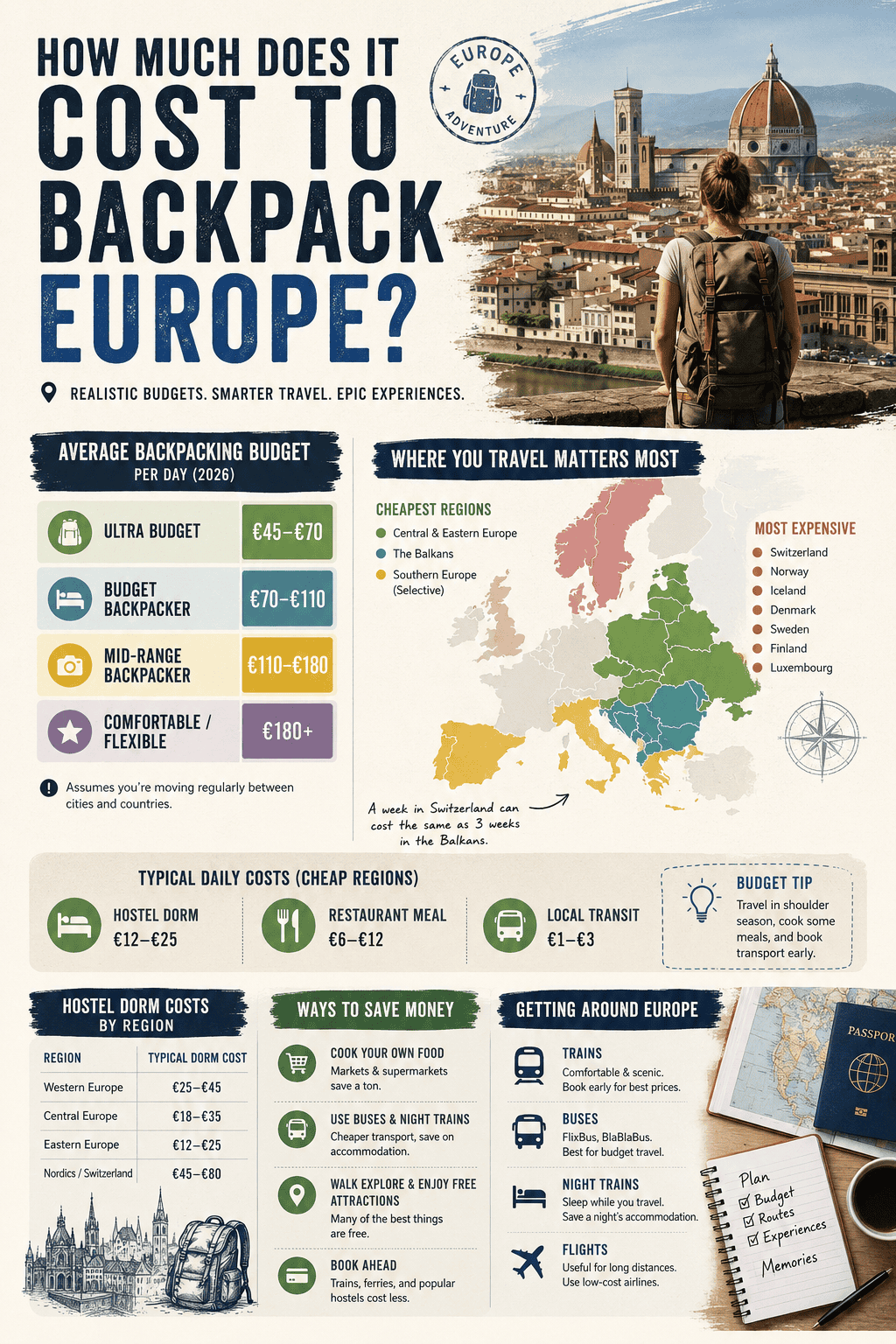
Here’s a realistic overview of what travelers typically spend when moving regularly between countries:
| Travel Style | Daily Budget | Monthly Estimate |
|---|---|---|
| Ultra Budget | €45–€70 | €1,350–€2,100 |
| Budget Backpacker | €70–€110 | €2,100–€3,300 |
| Mid-Range Backpacker | €110–€180 | €3,300–€5,400 |
| Comfortable / Flexible | €180+ | €5,400+ |
These figures assume you’re actively moving — not staying in one city for a month. The biggest variables that shift you between tiers are:
- Which countries you visit
- Accommodation style (dorm vs private room)
- Transportation strategy (flights vs trains vs buses)
- Season of travel
- How fast you move between cities
- Nightlife and drinking habits
The Biggest Budget Factor: Where You Travel
Europe is not a single-price destination. A route through Portugal, Poland, Hungary, and Albania can cost roughly half as much as the same number of days in Switzerland, Norway, and Denmark. Choosing your regions wisely is the single most powerful thing you can do for your budget.
Cheapest Regions for Backpackers
Central and Eastern Europe — Poland, Hungary, Slovakia, Romania, Bulgaria, Bosnia and Herzegovina, Albania
The Balkans — Serbia, Montenegro, North Macedonia, Kosovo
Southern Europe (selective) — Portugal, inland Spain, southern Italy, mainland Greece
Typical daily costs in these regions:
- Hostel dorm bed: €12–€25
- Sit-down restaurant meal: €6–€12
- Local public transit: €1–€3
Most Expensive European Countries
These destinations push even experienced budget travelers into higher spending brackets, because the essentials — not just the luxuries — are costly:
- Switzerland
- Norway
- Iceland
- Denmark
- Sweden
- Finland
- Luxembourg
Typical prices in these countries:
- Hostel dorm bed: €45–€80
- Budget meal: €18–€30
- Beer: €8–€12
- Train tickets: high without advance booking
A single week in Switzerland can cost as much as three weeks in the Balkans. That doesn’t mean avoiding these places — it means building in cheaper stretches around them.
Accommodation Costs Across Europe
Accommodation is typically the largest line item in a backpacker’s daily budget. Prices vary significantly by region and by season.
Hostel Dorm Beds
| Region | Typical Dorm Cost Per Night |
|---|---|
| Eastern Europe | €12–€25 |
| Southern Europe | €20–€40 |
| Western Europe | €35–€60 |
| Scandinavia | €45–€80 |
Prices spike considerably during summer (June–August), on weekends, during local festivals, and in high-traffic cities like Paris, Amsterdam, and Barcelona. A dorm bed that costs €22 in April can easily run €55–€60 in July.
When a Private Room Makes Sense
Many travelers start in dorms and burn out on the noise and disrupted sleep after a few weeks. Private rooms are often worth considering for couples (the per-person cost can be similar to two dorm beds), digital nomads who need reliable sleep, or anyone on a longer trip where recovery matters. In Eastern Europe particularly, a private Airbnb sometimes costs barely more than two dorm beds combined.
Hidden Accommodation Costs to Budget For
First-time backpackers often overlook expenses that accumulate over weeks:
- City tourist taxes (mandatory in cities like Venice, Amsterdam, and Paris — typically €1–€5 per night)
- Locker rentals (€1–€3 per day in many hostels)
- Laundry (€5–€10 per load)
- Towel hire
- Luggage storage between check-out and departures
- Late check-in fees
These are small individually but can add €5–€15 per day over a long trip.
Transportation Costs in Europe
Transportation is where smart backpackers save the most money — or lose it fastest.
Budget Airlines
Europe’s low-cost carriers can offer genuinely cheap fares on routes that would take a full day by train. You’ll regularly find flights in the €20–€50 range between major hubs. The main players are Ryanair, easyJet, Wizz Air, and Vueling.
The catch is the extras. Bag fees, seat selection charges, and off-site airport transfers (Ryanair in particular uses secondary airports far from city centres) can turn a €19 fare into €65+ at checkout. Always calculate the total cost including:
- Cabin bag and hold luggage fees
- Airport transfer to/from the city
- Seat selection (avoidable but sometimes worth it on long flights)
Trains in Europe
Train travel is one of the genuine pleasures of backpacking Europe, and it can be excellent value — if you book early.
Countries with strong rail value: Germany, Austria, Czech Republic, Italy
Countries where trains are expensive without advance booking: UK, France, Switzerland, Scandinavia
Booking timing matters enormously on popular routes. A Paris–Amsterdam Thalys ticket booked two months ahead can cost around €35. The same ticket the week before can run €140 or more. The same principle applies to routes through Italy and across France.
Is a Eurail Pass Worth It?
Eurail passes make sense for some itineraries and not others. They tend to work well if you’re taking frequent long-distance trains across multiple countries, prioritise flexibility over the lowest possible price, or are visiting expensive rail countries like Switzerland or Norway. They make less sense if you’re flying between many destinations, travelling slowly through fewer countries, or focusing on Eastern Europe where trains are already affordable.
Before buying, price out your planned routes individually using Trainline or national rail booking sites — the pass savings often look better in theory than in practice.
Overnight Transport as an Accommodation Strategy
Overnight buses and night trains serve a dual purpose: they move you between cities and eliminate one night’s accommodation cost. On a route like Belgrade to Sarajevo or Kraków to Vienna, this can mean saving €20–€40 on a hostel. Services like FlixBus and Eurolines cover a large network of overnight routes at low prices.
The tradeoff is sleep quality and energy. Using overnight transport once or twice a week works well for most people. Doing it every few nights tends to lead to exhaustion and, counterintuitively, more spending — tired travelers eat out more, take taxis, and make worse decisions.
Food Costs While Backpacking Europe
What you spend on food depends almost entirely on your habits. The gap between the cheapest and most expensive approach is wider here than almost anywhere else in your budget.
Budget-Conscious Food Strategy
The classic approach — grocery stores, hostel kitchens, bakery breakfasts, market lunches — keeps daily food costs in the €10–€20 range. Most European cities have excellent supermarkets (Lidl and Aldi operate across the continent) and local markets where eating well doesn’t require spending much. A baguette, cheese, and fruit from a French market costs €4–€6 and beats most tourist-trap restaurant lunches at any price.
Eating Out Regularly
If you prefer sitting down for meals, budget accordingly:
- Eastern Europe: €8–€15 per meal
- Italy, Spain, Portugal: €12–€20 per meal
- France, Netherlands, Germany: €18–€35 per meal
- Scandinavia and Switzerland: €25–€45 per meal
Alcohol compounds costs quickly. In cities like Amsterdam, Copenhagen, or Oslo, two or three drinks can easily cost as much as your hostel bed. This is one of the fastest ways a reasonable daily budget quietly doubles.
Sightseeing and Activity Costs
Europe offers an enormous amount that’s entirely free — medieval old towns, cathedrals, hiking trails, beaches, public parks, viewpoints, free walking tours, and more. These are often the most memorable parts of a trip. But the big-ticket attractions add up fast when you’re moving through multiple cities.
| Type of Activity | Typical Cost |
|---|---|
| Museums | €10–€25 |
| Famous landmarks (Eiffel Tower, Colosseum, etc.) | €15–€40 |
| Guided day tours | €40–€120 |
| Pub crawls | €15–€35 |
| Adventure activities | €50–€200+ |
A handful of big-ticket experiences — a Swiss mountain excursion, a Northern Lights tour in Norway, a Greek island sailing trip, or an Iceland glacier hike — can add several hundred euros to your total trip cost. Budget for them intentionally rather than treating them as spontaneous extras.
Many museums in Europe offer free entry on the first Sunday of the month, or discounted rates for under-26 travellers. It’s worth checking before you visit.
Realistic Total Budgets by Trip Length
2 Weeks in Europe
- Budget style: €1,200–€2,000
- Mid-range: €2,500–€4,000
Shorter trips tend to cost more per day. You move faster, pay for more transit, and rarely have time to cook or find cheaper local alternatives.
1 Month Backpacking Europe
- Budget backpacker: €2,200–€4,000
- Mid-range: €4,500–€6,500
A month gives you time to slow down, cook more, and negotiate better weekly hostel rates. The daily average starts to drop after the first week or two.
3 Months Backpacking Europe
- Budget traveller: €6,000–€9,000
- Comfortable backpacker: €10,000–€15,000+
Over three months, pacing matters more than almost anything else. Many long-term travelers overspend in the first month — novelty is expensive — and then cut corners aggressively to compensate. Building a sustainable daily rhythm from the start is far easier than course-correcting later.
Sample Daily Budgets (Itemised)
Ultra Budget: €55/day
- Hostel dorm: €18
- Groceries and cheap meals: €15
- Transportation: €10
- Attractions: €5
- Miscellaneous: €7
Works best in Eastern Europe with slow travel and minimal nightlife.
Balanced Budget: €100/day
- Hostel or occasional private room: €40
- Mix of restaurants and self-catering: €30
- Transportation: €15
- Attractions: €10
- Miscellaneous: €5
Suits multi-country trips with moderate comfort and occasional splurges.
Comfortable Backpacker: €170/day
- Private rooms or budget hotels: €90
- Eating out most meals: €45
- Transportation: €20
- Attractions and activities: €15
Appropriate for Western Europe travel, couples, or anyone prioritising rest and convenience over cost savings.
The Fastest Ways Travelers Blow Their Budget
Moving Too Fast
This is the single most common budget mistake. Every new city brings a transit cost, an orientation day with more eating out, more paid sightseeing, and less time to cook or settle. Travelers trying to tick off ten countries in three weeks often spend more and enjoy it less than those who stay four or five days per place.
Staying Only in Major Capitals
Paris, London, Amsterdam, Zurich, and Copenhagen are all wonderful — and all expensive. Smaller cities frequently offer better food, lower prices, and fewer crowds. Cities like Kraków, Ljubljana, Porto, Valencia, Sarajevo, and Brno regularly become trip highlights for travelers who give them a chance, at a fraction of the cost of the big capitals.
Travelling Only in Peak Summer
June through August is the most expensive time to be in Europe by nearly every measure: higher hostel prices, pricier flights, crowded trains, and fewer available beds. Shoulder season — April to May and September to October — usually delivers better value, similar or better weather, and far fewer crowds. If your schedule has any flexibility, this shift alone can cut costs by 20–30%.
Ignoring the True Cost of Budget Flights
A €19 Ryanair fare sounds excellent until you add a checked bag, a priority boarding fee, and a €25 bus transfer from an airport an hour outside the city. Always calculate the full door-to-door cost before assuming a budget flight beats the train.
Underestimating Nightlife Spending
Alcohol is quietly one of the biggest budget disruptors on the backpacker trail. A few nights of heavy drinking in Amsterdam, Prague, or Berlin can undo a week of careful spending elsewhere. This isn’t an argument against social travel — just a reason to track it honestly.
Practical Tips for Keeping Costs Down
- Travel slower. Fewer transit days means fewer large costs. Spending four nights somewhere instead of two almost always lowers your daily average.
- Cook at least some meals. Even cooking dinner three or four times a week saves a meaningful amount over a long trip.
- Mix expensive and cheap countries. Pair a week in Norway with two weeks in Poland. Follow Switzerland with Slovenia. The cheap stretches offset the expensive ones.
- Book trains early. On most European routes, prices rise sharply as the departure date approaches. Booking two to four weeks out makes a real difference.
- Stay outside city centres. Especially in Paris, Amsterdam, Venice, and other heavily touristed cities, a neighbourhood 15 minutes from the centre by metro often costs 30–40% less for accommodation.
- Use city cards selectively. Tourist cards that bundle transit and museum entry are sometimes excellent value and sometimes not. Do the maths before buying.
- Check free museum days. Many European cities offer free entry to major museums on specific days or evenings.
Is Backpacking Europe Expensive?
Compared to Southeast Asia or Central America, yes — Europe costs more at every budget tier. Compared to travelling around the United States, Australia, or the UK, it’s often surprisingly affordable, particularly in Eastern and Southern Europe.
The honest answer is that Europe can be done on almost any budget, but your destination choices matter far more than your willpower. A traveler spending three weeks in Eastern Europe on €65 a day isn’t toughing it out — they’re eating well, seeing a lot, and genuinely enjoying it. The same person in Scandinavia on the same budget would be miserable.
The smartest approach isn’t necessarily the cheapest. It’s knowing where spending more genuinely improves the experience — a particular train journey, a once-in-a-trip day tour, a better-located hotel for one night — and where it doesn’t.
Frequently Asked Questions
How much spending money do I need for two weeks in Europe?
For a budget-focused two-week trip, plan for €1,200–€2,000 in total daily spending (accommodation, food, transport, and activities). Mid-range travelers should budget €2,500–€4,000. These figures don’t include flights to and from Europe or travel insurance, which should be budgeted separately.
What is the cheapest country to backpack in Europe?
Albania, Kosovo, North Macedonia, and Bosnia and Herzegovina are consistently among the cheapest destinations for backpackers, with daily budgets of €35–€55 achievable. Poland, Hungary, Romania, and Bulgaria are also excellent value and offer more developed infrastructure for travelers.
How much cash should I carry while backpacking Europe?
Most of Europe is highly card-friendly, and carrying large amounts of cash is unnecessary. Keeping €50–€100 in local currency is usually enough for markets, small towns, or anywhere that doesn’t take cards. In Western Europe, you can often get by with less. In the Balkans, having slightly more cash on hand is useful as card acceptance is less universal.
Is it cheaper to use a Eurail pass or buy individual train tickets?
It depends on your route and booking timeline. For frequent train travel across multiple countries — especially in Western Europe — a Eurail pass can offer savings and useful flexibility. For travelers flying between many destinations, moving slowly, or primarily visiting Eastern Europe (where trains are already cheap), individual tickets bought in advance usually work out cheaper. Always price your specific route before committing to a pass.
What time of year is cheapest to backpack Europe?
Late March through May and September through October offer the best combination of reasonable prices, manageable crowds, and decent weather. November through February is cheapest overall, but some attractions have reduced hours and outdoor travel is less pleasant in northern and central Europe. Peak summer (June–August) is the most expensive window across almost every category.
Do I need travel insurance for backpacking Europe?
Yes. Medical costs, trip cancellations, and stolen belongings can each run into thousands of euros without insurance. For European Union travellers, an EHIC or GHIC card provides some state healthcare coverage within the EU — but it doesn’t cover everything and doesn’t replace comprehensive travel insurance. Budget around €30–€60 per month for a solid backpacker travel insurance policy, depending on your age and coverage level. Providers like World Nomads and SafetyWing are popular with long-term travelers.
By Mara Vale for Eurly
Last verified: May 2026. Prices are indicative and reflect typical 2026 market rates. Actual costs will vary based on season, booking timing, and individual travel style.

Mara Vale
Mara Vale writes Eurly travel guides for first-time Europe visitors who want practical routes, realistic pacing, and fewer avoidable planning mistakes.
Eurly guides are written to help readers make confident travel decisions, but opening hours, ticket rules, transit disruptions, and local conditions can change. Always verify key reservations and official schedules before you travel.