

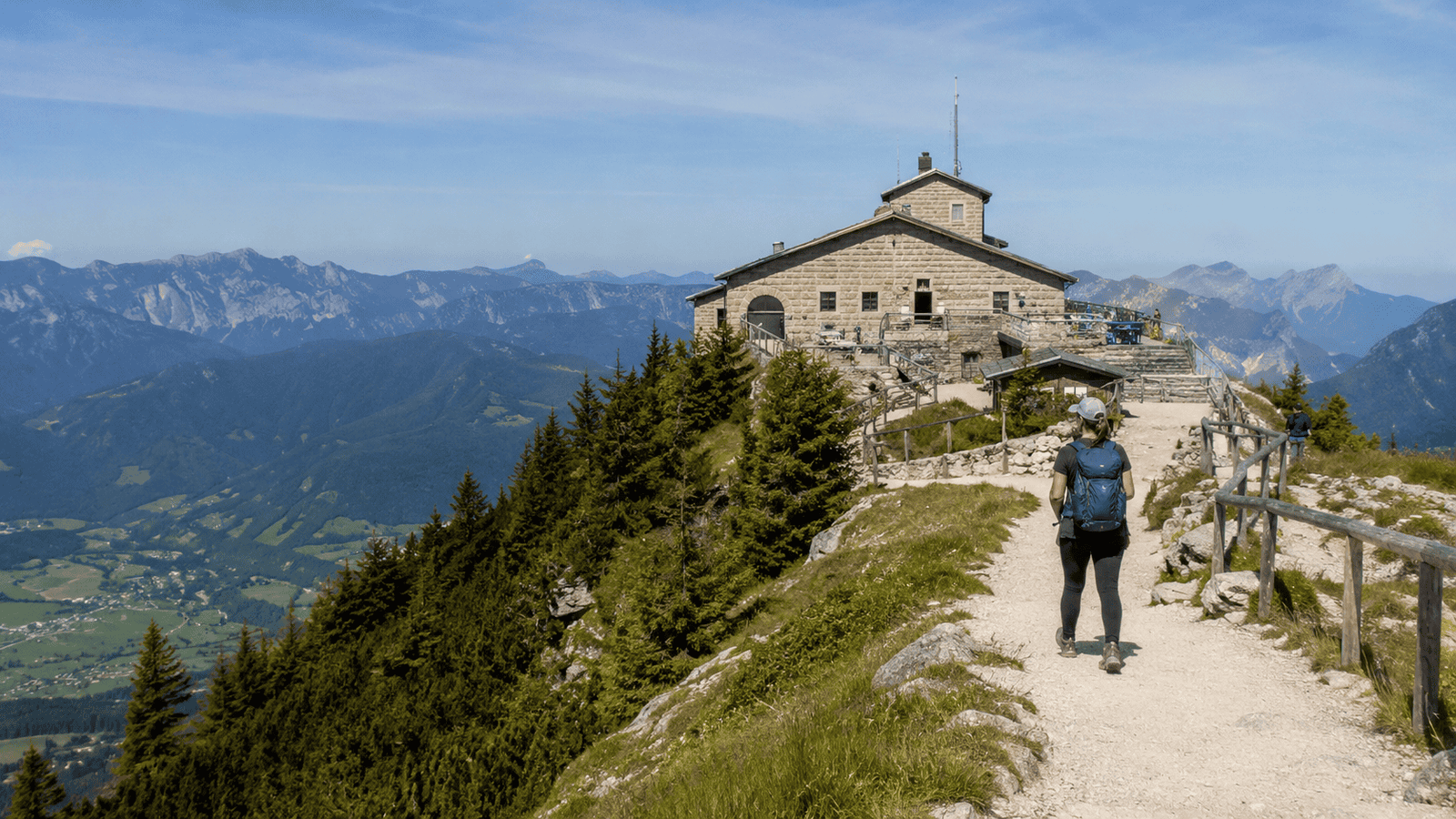
The phrase eagle’s lair leads most travelers to the same destination: the Eagle’s Nest, or Kehlsteinhaus, perched at 1,834 metres above Berchtesgaden in the Bavarian Alps. It arrives with a dramatic approach — a restricted mountain road cut into sheer cliffs, a tunnel through the rock, a brass elevator rising to the summit — and views on clear days that stretch across the border into Austria.
But the Eagle’s Nest is not only a viewpoint. It sits at the heart of the Obersalzberg, one of the most historically weighted landscapes in modern Europe. Getting this visit right means understanding the logistics, the history, and the choices that separate a memorable day from a frustrating one.
Quick Takeaways
Start here: The phrase eagle’s lair leads most travelers to the same destination: the Eagle’s Nest, or Kehlsteinhaus, perched at 1,834 metres above Berchtesgaden in the Bavarian Alps.
Planning note: But the Eagle’s Nest is not only a viewpoint.
This guide covers everything: what it is, whether it is worth your time, how to reach it, what it costs, how long to allow, and what to combine it with.
What Is the Eagle’s Lair?
The eagle’s lair that most English-speaking travellers search for is the Eagle’s Nest, or Kehlsteinhaus, above Berchtesgaden in southeast Germany. It was built between 1937 and 1938 as a representative mountain building connected to Hitler’s nearby Obersalzberg complex. Today it operates seasonally as a mountain restaurant, viewpoint, and historical site.
The building itself is smaller than many visitors expect. The drama is in the journey — the restricted road, the stone tunnel, the elevator, the terrace — and in the contrast between extraordinary natural scenery and an extraordinarily dark historical setting. The Eagle’s Nest pairs most naturally with Documentation Obersalzberg, the museum below on the mountain, which provides the fuller historical picture the summit alone cannot offer.
Is the Eagle’s Nest Worth Visiting?
Yes, for most travellers already in Berchtesgaden, Salzburg, or southeast Bavaria — provided you understand what kind of experience it is.
It is best for travellers who want:
- Panoramic alpine views without a serious mountain hike
- A historically significant and genuinely unusual travel stop
- A half-day from Berchtesgaden or a full day from Salzburg
- A visit that pairs well with Königssee, Ramsau, or the Berchtesgaden Salt Mine
It may disappoint if you expect:
- A large interpretive museum inside the Eagle’s Nest building
- A preserved Nazi-era residence
- Solitude in peak summer
- Guaranteed views in any weather
- A cheap, spontaneous stop with no waiting involved
The honest tradeoff: the Eagle’s Nest is more accessible than most alpine viewpoints, but that convenience brings crowds, timed buses, and a somewhat managed feel. Go early, check the weather forecast, and give yourself enough time not to rush it.
Where Is the Eagle’s Lair Located?
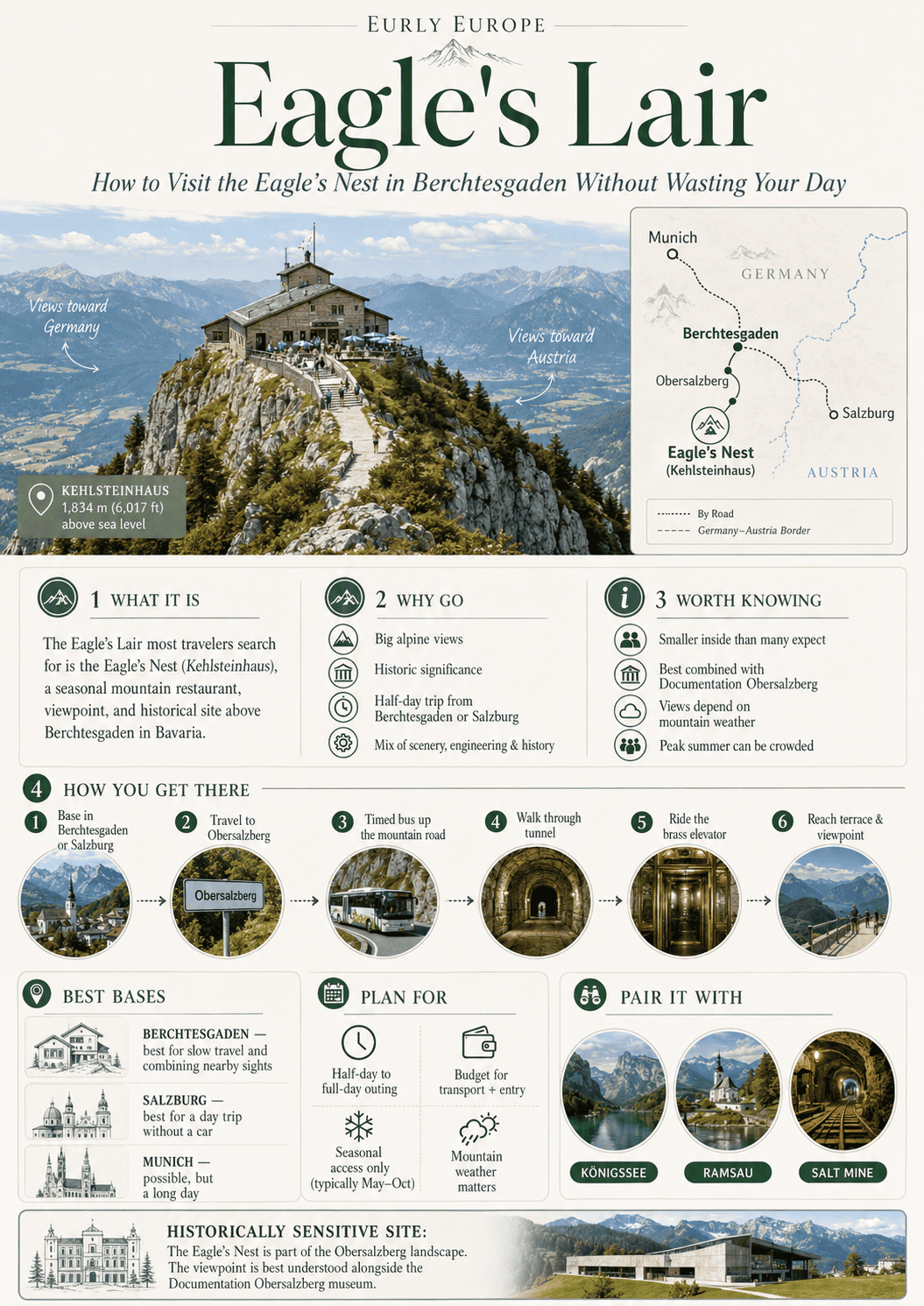
The Eagle’s Nest is above Obersalzberg, near Berchtesgaden in Bavaria, close to the Austrian border. Useful bases include:
Berchtesgaden: The best base for slow travellers, hikers, and anyone combining the Eagle’s Nest with Königssee, Ramsau, Jennerbahn, or the salt mine.
Salzburg: Practical for a day trip from Austria, but you need to manage connections carefully. A car gives you significantly more flexibility.
Munich: Possible as a long day trip, but only if you start early. Consider a guided tour if you do not want to manage the logistics independently.
Bad Reichenhall: A quieter spa-town base with rail access and a more relaxed pace than either Salzburg or Munich.
How to Get to the Eagle’s Nest
Private vehicles are not permitted on the final section of the mountain road. All visitors reach the summit via the official Eagle’s Nest bus from the Obersalzberg/Hintereck departure area.
Step 1: Reach Berchtesgaden or Obersalzberg
By public transport, aim first for Berchtesgaden Hauptbahnhof. Local buses connect the station to the Obersalzberg departure area. By car, navigate to the Eagle’s Nest bus departure point near Obersalzberg — not the summit. Parking is available but fills quickly on clear summer mornings.
Step 2: Take the Eagle’s Nest Bus
The special mountain bus travels the restricted Kehlstein Road, a steep, narrow route through tunnels and along cliff edges. It is part of the experience. At the top, you walk through a stone tunnel to the historic elevator, which rises through the mountain to the building. Bus and elevator are both included in the standard return ticket.
Step 3: Elevator or Walk
Most visitors take the elevator. A walking route from the upper bus area also exists and takes around 25 minutes. If you plan to walk, wear proper shoes — this is an alpine environment, not a city promenade.
How Much Does It Cost?
For 2026, the online adult return ticket is listed at €34.70. A family return ticket for two adults and children is listed at €70.90. Some guest-card and discounted tickets are available only at the on-site cash desk, not online.
Realistic per-person budgets:
Low-cost half-day from Berchtesgaden:
Eagle’s Nest ticket: around €35
Local transport or parking: €5–€15
Snacks or drinks: €5–€15
Total: around €45–€65
Comfortable half-day:
Eagle’s Nest ticket: around €35
Transport and parking: €10–€20
Coffee or lunch at the top: €15–€30
Museum or secondary attraction: variable
Total: around €65–€100
Guided day trip from Salzburg or Munich:
Guided tours vary widely in price but can be worth it if you want expert historical commentary and no logistical stress.
Food at the summit is not cheap, but you are paying for the altitude. If you are watching costs, eat well in Berchtesgaden beforehand and treat the Eagle’s Nest restaurant as a coffee and cake stop rather than a full lunch venue.
How Long Do You Need?
Allow at least 2 hours from the bus departure point — covering check-in, the bus ride, the tunnel, the elevator, the terrace, and the return journey. Most travellers benefit from more time.
- Fast visit (2–2.5 hours): Suitable when weather is uncertain or you only want the viewpoint.
- Balanced visit (3–4 hours): Best for most travellers. Time for the terrace, a drink, the historical exhibition, and a relaxed return.
- Full Obersalzberg day (5–6 hours): Best if you also visit Documentation Obersalzberg and want real historical depth, not just scenery.
Travellers coming from Salzburg should treat it as a half-day to full-day excursion. From Munich independently, treat it as a long full day and start early.
Best Time to Visit
The Eagle’s Nest is seasonal, typically opening from May into autumn depending on snow and mountain conditions. In 2026 the official reopening is listed for 7 May, with summer hours running into late September and shorter hours through October and into early November.
The best months:
Late May to June: Open access, green landscapes, and lighter crowds than high summer.
September: Often the sweet spot. Clear weather remains common, crowds ease, and the Alps are at their most photogenic.
July and August: Best for reliable access, but the busiest period. Book ahead and arrive early.
October: Atmospheric and quieter, but weather becomes unpredictable and hours shorten.
The best time of day is early morning. First departures are less crowded, morning light is excellent on clear days, and you give yourself a buffer if anything runs late. Afternoon visits can work, but cloud often builds over the mountains, and late arrivals have little margin for delays.
Should You Book Tickets in Advance?
Yes, booking online is the smart move during peak season, weekends, public holidays, and any clear-weather day when half of Bavaria will have the same idea. Bus capacity is limited.
Book in advance if:
- You are visiting in July or August
- You are travelling from Salzburg or Munich and cannot easily return another day
- The weather forecast looks clear
- You are travelling with children or a group
- You need a specific morning time slot
Buying on site may make sense if:
- You have a guest card discount only available at the desk
- Weather is uncertain and you want to keep your plans flexible
- You are staying in Berchtesgaden and can easily shift your visit by a day
- You are travelling in shoulder season on a weekday
The practical compromise: check the mountain weather first, then book a morning slot once the forecast looks reasonable.
Eagle’s Lair Itineraries
Half-Day from Berchtesgaden
Start after breakfast in Berchtesgaden. Take the local bus or drive to the Obersalzberg departure area. Ride the Eagle’s Nest bus, take the elevator, and allow 60–90 minutes on the summit. Return to visit Documentation Obersalzberg for historical context, then finish with dinner in Berchtesgaden’s old town. This is the most straightforward version of the visit.
Full Day with Königssee
Start early with the Eagle’s Nest while visibility is at its best. Return to Berchtesgaden by midday, then continue to Königssee and take the boat toward St. Bartholomä if time allows. This is a full but rewarding day. It works best in summer when daylight is long and you start early enough to avoid the worst of the queues at both sites.
Salzburg Day Trip
Leave Salzburg early and travel to Berchtesgaden, then continue to Obersalzberg for the Eagle’s Nest bus. After the visit, choose either Documentation Obersalzberg or a short walk in Berchtesgaden town before returning. Do not try to combine the Eagle’s Nest, Königssee, and a museum visit from Salzburg in a single day without a car, excellent timing, or a guided tour. The connections and queues can consume your entire schedule.
History-First Itinerary
Start with Documentation Obersalzberg before going up to the Eagle’s Nest. This order gives the summit far more meaning and helps you avoid treating the site like a scenic attraction with an inconvenient history attached. After the museum, take the bus up, visit the terrace and historical exhibition, then return to Berchtesgaden. This is the most responsible and intellectually rewarding way to experience the Obersalzberg.
What You Will Actually See at the Top
At the summit: a mountain restaurant, open terrace areas, alpine walking paths, and panoramic views across the Berchtesgaden Alps and into Austria. On a clear day the views are genuinely spectacular. In cloud, you may see very little beyond the building itself.
Inside, the Eagle’s Nest is not a large museum. Historical elements are present, including an exhibition on the sun terrace, but much of the experience is about the journey and the setting rather than interpretive displays.
The most memorable moments for most visitors:
- The mountain road seen from the bus windows
- The tunnel carved into the rock
- The historic elevator
- The terrace view on a clear day
- The uncomfortable contrast between natural beauty and the site’s historical purpose
That contrast is exactly why this visit deserves more than a brief photo stop.
Visiting Respectfully: Eagle’s Nest and Dark Tourism
The Eagle’s Nest is not a neutral alpine attraction. Its history is tied to National Socialism, propaganda, persecution, and genocide. The surrounding Obersalzberg was one of the key centres of Nazi power outside Berlin.
A respectful visit means avoiding poses or content that treat the site as a trophy backdrop. It also means giving yourself enough time to understand where you are. Documentation Obersalzberg is strongly recommended — without it, many visitors leave with a vague sense that they visited “Hitler’s mountain house,” which is both historically shallow and misses the real significance of the broader Obersalzberg area. The museum corrects that imbalance.
What to Wear and Bring
Even in summer, the Eagle’s Nest is a mountain environment. Weather can change quickly and temperatures at nearly 1,900 metres are noticeably cooler than in the valley.
Bring:
- A light jacket or wind layer
- Comfortable walking shoes (not flimsy sandals if you plan to explore the summit paths)
- Sunglasses
- Water
- A charged phone or camera
- Cash or card for food and extras
- Motion-sickness medication if steep, winding mountain roads affect you
Common Mistakes to Avoid
Navigating directly to the summit
Many travellers search for eagle’s lair or Eagle’s Nest and attempt to drive straight to the top. Private vehicles are not permitted on the final road. Navigate to the Eagle’s Nest bus departure area at Obersalzberg/Hintereck.
Visiting in bad weather without a backup plan
The Eagle’s Nest lives or dies by visibility. Cloud cover can completely erase the famous view. Have a fallback ready: Berchtesgaden Salt Mine, Documentation Obersalzberg, a lake walk at Königssee, or a day in Salzburg all work well in poor conditions.
Underestimating waiting times
Even when the bus ride itself is short, timed departures, ticket checks, crowds at the elevator, and peak-hour queues can add real friction. Do not book a tight connection immediately after your planned return.
Skipping the historical context
The Eagle’s Nest is more meaningful with Documentation Obersalzberg. Without it, the visit risks being a pretty mountain stop with a dark-history label loosely attached.
Cramming too much into one day
Eagle’s Nest, Königssee, Ramsau, Jennerbahn, and Salzburg cannot all be done well in a single day. Choose two major experiences and do them properly.
Eagle’s Nest vs Königssee: Which Should You Choose?
If you only have time for one, choose based on what kind of day you want.
Choose the Eagle’s Nest for history, unusual alpine engineering, and panoramic mountain views from a specific and significant location.
Choose Königssee for lake scenery, boat travel, photography, and a more nature-focused experience with fewer logistical complications.
For most first-time visitors to Berchtesgaden, Königssee is the more universally appealing choice. The Eagle’s Nest is more unusual, more historically layered, and more weather-dependent. If you have two days, do both. If you have one day, start with the Eagle’s Nest early and continue to Königssee only if timing and weather cooperate.
Can You Hike to the Eagle’s Nest?
Yes. Hiking routes exist from the Obersalzberg area, but they are steep and time-consuming. Hiking makes sense for travellers staying locally with proper footwear and a preference for an active day. It is not the right option if you are trying to combine the Eagle’s Nest with several other sights, or if you are short on time. Mountain weather and seasonal conditions also matter — this is not a casual urban walk.
Accessibility
The Eagle’s Nest is more accessible than most alpine viewpoints thanks to the bus, tunnel, and elevator system. Low-floor buses and paved tunnel access make much of the journey manageable for travellers with limited mobility. However, some areas — including the summit cross and certain interior sections — involve steps or uneven surfaces. Travellers using wheelchairs or with specific mobility needs should check current conditions before visiting and consider going with a companion.
Where to Stay
Berchtesgaden is the best all-round base, giving you easy access to the Eagle’s Nest, Königssee, the salt mine, Ramsau, and Jenner mountain. Staying at least one night here gives you the flexibility to shift your visit if early weather is poor.
Salzburg is the best base if you want city culture alongside one alpine day trip. More accommodation options and better transport connections, but Eagle’s Nest logistics take more planning from here.
Ramsau bei Berchtesgaden is ideal for a quieter alpine stay, particularly if you have a car.
Bad Reichenhall suits travellers who want a slower, spa-town atmosphere with train access to the region.
Alternatives If the Eagle’s Nest Is Closed or Weather Is Poor
Documentation Obersalzberg: The best historical alternative and worth visiting even when the Eagle’s Nest is open.
Berchtesgaden Salt Mine: Excellent in bad weather and particularly good for families.
Königssee: Works in overcast but non-stormy conditions, though lake views also benefit from clear skies.
Ramsau and Hintersee: Beautiful for photography and gentle walking even on grey days.
Salzburg: The best rainy-day cultural option if you are based near the border.
Final Verdict: Who Should Visit the Eagle’s Lair?
Visit the eagle’s lair if you want one of Europe’s most striking combinations of alpine scenery, engineering ingenuity, and difficult 20th-century history. It is not a hidden gem, and it is not a simple nature escape. It is popular, seasonal, weather-dependent, and emotionally complex.
Planned well, the Eagle’s Nest is one of the most memorable stops in Bavaria. Go early, book ahead when the forecast looks clear, pair it with Documentation Obersalzberg, and resist the temptation to pack too much into the same day.
The best version of this visit is not standing on the terrace for a photograph. It is understanding why this extraordinary mountain setting became historically significant — and leaving enough time to let that land properly.
FAQ: Eagle’s Lair and the Eagle’s Nest
Is eagle’s lair the same as the Eagle’s Nest?
Yes. Most travellers using the phrase eagle’s lair are searching for the Eagle’s Nest, or Kehlsteinhaus, above Berchtesgaden in Bavaria, Germany. The two terms refer to the same site.
Can you drive to the Eagle’s Nest?
No. Private vehicles are not permitted on the final section of the mountain road. Visitors drive or travel by public transport to the Obersalzberg departure area, then take the official Eagle’s Nest bus up to the summit.
How long should I spend at the Eagle’s Nest?
Allow at least 2 hours from the bus departure point. Most travellers benefit from 3–4 hours, which allows time for the terrace, food or coffee, the historical exhibition, and a comfortable return without rushing.
Is the Eagle’s Nest open year-round?
No. It operates seasonally, typically from spring or early summer into autumn, depending on snowpack and mountain conditions. In 2026 it reopens on 7 May. Check official sources before planning your visit.
Is the Eagle’s Nest suitable for children?
Logistically yes — the bus and elevator make access easier than most alpine viewpoints. Parents should be prepared for crowds, mountain weather, and the serious historical context of the site, which warrants an age-appropriate conversation.
Is it better to visit from Salzburg or Munich?
Salzburg is much more practical for a day trip. Munich is possible but results in a very long day. If the Eagle’s Nest is a priority, staying overnight in Berchtesgaden gives you the most flexibility and the easiest access.
What should I combine with the Eagle’s Nest?
Documentation Obersalzberg for historical depth, Königssee for lake scenery, or simply a meal and a walk in Berchtesgaden town afterward. Resist the urge to combine too many sights in a single day.
Is the Eagle’s Nest overrated?
It can feel overrated if you visit only for the building or arrive in poor visibility. It feels considerably more worthwhile when the views are clear and you have enough context to understand the Obersalzberg’s historical significance. Preparation makes a real difference here.
Official ticket and schedule information: Kehlsteinhaus official website. Historical background: Documentation Obersalzberg. Regional transport: Berchtesgadener Land tourism.
By Mara Vale for Eurly
Last verified: June 2026. Ticket prices, opening dates, and transport schedules are subject to change. Always confirm with official sources before visiting.

Mara Vale
Mara Vale writes Eurly travel guides for first-time Europe visitors who want practical routes, realistic pacing, and fewer avoidable planning mistakes.
Eurly guides are written to help readers make confident travel decisions, but opening hours, ticket rules, transit disruptions, and local conditions can change. Always verify key reservations and official schedules before you travel.