
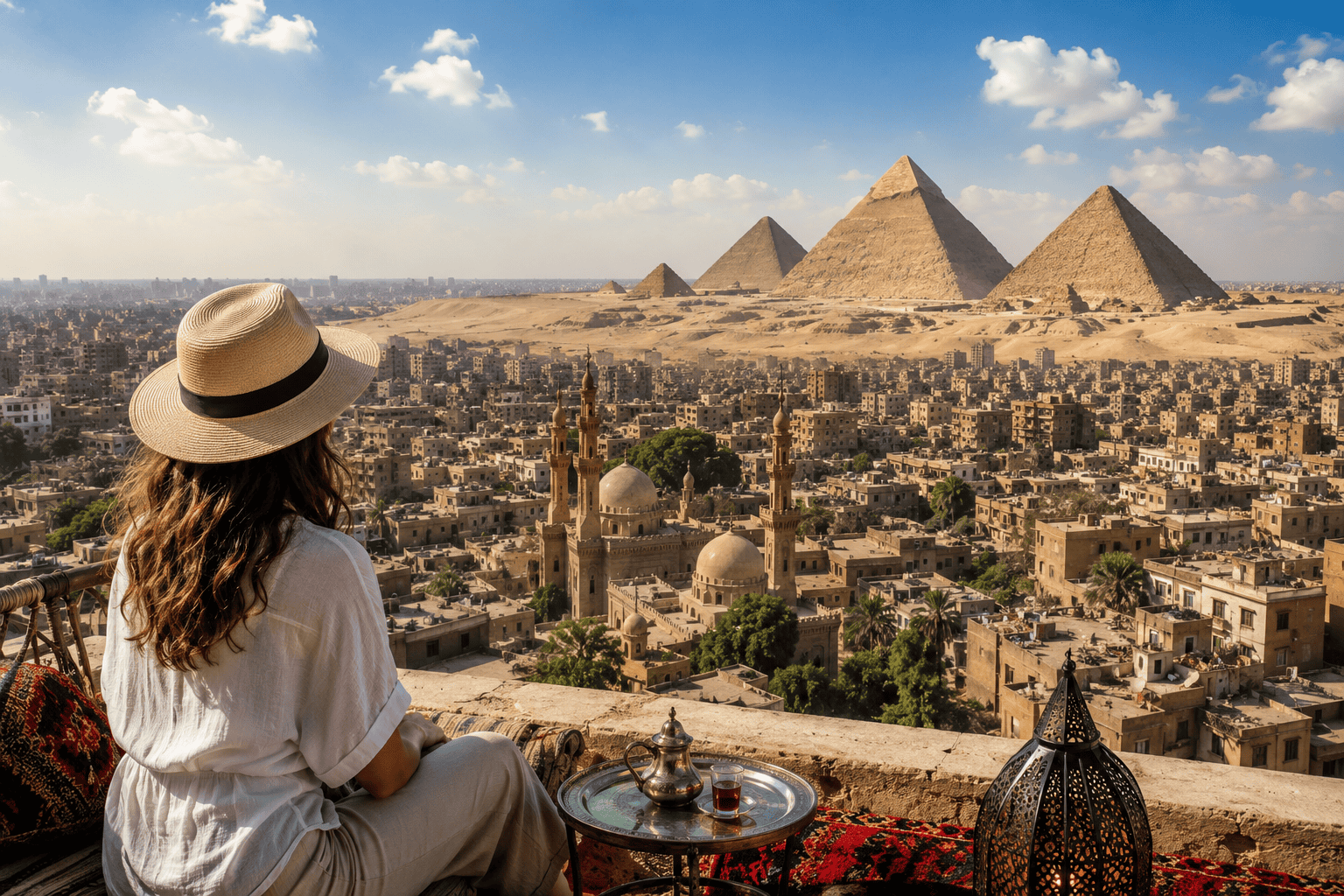
Egypt and Cairo make an unforgettable first trip, combining pyramid views, world-class museums, Nile scenery, desert light, and ancient history. Cairo is the busy, layered gateway, while the wider country rewards travelers who plan their route carefully instead of trying to see everything in one rushed week.
For Europe-based travelers, Egypt is one of the most accessible long-haul-feeling trips without a punishing flight. Direct connections from major European cities can put you in Cairo in around four to five hours, and the cost of food, taxis, local transport, and many hotels can be significantly lower than in Western Europe. The tradeoff is that Egypt requires more energy on the ground. Cairo is intense, traffic-heavy, dusty, and full of small negotiations. It can be extraordinary — but it is rarely effortless.
Quick Takeaways
Start here: Egypt and Cairo make an unforgettable first trip, combining pyramid views, world-class museums, Nile scenery, desert light, and ancient history.
Planning note: For Europe-based travelers, Egypt is one of the most accessible long-haul-feeling trips without a punishing flight.
This guide covers how to plan Egypt and Cairo well: where to stay, what to see first, how many days to spend, what to budget, which mistakes to avoid, and when paying more for comfort is worth it.
Why Egypt and Cairo Work Well as a Trip from Europe
Egypt is especially appealing from Europe because it offers a dramatic change of scenery without the time-zone shock of Southeast Asia or the Americas. Cairo gives you Islamic architecture, Coptic churches, Nile-side hotels, the Egyptian Museum, the Grand Egyptian Museum near Giza, and the Pyramids of Giza — all within one metropolitan area.
For travelers from London, Paris, Rome, Madrid, Berlin, Amsterdam, Athens, and Istanbul, Cairo can work as either a standalone city break or the start of a longer Egypt itinerary. The key is deciding which version of the trip suits you.
A short Egypt and Cairo trip works best if you want:
- The Pyramids of Giza and the Sphinx
- One or two major museums
- Islamic Cairo and Khan el-Khalili market
- A Nile dinner or sunset viewpoint
- A warm-weather cultural break from Europe
A longer Egypt itinerary is better if you also want:
- Luxor’s temples and Valley of the Kings
- Aswan and Abu Simbel
- A Nile cruise
- Red Sea beach time in Hurghada or Sharm el-Sheikh
- Desert experiences outside the capital
The most common mistake is treating Cairo as a quick transfer stop. It is chaotic, but it is also where many travelers first understand modern Egypt: the call to prayer over traffic, families walking along the Nile at night, coffeehouses, street food, mosques, churches, markets, and layers of history that do not fit neatly into one museum visit.
How Many Days Do You Need for Egypt and Cairo?
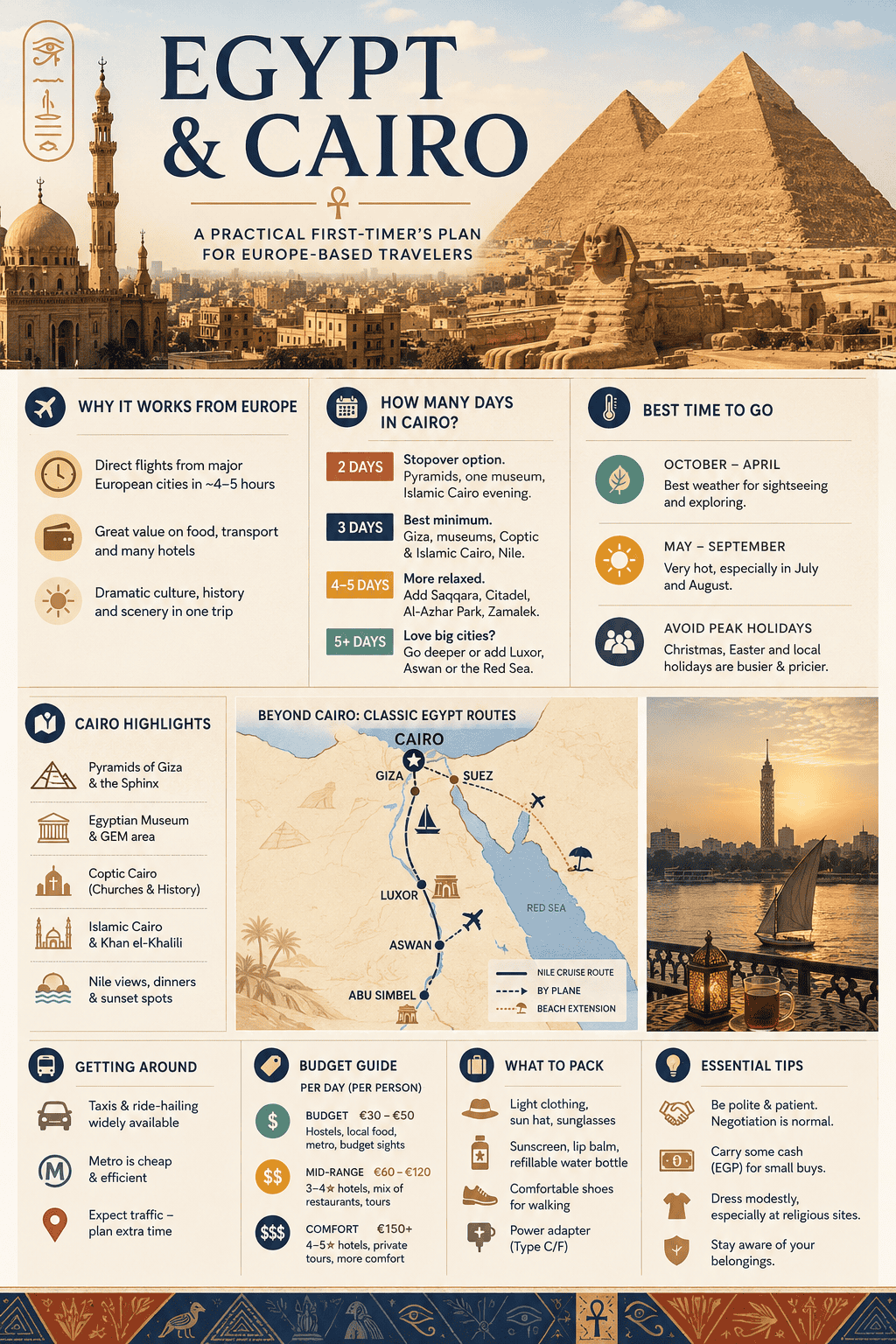
For most first-time visitors, three full days in Cairo is the practical minimum. Two days is possible, but it feels rushed and leaves little room for traffic, heat, museum fatigue, or the inevitable delays that come with moving around a megacity.
- 2 days in Cairo: Best as a stopover before Luxor, Aswan, or the Red Sea. Prioritize the Pyramids of Giza, the Sphinx, one museum, and one evening in Islamic Cairo.
- 3 days in Cairo: The best minimum for first-timers. Visit Giza properly, spend a solid day on museums and Coptic Cairo, and dedicate time to Islamic Cairo, Khan el-Khalili, and a Nile-side evening.
- 4 to 5 days in Cairo: Better for slower travelers, families, photographers, and anyone who wants to include Saqqara, Dahshur, the Citadel, Al-Azhar Park, Zamalek, and more relaxed meals.
- More than 5 days in Cairo: Worth it if you enjoy large cities, local neighborhoods, architecture, and slower travel. Otherwise, use the extra days for Luxor, Aswan, or the Red Sea.
Best Time to Visit Egypt and Cairo
The best time to visit Egypt and Cairo is generally October to April. Temperatures are more manageable, sightseeing is less punishing, and long outdoor visits to the Pyramids of Giza or Saqqara feel more enjoyable.
November to February is the most comfortable window for many visitors. Days are warm rather than hot, evenings can be cool, and walking around Cairo is more pleasant. The tradeoff is that this is also peak season, so flights and well-located hotels cost more.
March, April, October, and early November are strong shoulder-season choices. You may find better prices than the winter peak, though you should still prepare for strong sun and occasional dusty conditions.
May to September offers budget pricing but difficult sightseeing conditions. Cairo, Giza, Luxor, and Aswan can all become seriously tiring in summer heat. If you travel in these months, start early each day, book hotels with reliable air conditioning, and avoid overloading your schedule.
Where to Stay in Cairo
Choosing where to stay in Cairo matters more than most first-timers expect. Traffic can turn a short-looking journey on the map into a slow crossing of the city. The best area depends on your priorities.
Zamalek — Best Overall for First-Time Visitors
Zamalek sits on Gezira Island in the Nile and is one of the most practical bases for first-time travelers. It has cafes, restaurants, embassies, leafy streets, and a calmer atmosphere than much of central Cairo. It is not silent or polished in a European sense, but it offers a comfortable landing.
Stay in Zamalek if you want a practical balance of restaurants, river views, and access to Downtown Cairo without being thrown straight into the city’s most intense energy. The tradeoff: it is not close to the pyramids, so your Giza day will still involve a meaningful drive.
Downtown Cairo — Best for Museums and Urban Energy
Downtown Cairo puts you near Tahrir Square, the Egyptian Museum, older landmark hotels, and early 20th-century architecture. It can be atmospheric, walkable in parts, and exciting for travelers who want to feel the city immediately.
Stay Downtown if you want central access and do not mind noise, traffic, and uneven pavements. Quality varies significantly between hotels, so choose carefully and read recent reviews.
Giza — Best for Pyramid Views
Staying in Giza is memorable if your hotel has a clear pyramid view. Waking up near the Pyramids of Giza is genuinely special, and it makes an early start far easier on your main pyramid day.
Stay in Giza if the pyramids are your primary reason for visiting or if you have only one night in Cairo. The tradeoff: Giza can feel more tourist-pressure-heavy, and it is less convenient for Islamic Cairo, Downtown, Zamalek, and Coptic Cairo.
New Cairo — Best for Business, Not Sightseeing
New Cairo has modern hotels, malls, and a calmer planned-city feel. It works for business travelers attending events, but it is not a practical base for sightseeing. You will spend more time in cars getting anywhere historic.
A Practical 3-Day Cairo Itinerary
This itinerary is designed for first-time travelers who want the major sights without exhausting themselves by day two.
Day 1 — Pyramids of Giza, Sphinx, and Saqqara
Start the Giza Plateau as early as possible — not just to beat the crowds, but to avoid heat, haze, and fatigue. The site is large and exposed, and it is more physically demanding than many travelers expect.
See the Great Pyramid of Khufu, the Pyramid of Khafre, the Pyramid of Menkaure, the Sphinx, and at least one panoramic viewpoint. Decide in advance whether you want to go inside a pyramid. Many travelers find the interior cramped, hot, and less visually rewarding than expected. It is worth doing if the experience itself matters to you, but it is not essential for everyone.
If your budget allows, hire a reputable local guide or driver for the day. This is one of the places where paying more measurably reduces stress. A good guide helps with pacing, ticketing, viewpoints, and managing the persistent camel and carriage pressure around the site.
In the afternoon, continue to Saqqara. Home to the Step Pyramid of Djoser, it feels noticeably quieter than Giza and helps you understand pyramid history in a fuller context. If you are especially interested in ancient Egypt, Dahshur — with its Bent Pyramid and Red Pyramid — is worth adding. For most travelers, Giza plus Saqqara is a full and satisfying day.
Evening: keep dinner simple. Choose a restaurant near your hotel rather than planning a complicated cross-city journey after a tiring day.
Day 2 — Egyptian Museums, Coptic Cairo, and the Nile
Dedicate day two to Cairo’s museum and religious-history side. Depending on current openings, your interests, and ticket availability, choose between the Egyptian Museum at Tahrir Square, the Grand Egyptian Museum near Giza, or the National Museum of Egyptian Civilization. Do not attempt to complete a major Egyptian museum in a single visit. Choose a focus — pharaohs, daily life, royal mummies, statuary, or the Tutankhamun collection — and allow yourself to absorb it rather than sprint through it.
After the museum, visit Coptic Cairo. The Hanging Church, Saints Sergius and Bacchus Church, the Ben Ezra Synagogue area, and the surrounding lanes offer a quieter, layered contrast to the city’s traffic. This is one of Cairo’s most rewarding and manageable areas, especially for travelers interested in the city beyond the pyramids.
In the evening, walk along the Nile Corniche, have dinner in Zamalek, or book a simple Nile dinner cruise if you prefer an organized, low-effort night after two busy days. Cruises can feel touristy, but some travelers genuinely enjoy them as easy wind-down evenings.
Day 3 — Islamic Cairo, Khan el-Khalili, Citadel, and Al-Azhar Park
Spend your third day in Islamic Cairo, where the city feels most layered and atmospheric: minarets, old gates, markets, mosques, narrow lanes, craft workshops, and centuries of architecture pressed into daily life.
Start at the Citadel of Saladin and the Mosque of Muhammad Ali for sweeping city views and an accessible architectural introduction. Move toward Sultan Hassan Mosque and Al-Rifa’i Mosque if you enjoy historic religious architecture. Then explore the Khan el-Khalili market, Al-Muizz Street, and the historic gates of Cairo at a slower pace — browse, drink tea, look up at the buildings, and expect gentle bargaining rather than aggressive shopping.
If timing allows, end your day at Al-Azhar Park for sunset. It offers one of Cairo’s best moments of calm, with views back toward the historic city.
What to Add If You Have More Time
If you have four or five days in Cairo, add one or two of the following rather than cramming everything into your first three days.
Saqqara and Dahshur Properly
Many travelers rush Saqqara as a quick add-on after Giza. It deserves more time. The Step Pyramid of Djoser, surrounding tombs, causeways, and desert setting tell a fuller story of pyramid history than the famous Giza skyline alone. Dahshur is quieter still, and often more atmospheric for those who appreciate ancient sites without crowds.
A Food Tour or Local Eating Walk
Cairo rewards slow eating. Try koshari, ful medames, taameya, grilled kofta, molokhia, fresh juices, and Egyptian desserts such as konafa and basbousa. A well-organized food tour can be worth doing early in your trip because it builds confidence to order independently later.
A Zamalek and Downtown Slow Day
Not every Cairo day needs to be ancient history. Spend time in Zamalek cafes, bookshops, galleries, and riverside restaurants. Explore Downtown’s old cinemas, fading belle époque architecture, and traditional coffeehouses with realistic expectations about traffic and street conditions.
A Day Trip to Alexandria
Alexandria is possible as a long day trip from Cairo, but it works better as an overnight stay if pacing matters to you. The Mediterranean atmosphere, Qaitbay Citadel, Bibliotheca Alexandrina, seafood restaurants, and the Corniche offer a very different side of Egypt. Allow for meaningful travel time each way.
Cairo Budget: What It Really Costs
Egypt can be significantly more affordable than many European destinations, but Cairo covers a wide price range. Comfort upgrades often make the trip much smoother and are usually worth budgeting for on a first visit.
Budget Traveler
A budget traveler staying in simple accommodation, using ride-hailing selectively, eating local food, and limiting paid guided experiences might spend around €40–€70 per day, excluding international flights and intercity travel. This approach works best for experienced independent travelers who are comfortable with noise, bargaining, and flexible plans.
Mid-Range Traveler
A mid-range traveler staying in a comfortable hotel, using ride-hailing or private transfers, booking one or two guided visits, and eating in a mix of local and nicer restaurants might spend around €90–€170 per day. This is the best-value zone for most first-time visitors. You avoid the hardest friction points without turning the whole trip into a luxury package.
Comfort or Luxury Traveler
A comfort-focused traveler staying in high-end hotels, hiring private guides and drivers daily, booking premium pyramid or museum experiences, and choosing polished restaurants can spend €200–€400+ per day. This level can be worth it for families, older travelers, short trips, or anyone who wants maximum history with minimum daily logistics.
Getting Around Cairo
Cairo is not a city where most first-time visitors simply walk everywhere. Distances are large, traffic is heavy, and pavements are inconsistent across much of the city.
- Ride-hailing apps: Often the easiest way to move around Cairo. They reduce fare negotiations, give you a clear cost estimate before you get in, and let you track your route. Build in extra time before any fixed commitment — museum openings, train departures, or dinner bookings across town.
- Cairo Metro: Inexpensive and useful for certain routes, particularly if your hotel is near a station. It does not cover every tourist route, so most visitors combine it with ride-hailing or taxis.
- Private driver: Worth considering for Giza, Saqqara, Dahshur, airport transfers, and full sightseeing days. Costs more than ride-hailing, but can save significant time and reduce decision fatigue.
- Walking: Works well within specific areas — parts of Zamalek, sections of Downtown, Coptic Cairo, Al-Muizz Street, Khan el-Khalili, and museum grounds. Do not plan Cairo like Rome or Lisbon. The city is walkable in pockets, not as one continuous sightseeing grid.
What to Eat in Cairo
Egyptian food is one of the most underrated parts of a Cairo trip. Start with simple classics and work outward from there.
Koshari is a filling mix of rice, lentils, pasta, chickpeas, tomato sauce, garlic vinegar, and crispy onions. It is inexpensive, fast, and ideal for lunch. Ful medames — slow-cooked fava beans served with bread, eggs, vegetables, and pickles — is the classic Egyptian breakfast. Taameya, Egypt’s fava-bean version of falafel, is a must alongside it.
Traditional restaurant menus typically feature grilled meats, kofta, hawawshi, molokhia, stuffed pigeon, fresh baladi bread, and rice dishes. For dessert, look for basbousa, konafa, om ali, and rice pudding.
The practical note: eat at busy, fresh, and locally popular spots, but be cautious with raw salads, ice, and street food hygiene if you have a sensitive stomach. Carry rehydration salts and basic stomach medication, especially if you are continuing to Luxor or Aswan after Cairo.
What to Wear in Cairo
Cairo is a large, modern city, but Egypt is socially conservative compared with much of Europe. Formal dress is not required, but modest clothing is both practical and respectful.
For women, loose trousers, long skirts, linen shirts, and dresses that cover shoulders and knees work well across most contexts. A lightweight scarf is useful for mosque visits and sun protection. For men, lightweight trousers and T-shirts are generally fine, though trousers are better for mosques and smarter restaurants. Longer shorts are usually acceptable in casual settings.
Focus your Egypt packing on breathable fabrics, comfortable shoes for uneven surfaces, quality sunscreen, and dust-resistant clothing rather than planning your wardrobe around photographs. Practical comfort matters far more on the ground than style.
Common Mistakes to Avoid in Egypt and Cairo
- Booking too little time in Cairo. Many travelers attempt Cairo in a single day. That usually means a rushed pyramid visit, one museum sprint, hours in traffic, and no real feel for the city. Give Cairo at least three days.
- Underestimating traffic. A 10-kilometre journey can easily take far longer than expected. Group sights by area: Giza sights together, Islamic Cairo sights together, Downtown and Coptic Cairo together.
- Saying yes too quickly at tourist sites. At major attractions, people may offer camel rides, unsolicited photos, guiding, or souvenirs. Some offers are legitimate, others are overpriced, and some become uncomfortable. Decide what you want before you arrive, agree prices clearly in advance, and feel comfortable saying no.
- Skipping smaller ancient sites. The Pyramids of Giza are essential, but Saqqara and Dahshur can be more peaceful and, for some travelers, more rewarding. Do not stop at the most famous site alone.
- Trying to travel too cheaply. Egypt can be inexpensive, but the cheapest option is not always the best value. A good guide, a reliable driver, a better-located hotel, or a direct flight can meaningfully transform your trip.
- Ignoring heat and sun. Even outside summer, Cairo and Giza can feel punishing in exposed areas. Start early each day, carry water, wear sunscreen, and avoid stacking multiple outdoor sights in the afternoon heat.
Should You Visit Egypt and Cairo Independently or With a Tour?
Independent travel in Cairo is entirely possible, especially for confident travelers. You can book your own hotel, use ride-hailing apps, buy tickets at sights, and hire guides only where they add genuine value.
A private guide is most useful at the Pyramids of Giza and Saqqara, in Islamic Cairo, for museum visits where context makes the difference, and on short trips where wasted time is costly. A group tour can work well if you prefer social travel and built-in convenience — but check the itinerary carefully. Some tours spend excessive time at carpet shops, perfume demonstrations, papyrus galleries, or commission-based restaurants.
The best compromise for many first-timers is independent accommodation combined with private guided days for the most complex or time-sensitive sights.
A Good First Egypt Itinerary from Europe
Use Cairo as your anchor and add one other region, depending on how much time you have.
5 Days: Cairo Only
Best for a focused cultural city break.
- Day 1: Arrive, settle into Zamalek or Downtown, easy evening
- Day 2: Pyramids of Giza and Saqqara
- Day 3: Museum and Coptic Cairo
- Day 4: Islamic Cairo, Citadel, Khan el-Khalili
- Day 5: Slow morning, food, shopping, depart
7 Days: Cairo and Luxor
Best for ancient Egypt without rushing too much.
- Day 1: Arrive Cairo
- Day 2: Pyramids of Giza and Saqqara
- Day 3: Museum, Coptic Cairo, Islamic Cairo evening
- Day 4: Fly to Luxor, East Bank temples
- Day 5: West Bank — Valley of the Kings, tombs and temples
- Day 6: Extra Luxor time or return to Cairo
- Day 7: Depart
10 Days: Cairo, Luxor, Aswan, and Abu Simbel
Best for a classic Egypt route.
- Days 1–3: Cairo
- Days 4–5: Luxor
- Day 6: Transfer toward Aswan
- Days 7–8: Aswan and Philae Temple
- Day 9: Abu Simbel day trip
- Day 10: Return and depart
10 to 12 Days: Cairo, Nile, and Red Sea
Best for travelers who want history plus genuine rest. Start with Cairo, continue to Luxor and Aswan, then finish with time in Hurghada, El Gouna, or Sharm el-Sheikh. Ending at the Red Sea rather than Cairo is the smarter order — it gives you recovery time after heavy sightseeing before your return flight.
Practical Entry Advice
Check visa requirements before booking, as rules depend on your nationality. Many travelers use Egypt’s official e-Visa system or visa-on-arrival options, but policies and fees can change. Apply in advance if you prefer to avoid arrival uncertainty, and ensure your passport has sufficient validity for the duration of your trip.
Keep both printed and digital copies of your hotel booking, return flight, travel insurance, and any visa approval documents. Travel insurance is strongly recommended for Egypt — choose a policy that covers medical care, trip disruption, missed connections, and any planned activities such as Red Sea diving or desert excursions. More information on Egypt’s official e-Visa is available via the Egyptian e-Visa portal.
Safety and Comfort in Cairo
Most travelers visit Cairo without serious problems, but the city can feel overwhelming, particularly on arrival. The most common issues are tourist-site pressure, heavy traffic, heat, and general urban intensity rather than serious danger.
Standard city precautions apply: keep valuables secure, avoid displaying cash, use reputable transport options, confirm prices before agreeing, and be more cautious late at night in unfamiliar areas. Solo travelers should be selective about hotel location and transport choices. Women traveling alone may receive more attention than they are accustomed to in parts of Europe; dressing modestly, using ride-hailing apps, choosing well-reviewed hotels, and booking guides for complex sightseeing days can all make the experience more comfortable.
The UK Foreign Office and equivalent government travel advice pages for your country are worth checking before departure for the most current safety guidance.
Is Egypt and Cairo Worth It?
Egypt and Cairo are absolutely worth it for travelers who want history, scale, atmosphere, and a destination that feels genuinely different from anywhere in Europe. But this is not a frictionless city break. Cairo asks for patience. You will deal with traffic, noise, dust, crowds, and moments of negotiation. In return, you get the pyramids at dawn, museum halls filled with ancient objects, mosques and markets that still feel fully alive, Nile evenings, and a city that cannot be reduced to a postcard.
The smartest approach is to choose a clear route, spend enough time in the capital, pay for comfort where it matters most, and leave space between major sights. Cairo is best when you stop trying to control every minute and give yourself enough room to absorb it.
FAQ: Egypt and Cairo Travel
Is Cairo good for a first trip to Egypt?
Yes. Cairo is the main international gateway and gives you access to the Pyramids of Giza, major museums, Islamic Cairo, Coptic Cairo, and the Nile. It is intense, so first-timers should plan carefully and avoid overloading each day.
How many days should I spend in Cairo?
Three full days is the recommended minimum for most first-time visitors. Two days is possible but feels rushed. Four or five days is better if you want to include Saqqara, Dahshur, Islamic Cairo, Coptic Cairo, multiple museums, and time to eat well without rushing.
Can you visit the Pyramids of Giza from Cairo?
Yes. The Pyramids of Giza are part of the Greater Cairo area. Travel time depends on traffic and where you are staying. From Zamalek or Downtown, the drive can take 30–60 minutes depending on conditions. Staying in Giza puts you closer to the plateau but farther from other major sights.
Is Cairo expensive for European travelers?
Cairo is generally cheaper than most European capitals, particularly for food, local transport, and mid-range hotels. However, guided tours, private drivers, international-standard hotels, and major sightseeing days can raise the daily cost. Most first-timers benefit from budgeting for some comfort upgrades.
Is Cairo safe for tourists?
Most tourists visit Cairo without serious safety issues. The most common challenges are tourist-site pressure, traffic, heat, and general city intensity. Use reputable transport, choose a well-reviewed hotel in a practical location, agree prices before committing to anything, and book guides for complex sightseeing days where they reduce stress.
What is the best area to stay in Cairo?
Zamalek is widely considered the best base for first-time visitors due to its calmer atmosphere, restaurant access, and Nile proximity. Downtown suits travelers who want central urban energy and museum access. Giza is best if pyramid views are your top priority and you have limited time.
Should I visit Luxor as well as Cairo?
If you have at least seven days, Cairo plus Luxor is one of the strongest first Egypt itineraries. Cairo gives you the pyramids and museums; Luxor adds temples, tombs, and a deeper ancient Egypt experience. Short domestic flights between Cairo and Luxor are widely available.
Do I need a guide in Cairo?
You do not need a guide for everything, but a good guide adds genuine value at the Pyramids of Giza, Saqqara, Dahshur, Islamic Cairo, and major museums. A guide can save time, explain context, and reduce stress at the busiest tourist sites.
What should I not miss in Cairo?
The Pyramids of Giza, the Sphinx, at least one major Egyptian museum, Islamic Cairo, Khan el-Khalili market, Coptic Cairo, and a Nile-side evening are the core Cairo highlights. If you have extra time, Saqqara and Dahshur are well worth adding.
Is Egypt a good winter sun destination from Europe?
Yes. Egypt is one of the strongest winter sun options within easy reach of Europe, particularly if you combine Cairo with Luxor, Aswan, or the Red Sea coast. For outdoor sightseeing, November to February is far more comfortable than the summer months.
For official tourism information, see Visit Egypt and the Grand Egyptian Museum website for current admission details.
By Mara Vale for Eurly
Last verified: June 2025

Mara Vale
Mara Vale writes Eurly travel guides for first-time Europe visitors who want practical routes, realistic pacing, and fewer avoidable planning mistakes.
Eurly guides are written to help readers make confident travel decisions, but opening hours, ticket rules, transit disruptions, and local conditions can change. Always verify key reservations and official schedules before you travel.