

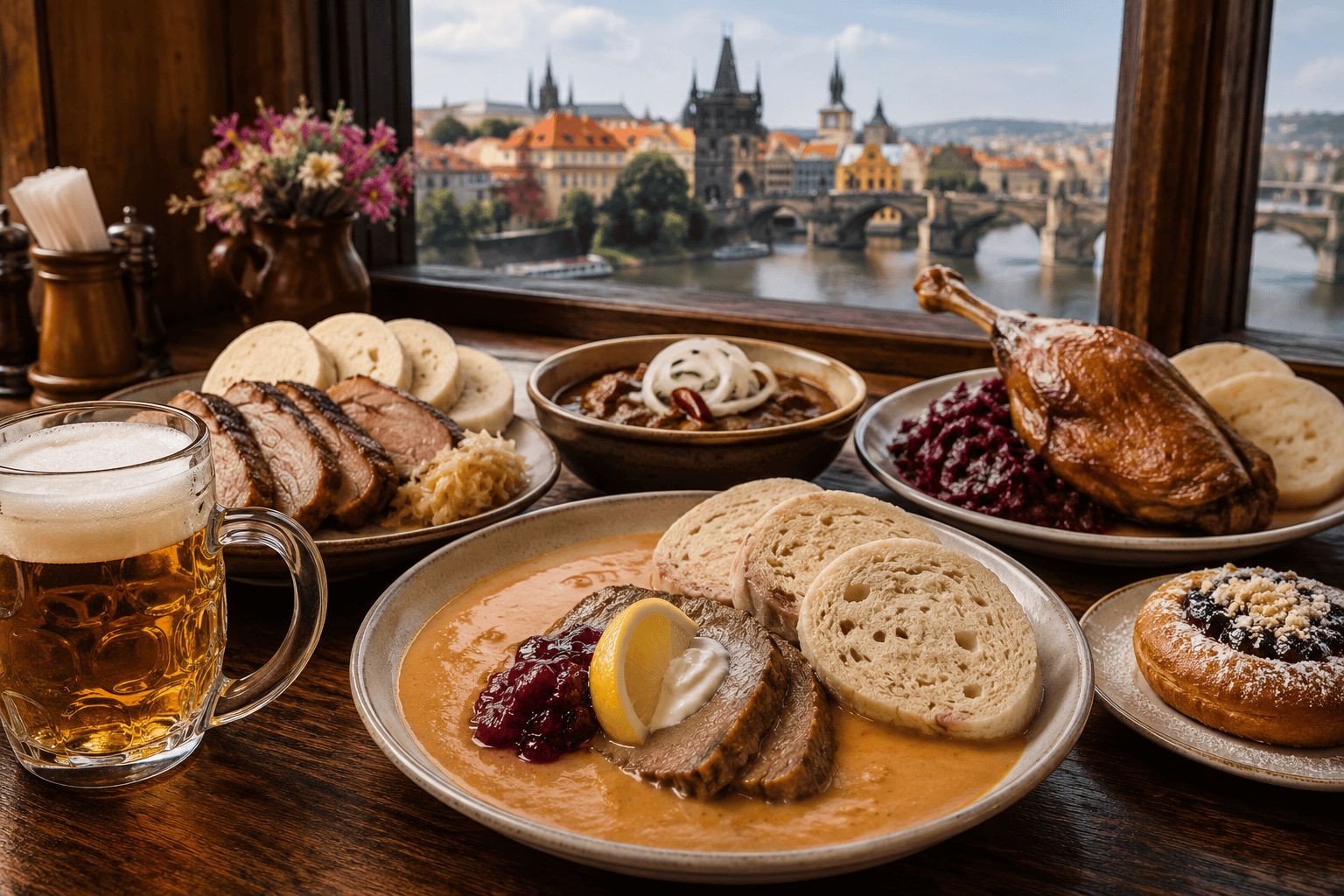
If you're wondering what to eat in Prague, start with the city's hearty Czech comfort food: svíčková (marinated beef with creamy sauce), vepřo knedlo zelo (roast pork, dumplings, sauerkraut), Czech goulash, roast duck, and fried cheese. Meals are generous, deeply flavored, and made to pair with world-class Czech lager. Budget around €20–32 per day for a comfortable mid-budget food experience—significantly less than most Western European capitals.
Many visitors arrive in Prague knowing little beyond Czech beer and trdelník. The reality is far more interesting. Czech cuisine is hearty, affordable by European standards, and rooted in centuries of Bohemian, Austro-Hungarian, and Central European cooking. Rich sauces, slow-cooked meats, soft dumplings, and warming soups define the culinary character of the city — and the best examples cost a fraction of what you’d pay in Vienna or Munich.
Quick Takeaways
Start here: If you're wondering what to eat in Prague, start with the city's hearty Czech comfort food: svíčková (marinated beef with creamy sauce), vepřo knedlo zelo (roast pork, dumplings,...
Planning note: Many visitors arrive in Prague knowing little beyond Czech beer and trdelník.
This guide covers the signature dishes to try, what to order, realistic price expectations, and a few local dining habits worth knowing before you sit down.
What To Eat In Prague: What Food Is Prague Known For?
Prague’s culinary identity is built around comfort, richness, and generous portions. The city draws from Bohemian traditions alongside influences from Austria-Hungary, Germany, and neighboring Central European cuisines. The result is a menu of slow-cooked meats, thick gravies, soft dumplings, and warming soups designed to pair naturally with Czech lager.
The dishes Prague is most known for include:
- Svíčková — marinated beef sirloin with creamy root vegetable sauce
- Vepřo knedlo zelo — roast pork with dumplings and sauerkraut
- Czech goulash — a thicker, stew-like take on the Central European classic
- Pečená kachna — roast duck with red cabbage and dumplings
- Smažený sýr — breaded fried cheese with tartar sauce
- Kulajda — a creamy mushroom and dill soup
- Knedlíky — bread, potato, or fruit dumplings
- Chlebíčky — open-faced sandwiches from bakeries and delicatessens
- Koláče — traditional filled pastries
- Czech lager — inseparable from the food culture
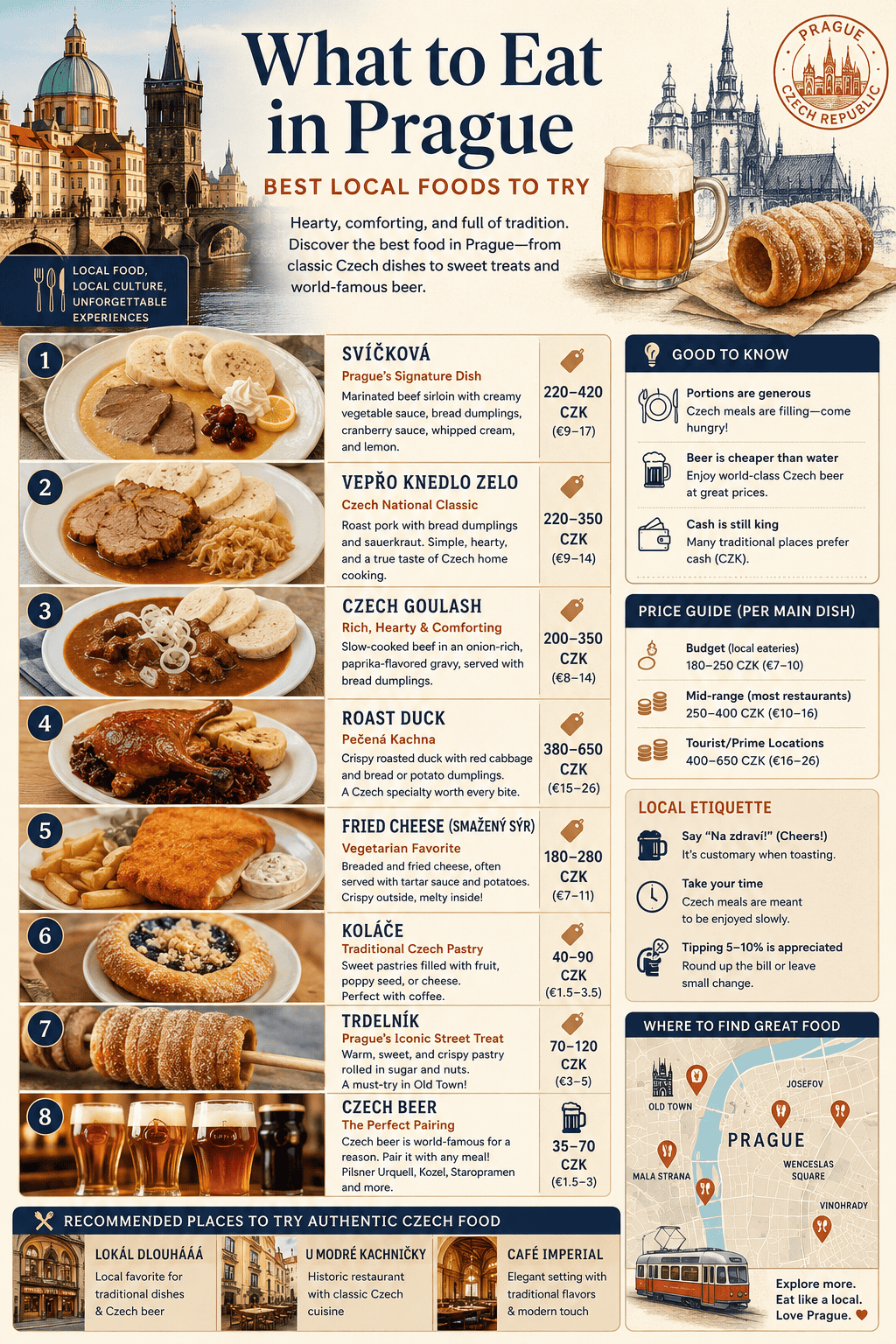
The 10 Best Local Foods to Try in Prague
1. Svíčková — Prague’s Signature Dish
If you try one piece of traditional food in Prague, make it svíčková. This is the dish locals are proudest of, and for good reason. Marinated beef sirloin is slow-cooked and served with a creamy sauce made from roasted root vegetables — carrots, celery, and parsley root — then finished with bread dumplings, cranberry sauce, a spoon of whipped cream, and a slice of lemon.
The combination sounds unusual. In practice, the balance of savory beef, lightly sweet sauce, tart cranberries, and soft dumplings is genuinely addictive. Many first-time visitors call it the most memorable meal of their trip.
| Setting | Typical price |
|---|---|
| Local restaurants | 220–320 CZK (€9–13) |
| Tourist-area restaurants | 280–420 CZK (€11–17) |
Where to try it: Lokál Dlouhááá, U Modré Kachničky, Café Imperial.
2. Vepřo Knedlo Zelo — The National Dish
The name literally translates as pork, dumpling, cabbage — and that is exactly what arrives at the table. Slow-roasted pork, bread dumplings, and braised sauerkraut. Simple, filling, and a staple of Czech home cooking for generations.
It appears on nearly every traditional restaurant menu and provides one of the most authentic introductions to Czech cuisine available. Order this at lunch after a morning of sightseeing — it will carry you comfortably through the afternoon.
Typical price: 220–350 CZK (€9–14).
3. Czech Goulash
Although Hungary made goulash famous across Central Europe, the Czech version developed into its own distinct dish. Where Hungarian goulash tends toward a thinner, soup-like consistency, Czech goulash is thick and stew-like, served with bread dumplings rather than potatoes.
Expect slow-cooked beef in a deep paprika and onion-rich gravy, with dumplings that soak up every drop of sauce. Order a Czech lager alongside it — this is one of the most natural food-and-beer pairings in Prague.
Typical price: 200–350 CZK (€8–14).
4. Roast Duck — Pečená Kachna
Roast duck is one of the most celebrated dishes in Czech cooking. A well-prepared pečená kachna arrives with crispy skin, tender meat, braised red cabbage, and either bread or potato dumplings. The richness of the duck pairs naturally with the slightly sweet cabbage.
Note that many traditional restaurants only serve duck on certain days of the week — it’s worth checking the menu before committing to a specific venue.
Typical price: 350–600 CZK (€14–24).
Where to find it: U Kroka, Mincovna, U Pinkasů.
5. Smažený Sýr — Fried Cheese
For a quick, affordable, and deeply satisfying meal, try smažený sýr. A thick slab of cheese — usually Edam or a semi-soft variety — is coated in breadcrumbs and deep-fried until golden. It comes with fries, tartar sauce, and sometimes a small salad.
It is also one of the easiest local dishes for non-meat eaters. Don’t dismiss it as a tourist snack — locals genuinely eat and enjoy it, and it appears on menus across the city at every price level.
Typical price: 160–260 CZK (€6–10).
6. Kulajda Soup
Many visitors focus on main dishes and miss one of the finest Czech starters. Kulajda is a creamy soup built around mushrooms, potatoes, dill, and cream, finished with a poached egg in the center. The flavor is rich but surprisingly balanced — earthy and warming without being heavy.
It’s an especially good choice in autumn and winter, when mushroom season makes the best versions particularly impressive.
Typical price: 80–150 CZK (€3–6).
7. Czech Dumplings — Knedlíky
Dumplings appear alongside almost every major dish in Czech cuisine, so understanding the varieties helps when reading menus.
- Bread dumplings — the standard accompaniment to gravies and sauces; soft and ideal for soaking up liquid
- Potato dumplings — denser, often served with duck or roast pork
- Fruit dumplings — sweet versions filled with plum, apricot, or strawberry; served as a dessert course
If you’re exploring the best food in Prague systematically, trying each dumpling style across different meals is a genuine pleasure.
8. Chlebíčky — Open-Faced Sandwiches
For a lighter, faster meal, chlebíčky are one of the great understated pleasures of Prague eating. These open-faced sandwiches appear in bakeries, cafés, and delicatessens across the city. Common toppings include ham, egg, potato salad, cheese, and pickles — arranged neatly on a slice of baguette-style bread.
Typical price: 40–90 CZK (€1.50–4) per piece.
They are ideal for budget travelers, quick lunches between sightseeing, or picking up something to eat on the move. The quality varies significantly between venues — look for bakeries with visible local foot traffic rather than those positioned near major tourist landmarks.
9. Koláče — Traditional Czech Pastries
Koláče are traditional Czech pastries filled with poppy seeds, sweet cheese (tvaroh), plum jam, or fruit preserves. They’re a staple of Czech bakeries and an ideal breakfast or afternoon snack alongside coffee.
Typical price: 30–80 CZK (€1–3).
Where to buy: Local bakeries and farmers markets offer far better quality than anything sold near Old Town Square. The Nusle or Vinohrady neighborhoods have several good options.
A note on trdelník: The chimney cake sold on almost every tourist street in Prague is marketed as a traditional Czech specialty. It isn’t — at least not in its current form. Trdelník became a tourist-market product in Prague relatively recently and has no strong historic connection to Bohemian food culture. Koláče are a far more authentic pastry tradition.
10. Czech Beer
Technically not food, but no guide to what to eat in Prague can ignore Czech beer. The Czech Republic holds one of the highest per-capita beer consumption rates in the world, and Prague is one of the best cities anywhere to experience traditional lager culture. Czech Pilsner — light, clean, and carefully poured — is the default order.
Popular choices include Pilsner Urquell, Kozel, Budvar, and Staropramen. At local pubs, beer is often cheaper than soft drinks or mineral water, which surprises many first-time visitors.
| Setting | Typical price (500ml) |
|---|---|
| Local pubs | 55–80 CZK (€2–3) |
| Tourist-center restaurants | 80–120 CZK (€3–5) |
Where Should First-Time Visitors Eat in Prague?
The restaurants below have established reputations for reliable Czech food across a range of settings and price points. All are worth considering for a first visit.
| Restaurant | Best for | Notes |
|---|---|---|
| Lokál Dlouhááá | Beer, svíčková, local atmosphere | Best all-rounder — book ahead for dinner |
| Café Imperial | Historic setting, Czech classics, breakfast | Art Nouveau interior; popular with visitors and locals alike |
| U Modré Kachničky | Premium Czech cuisine, game meats | Special occasion — reservations essential |
| U Kroka | Roast duck, Czech home cooking | Strong local reputation; slightly off the tourist path |
| Mincovna | Traditional recipes, central location | Modern presentation; good for Old Town visits |
Book ahead for dinner at U Modré Kachničky and Lokál Dlouhááá. Both fill up quickly, especially on weekends. Walk-ins are possible at lunch but uncertain at dinner. Café Imperial also benefits from a reservation if you plan to visit for a weekend breakfast.
How Much Should You Budget for Food in Prague?
Prague remains meaningfully more affordable than most Western European capitals, though prices have risen over recent years. The figures below cover food only and use EUR equivalents at approximate current rates.
Budget traveler: Chlebíčky or soup at lunch + one sit-down meal per day = roughly €20–32/day
Mid-range traveler: Two sit-down meals with beer = roughly €40–72/day
Food-focused traveler: Full meals at quality restaurants + tastings = €80+/day
Weekday lunch specials (polední menu) are the single best-value option in Prague. Many traditional restaurants offer two or three courses including a drink for 180–280 CZK (€7–11). Always check whether a lunch menu is available — it often includes dishes not on the regular menu at a significantly lower price.
Local Dining Etiquette in Prague
A few customs are worth knowing before you sit down.
- Don’t rush the meal. Czech dining tends to be unhurried, particularly in traditional restaurants. Servers won’t hover or push you out, and that’s intentional.
- Ask for the bill. Servers rarely bring the check automatically. Catch their eye and ask — a simple “účet, prosím” (bill, please) works well.
- Tip around 10%. Tipping is standard for good service. Round up or leave 10% rather than adding it automatically through a card terminal — cash tips are more direct.
- Carry some cash. Cards are widely accepted in most Prague restaurants, but smaller pubs, markets, and older cafés sometimes prefer cash. Having 500–1,000 CZK on hand avoids problems.
Common Food Mistakes Tourists Make in Prague
Eating only around Old Town Square. Restaurants immediately adjacent to major landmarks charge premium prices and often serve lower-quality versions of Czech classics. Walk ten minutes toward Vinohrady, Žižkov, or Nusle and the quality-to-price ratio improves substantially.
Treating trdelník as a traditional Czech specialty. It’s heavily marketed but has no meaningful historic connection to Czech food culture. Skip it in favor of koláče from a proper bakery.
Skipping the weekday lunch menu. The polední menu (lunch special) is one of the best food deals in Central Europe. Many visitors don’t realize it exists and pay full dinner prices at lunchtime unnecessarily.
Ignoring daily specials. Roast duck, seasonal game dishes, and the best soups frequently appear only as daily specials, not on the standard menu. Ask what’s available before ordering from the printed card.
Underestimating portion sizes. Czech mains are large. If you’re ordering multiple courses, consider sharing a starter or skipping it entirely — the main dishes are filling enough that many visitors end up leaving food behind.
What Local Dishes Should I Try in Prague? — A Quick Priority List
If you’re only in Prague for a few days and want to cover the essentials, prioritize these five in order:
- Svíčková — the signature dish; try it at least once
- Vepřo knedlo zelo — the national dish; approachable and widely available
- Czech goulash — the easiest entry point for visitors unfamiliar with Czech food
- Roast duck — the most celebratory meal; plan ahead for availability
- Smažený sýr — the best quick, affordable, and genuinely local option
Together these five dishes represent the core of Prague’s culinary identity and between them cover the full range of the city’s traditional food in Prague — from slow celebration meals to fast-casual favorites.
Prague’s food scene earns far less attention than its architecture and beer culture, but it deserves considerably more. The city offers some of Central Europe’s most satisfying traditional cooking at prices that feel remarkable by Western European standards. Venture beyond the most touristy streets, use the lunch specials, and arrive hungry. The best meals in Prague are hearty, affordable, and deeply rooted in Czech history — exactly the kind of food that turns a city visit into a travel memory.
Frequently Asked Questions — Food in Prague
What is the most famous food in Prague?
Svíčková is widely considered Prague’s most iconic dish — marinated beef sirloin with creamy root vegetable sauce, bread dumplings, cranberry sauce, and whipped cream. It’s the dish locals are most proud of and the one most food-focused visitors remember longest. Vepřo knedlo zelo (roast pork, dumplings, sauerkraut) is a close second and often considered the national dish of the Czech Republic.
Is Prague a good city for vegetarian travelers?
Traditional Czech cuisine is heavily meat-focused, but Prague has improved considerably for vegetarians in recent years. Smažený sýr (fried cheese), kulajda soup, fruit dumplings, chlebíčky with vegetarian toppings, and koláče pastries all work well for non-meat eaters. The city’s growing number of modern restaurants and cafés also offer broader vegetarian and vegan menus, particularly in the Vinohrady and Žižkov neighborhoods.
Is food expensive in Prague compared to other European cities?
No — Prague remains one of the more affordable capital cities in Europe for food. A proper sit-down lunch at a traditional Czech restaurant typically costs €7–14, and weekday lunch specials can bring that down further. Beer is often cheaper than soft drinks. Prices near Old Town Square are higher and less representative; venturing slightly off the main tourist circuit brings costs down significantly.
What should I avoid eating in Prague as a tourist?
Avoid restaurants immediately surrounding Old Town Square and Wenceslas Square unless you have a specific recommendation — they frequently charge higher prices for lower-quality versions of Czech classics. Trdelník (chimney cake) is heavily marketed as a traditional Czech food but isn’t historically significant to Prague’s culinary culture. Also avoid dismissing daily specials or the lunch menu, which are often where the best and freshest dishes appear.
When is the best time to experience Czech food culture in Prague?
Autumn (September through November) is particularly good — seasonal mushrooms make kulajda and other soups especially compelling, roast duck is at its best, and many restaurants offer game dishes not available in summer. The city’s Christmas markets (late November through December) also feature seasonal Czech street food worth trying, including trdelník in its more traditional festival form, svařák (mulled wine), and roasted meats.
Official resources: The Czech Tourism Authority’s food guide covers regional Czech cuisine in more depth. For farmers markets and seasonal food events, Prague.eu (the official city tourism site) publishes current listings.

Mara Vale
Mara Vale writes Eurly travel guides for first-time Europe visitors who want practical routes, realistic pacing, and fewer avoidable planning mistakes.
Eurly guides help readers make confident travel decisions, but opening hours, ticket rules, transit disruptions, and local conditions can change. Always verify key reservations and official schedules before you travel.
By Mara Vale for Eurly
Last verified: June 2026
Mara Vale
Mara Vale writes Eurly travel guides for first-time Europe visitors who want practical routes, realistic pacing, and fewer avoidable planning mistakes.
Eurly guides are written to help readers make confident travel decisions, but opening hours, ticket rules, transit disruptions, and local conditions can change. Always verify key reservations and official schedules before you travel.