
Knowing when to go to Portugal depends on the trip you want, because the country offers beach escapes, city breaks, wine routes, surf seasons, and pilgrimages year-round. Spring and autumn often bring the best balance of pleasant weather, lighter crowds, and good value, while summer suits Algarve beach holidays and winter works well for culture, food, and big-wave surf.
For most first-time travelers, the honest answer to when to go to Portugal is May, June, September, or early October. These months offer the strongest balance of pleasant weather, open restaurants and attractions, lively towns, and fewer headaches than peak summer. But that does not mean the same month works for every traveler or every region.
Quick Takeaways
Start here: Knowing when to go to Portugal depends on the trip you want, because the country offers beach escapes, city breaks, wine routes, surf seasons, and pilgrimages year-round.
Planning note: For most first-time travelers, the honest answer to when to go to Portugal is May, June, September, or early October.
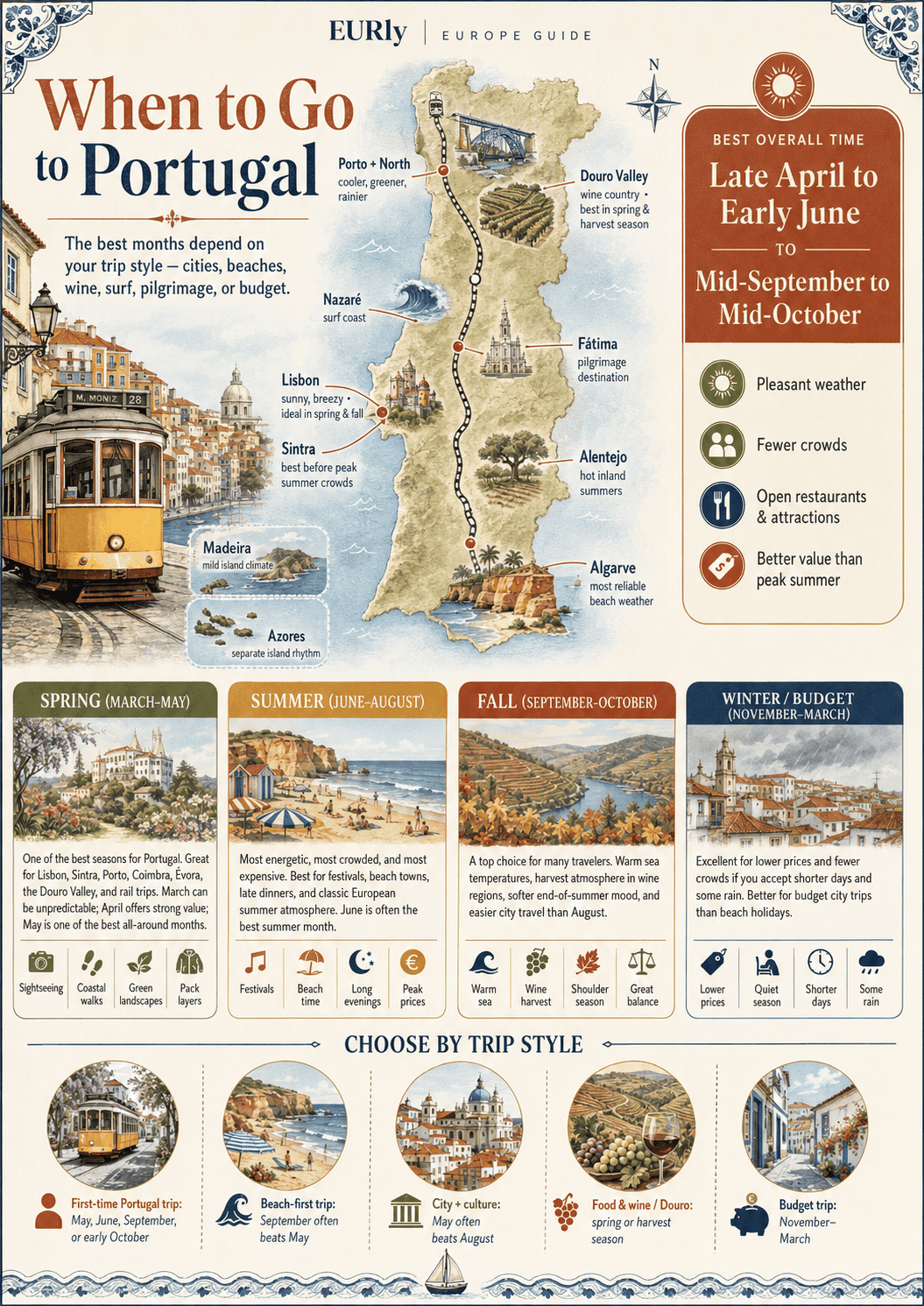
Portugal is compact but climatically varied. Porto and the north are greener, cooler, and rainier. Lisbon and the central coast are sunnier but often breezy. The Algarve has the most reliable beach weather. Inland areas such as the Alentejo and Douro can feel dramatically hotter in summer and quieter in winter. Madeira and the Azores follow their own rhythms entirely.
This guide breaks down the real traveler tradeoffs by season, region, budget, and travel style so you can choose the right dates rather than simply chasing good weather.
When To Go To Portugal: The Best Time to Visit Portugal Overall
The best overall time to visit Portugal is late April to early June or mid-September to mid-October.
These shoulder-season windows give you many of the advantages of summer without the full crowds, highest hotel prices, and most intense afternoon heat. Lisbon is easier to walk, Porto is still lively, the Douro Valley is scenic, and the Algarve is pleasant even if the Atlantic can still feel cool in spring.
-
May or early June: Green landscapes, long sightseeing days, outdoor dining, and the start of festival season.
-
September or early October: Warmer sea temperatures, harvest atmosphere in wine regions, and a softer end-of-summer mood.
For beach-first trips, September often beats May. For city-and-culture trips, May often beats August. For budget trips, November through March can be excellent if you accept shorter days and some rain.
Portugal by Season: What Each Time of Year Is Really Like
Spring: March to May
Spring is one of the best seasons for Portugal, especially if your trip includes Lisbon, Sintra, Porto, Coimbra, Évora, the Douro Valley, or a north-to-south rail itinerary.
March can still be unpredictable, especially in Porto and the north, but it brings fewer crowds and lower prices than later spring. April is often a strong value month, with more sunshine, blooming countryside, and a livelier feeling in restaurants and squares. May is one of the most reliable all-around months: warm enough for terraces and coastal walks, but not yet overwhelmed by summer tourism.
Spring is especially good for:
-
Lisbon sightseeing without severe heat
-
Sintra before the busiest summer day-trip crowds
-
Porto and the Douro Valley before peak season
-
Walking holidays in the Alentejo or along the coast
-
Travelers who want comfort more than beach perfection
The tradeoff is that spring weather is not guaranteed. You may get sunny afternoons in Lisbon or a damp, cool day in Porto. Pack layers and do not build an itinerary that depends entirely on beach time.
Summer: June to August
Summer is Portugal at its most energetic, expensive, and crowded. It is also the best season for travelers who want festivals, beach towns, late dinners, long evenings, and a classic European summer atmosphere.
June is the most attractive summer month for many visitors. Lisbon’s popular saints celebrations fill neighborhoods with music, grilled sardines, decorations, and street parties. Porto’s São João festivities on the night of June 23–24 are among the city’s great annual events. The weather is usually warm, but the intense July and August heat has not yet fully arrived.
July and August are peak season, especially in the Algarve, Nazaré, Comporta, Cascais, Ericeira, and other coastal destinations. Expect higher accommodation prices, busy beaches, and restaurants that require advance reservations. August is also a major vacation month for Portuguese and other European travelers, so the Algarve can feel packed while some small urban businesses may close for holidays.
Summer is best for:
-
Algarve beach holidays
-
Families tied to school breaks
-
Festivals and nightlife
-
Island trips to Madeira or the Azores
-
Beginner surf lessons in calmer summer conditions
-
Travelers who enjoy heat and long days
The mistake to avoid is treating August as the best month for every Portugal trip. It can be wonderful on the coast, but it is often uncomfortable for inland sightseeing. Évora, the Alentejo, and parts of the Douro can be very hot. Lisbon’s hills can feel punishing in the afternoon. If you visit in high summer, plan outdoor sightseeing for early morning, take a long lunch break, and save viewpoints, riverfront walks, or beach time for later in the day.
Fall: September to November
Fall may be Portugal’s most underrated season. September still feels like summer across much of the country, especially on the coast, but crowds begin to thin once school holidays end. The Algarve remains warm, sea temperatures are more inviting than in spring, and Lisbon is easier to enjoy on foot.
Late September and early October are particularly strong choices for first-time visitors who want a balanced trip covering Lisbon, Porto, the Douro Valley, and perhaps a few Algarve days. The Douro Valley has harvest energy, wine estates are active, and the light across the vineyards can be extraordinary.
By late October and November, rainfall becomes more likely, especially in the north. That does not ruin the season, but it changes the kind of trip you should plan. Think museums, food, wine bars, tiled churches, historic hotels, and fewer ambitious beach expectations.
Fall is best for:
-
Wine-focused trips in the Douro and Alentejo
-
Warm but not scorching city breaks
-
Algarve visits with fewer crowds
-
Photography and scenic drives
-
Travelers who want a calmer version of summer
The main tradeoff is increasing weather variability as you move into November. The later you travel, the more flexible your itinerary should be.
Winter: December to February
Winter in Portugal is mild compared with much of northern Europe, but it is not a guaranteed-sun escape everywhere. Lisbon and the Algarve can be genuinely pleasant, with sunny days mixed with rain. Porto and the north are cooler and wetter. Inland areas can feel chilly at night, especially in older stone buildings that lack modern heating.
Winter is excellent for budget-conscious travelers, repeat visitors, remote workers, and anyone more interested in food, wine, architecture, and local life than beach weather. Lisbon and Porto are atmospheric in winter, hotel prices are often lower outside Christmas and New Year, and major sights are easier to enjoy without queues.
The Algarve is quieter in winter. Some resort towns feel sleepy and a few seasonal restaurants or beach services may close, but places such as Lagos, Tavira, Faro, and Olhão still work well for a relaxed off-season stay. Madeira is a strong winter alternative if you want milder weather, gardens, hiking, and ocean views without depending on mainland beach conditions.
Winter is best for:
-
Lower hotel rates
-
Lisbon and Porto city breaks
-
Food, wine, museums, and architecture
-
Madeira escapes
-
Travelers who dislike crowds
-
Longer stays with a slower rhythm
The mistake to avoid is packing only for warm Portugal. Bring a rain jacket, sweaters, and shoes that can handle slick cobblestones.
For more on this part of the trip, also see our 3 Days in Porto: A Realistic Itinerary for First-Time Visitors.
Best Months to Visit Portugal by Travel Style
Best Time for a First Trip to Portugal
For a first trip, go in May, early June, September, or early October.
These months work well for a classic itinerary combining Lisbon, Sintra, Porto, the Douro Valley, and either the Algarve, Coimbra, Évora, or Nazaré. You will have enough warmth for outdoor meals and coastal views without the worst summer congestion.
A practical first-timer structure:
-
3 nights in Lisbon
-
1 night in Sintra or Cascais, or a day trip from Lisbon
-
2 nights in Porto
-
1–2 nights in the Douro Valley
-
2–3 nights in the Algarve or Alentejo, depending on whether you want beaches or countryside
In May, lean slightly more toward cities, countryside, and culture. In September, add more beach time.
Best Time for Lisbon
Lisbon is best in April, May, June, September, and October.
The city’s hills, viewpoints, tiled façades, and miradouros are much more enjoyable when the weather is warm rather than hot. May is excellent for walking neighborhoods such as Alfama, Mouraria, Príncipe Real, and Campo de Ourique. June is festive, especially around Santo António on June 12–13, but central neighborhoods can be noisy during celebrations and accommodations can be pricier.
July and August are fine if you enjoy summer energy, but plan carefully. Visit Belém early in the morning, book restaurants ahead, and use day trips to Cascais or the Lisbon coast beaches when the city heats up.
Winter Lisbon is good value and still lively. It is not beach weather, but it is workable for museums, food, viewpoints, trams, and day trips when rain is light.
Best Time for Porto and Northern Portugal
Porto is best in May, June, September, and early October.
Northern Portugal is cooler and rainier than the south, so late spring and early fall are the natural sweet spots. Porto’s riverside, the wine lodges in Vila Nova de Gaia, and day trips to Braga, Guimarães, and the Douro Valley are more enjoyable when conditions are settled.
June is a standout month because of São João, Porto’s biggest annual celebration. It is lively, memorable, and crowded, so book accommodation well in advance if you want to be there for the festival.
November through March can be atmospheric in Porto, but rain is more common. This season suits travelers who lean toward wine cellars, long lunches, bookstores, churches, and moody river views.
Best Time for the Algarve
The Algarve is best in June, September, and early October for most travelers.
July and August have the hottest weather and busiest beach scene, which works well for families and dedicated summer vacationers. But for many visitors, the Algarve is better just outside peak season. June brings warm weather before the full rush. September keeps the summer feeling while offering fewer crowds, warmer water, and better availability.
May can be lovely for hiking, kayaking, coastal walks, and towns such as Lagos, Tavira, Faro, and Silves, though beach swimming may still feel cool. October is often excellent early in the month, but conditions become less predictable later.
Winter in the Algarve is quiet and mild. It suits longer stays, golf, walking, birdwatching around the Ria Formosa natural park, and low-key town life. It is not the right choice if you want a lively resort atmosphere.
Best Time for the Douro Valley
The Douro Valley is best in May, June, September, and October.
Spring brings green hillsides and pleasant temperatures. September is the famous harvest season, when wine estates are active and the valley has a special energy. October can also be beautiful, with autumn color and a calmer pace.
Avoid building a Douro itinerary around strenuous outdoor activity in July or August unless you are comfortable with significant heat. The valley can feel much hotter than Porto, and most experiences here revolve around slow lunches, wine tastings, river views, and scenic drives or train rides rather than nonstop sightseeing.
Best Time for Madeira
Madeira works as a year-round destination, but the most popular windows are April to June and September to November.
The island is known for hiking, gardens, levada walks, mountain scenery, and ocean views. Summer is warm and attractive, but rarely as intense as parts of mainland Portugal. Winter is mild compared with northern Europe, making Madeira a good choice for active off-season travel.
If hiking is a priority, check local trail conditions before arrival. Some paths may be closed after storms or heavy rainfall, and flexibility helps.
Best Time for the Azores
The Azores are best in June to September for the warmest and most reliable conditions.
The islands are lush because weather changes quickly. Clouds move in and out, and rain is part of the experience. Summer gives you the best odds for hiking, whale watching, lake viewpoints such as Sete Cidades and Lagoa do Fogo on São Miguel, and inter-island travel. September can be especially appealing because it remains mild while peak summer visitors have eased.
The Azores are not a classic beach destination in the way the Algarve is. Go for volcanic landscapes, hot springs, hiking, hydrangeas, dramatic coastlines, and slow island life.
Month-by-Month Guide to Portugal
January
One of the cheapest and quietest months for mainland Portugal. Lisbon and the Algarve can be mild, while Porto and the north are wetter. Good for museums, food, wine bars, and slow city travel. Not the month for beach expectations.
Best for: budget trips, Lisbon, Porto, Algarve long stays, Madeira
Avoid if: you want beach clubs, swimming, or long daylight hours
February
Still low season, with Carnival bringing color to some towns depending on the calendar. Weather remains changeable, but sightseeing crowds are light. Good for travelers who prefer saving money over chasing perfect conditions.
Best for: low prices, Carnival atmosphere, city breaks
Avoid if: rain would significantly affect your plans
March
The transition into spring begins. Beautiful sunny days are possible, but rain and cool evenings are still realistic. A good month for Lisbon, Évora, Coimbra, and early-season exploring without major crowds.
Best for: flexible travelers, spring flowers, lower crowds
Avoid if: you need predictable warmth
April
One of the best value months in Portugal. The country feels more awake, countryside areas are green, and the weather is generally better than winter without summer pricing. Easter and Holy Week can raise demand in some areas, so check dates before assuming it will be quiet.
Best for: value, sightseeing, countryside, walking
Avoid if: you need guaranteed beach weather
May
One of the best months to visit Portugal. Lisbon, Porto, Sintra, the Douro Valley, and the Alentejo are all appealing. The Algarve is warm enough for beach days, though the ocean may still feel cool for swimming.
Best for: first-time trips, road trips, food and wine, sightseeing
Avoid if: warm-water swimming is your only goal
June
Lively, warm, and festive. Lisbon and Porto host major popular saints celebrations, and the Algarve begins to feel like full summer. A strong month for travelers who want energy without the full intensity of August.
Best for: festivals, early beach season, long evenings
Avoid if: you need quiet nights in central festival neighborhoods
July
Hot, sunny, and busy. Good for the Algarve, coastal towns, islands, and beach-focused trips. Inland sightseeing can be tiring in the afternoon heat, so plan around it.
Best for: beaches, families, nightlife, island trips
Avoid if: you dislike crowds or higher prices
August
Peak vacation month. The Algarve and popular beach towns are at their busiest and most expensive. Lisbon can be hot, and some local businesses may close as residents take holidays. Book early and keep the itinerary realistic.
Best for: classic summer holidays, beach resorts, nightlife
Avoid if: you want quiet towns, flexible bookings, or budget stays
September
One of the best months in Portugal. The weather remains warm, the sea is often more inviting than in spring, and crowds ease after school holidays end. Excellent for combining Lisbon, Porto, the Douro Valley, and the Algarve in one trip.
Best for: beaches plus culture, wine trips, first-time itineraries
Avoid if: you expect empty sights everywhere — it remains a popular month
October
Early October is often excellent, especially for Lisbon, Porto, the Douro, and the Algarve. Rain becomes more likely later in the month, particularly in the north. A great time for travelers who want atmosphere and lower pressure after summer.
Best for: wine, cities, softer weather, fewer crowds
Avoid if: you need reliable beach weather late in the month
November
Low season, wetter, and quieter. Best for slow travel, city breaks, and budget-conscious trips. Porto can be rainy, while Lisbon and the Algarve are more forgiving but still unpredictable.
Best for: value, food, museums, slow travel
Avoid if: you want sunny coastal days every day
December
Holiday lights, winter food, and a quieter mood outside Christmas and New Year. Lisbon and Porto are festive, Madeira is popular for winter sun and New Year celebrations, and the Algarve is peaceful.
Best for: festive city breaks, Madeira, off-season prices
Avoid if: you want a full beach-resort scene
Best Time to Visit Portugal for Lower Prices
The cheapest time to visit Portugal is generally November through March, excluding Christmas, New Year, Carnival periods, and major event dates. You will typically find better hotel rates, more flexible restaurant bookings, and quieter attractions.
For the best balance of price and weather, consider:
-
Late February to March for city breaks
-
April for value before the main season begins
-
Late October to November for lower prices after summer
-
January for the quietest travel experience overall
Be careful with June festival dates, August beach stays, and major pilgrimage dates around Fátima. Even when the country overall is not at peak occupancy, a specific town can sell out quickly around a large event.
A realistic daily budget for Portugal varies by season and travel style:
-
Budget traveler: €60–€100 per day, using hostels or simple guesthouses, bakeries, public transport, and free or low-cost sights
-
Mid-range traveler: €120–€220 per day, using comfortable hotels or apartments, casual restaurants, paid attractions, and occasional taxis or tours
-
Higher-comfort traveler: €250+ per day, especially with boutique hotels, private transfers, wine tastings, guided day trips, and peak-season stays
Lisbon, Porto, and the Algarve in summer will push costs higher. Smaller towns, winter dates, and apartment stays can reduce costs significantly.
Best Time to Visit Portugal for Beaches
For beach weather, travel from June to September, with September often the strongest overall beach month.
The Algarve has the most reliable beach climate, with notable stretches around Lagos, Albufeira, Carvoeiro, Vilamoura, Tavira, and the barrier islands near Faro and Olhão. The Lisbon coast, including Cascais and Costa da Caparica, is convenient but can be breezy. The west coast around Ericeira, Peniche, and Nazaré is dramatic but more exposed to Atlantic swell and wind.
One important reality: Portugal’s ocean water is cooler than many visitors expect. This is the Atlantic, not the Mediterranean. Even in summer, some beaches feel refreshing rather than warm. If swimming comfort matters, September is often better than May because the water has had the full summer to warm up.
Best Time for Surfing in Portugal
Portugal has surf year-round, but the right season depends on your level.
Beginners usually do best in summer and early fall, when waves are generally more manageable and surf schools operate at full capacity. Ericeira, Peniche, Costa da Caparica, and the Algarve all have good beginner options depending on conditions.
Experienced surfers often prefer autumn through spring, when Atlantic swells are stronger. Nazaré’s famous big-wave season is associated with the colder months, though large waves are never guaranteed and always depend on specific swell conditions.
Do not plan a surf trip around a single beach. Conditions change quickly, and good surf schools and guides will direct you to beaches that match your current level.
Best Time for Wine, Food, and Festivals
Portugal’s food scene is rewarding year-round, but certain seasons add genuine depth.
For wine travel, the Douro Valley is especially appealing in September and October, when harvest activity and autumn scenery bring the region to life. The Alentejo is wonderful in spring and fall, with wine estates, olive groves, cork oak landscapes, and whitewashed towns such as Évora, Estremoz, and Monsaraz.
For festivals, June is the standout month. Lisbon celebrates Santo António around June 12–13, while Porto celebrates São João on the night of June 23–24. These are not quiet cultural performances. They are street-level celebrations with food, music, crowds, and late nights across entire neighborhoods.
For religious travel, Fátima draws its largest crowds around May 13 and October 13, when major pilgrimage dates bring significant numbers of visitors. Book accommodation well ahead if you plan to stay nearby on those dates.
Best Time for Avoiding Crowds in Portugal
For fewer crowds, choose November through March, or travel in April and late October for a compromise between comfort and calm.
Crowd patterns in Portugal are very location-specific. Lisbon and Porto now see tourism across most of the year, but the difference between a weekday in February and a Saturday in June is still meaningful. Sintra can feel crowded even outside peak season because it is one of the most popular day trips from Lisbon. The Algarve changes dramatically between winter quiet and August intensity.
To avoid crowds without sacrificing too much weather:
-
Visit Lisbon in March, April, or late October
-
Visit Porto in April, May, or October
-
Visit the Algarve in May, June, September, or early October
-
Sleep overnight in Sintra instead of arriving on a day trip only
-
Visit popular monuments early morning or late afternoon, not mid-morning
-
Choose secondary towns such as Tavira, Tomar, Viana do Castelo, or Évora over the main tourist centers
When Not to Go to Portugal
There is no truly bad time to visit Portugal, but there are bad matches between expectations and season.
Avoid August if you dislike heat, crowds, and high prices. It is especially intense in the Algarve and along the main beach corridors.
Avoid November to February if your trip depends on beach swimming, rooftop bars every evening, and guaranteed sunshine.
Avoid midday sightseeing in July and August in Lisbon, Évora, or the Douro Valley if you are sensitive to heat. Schedule outdoor activity for morning or evening.
Avoid major festival or pilgrimage dates if you have not booked accommodation well in advance. These events can be wonderful, but they affect hotel prices, traffic, restaurant availability, and noise levels significantly.
Avoid assuming Portugal is always warm. Winter evenings can feel genuinely cold indoors, and rain makes cobblestoned streets slippery underfoot.
Regional Planning: Matching the Month to the Place
Lisbon, Sintra, and Cascais
Best months: April, May, June, September, October
Best for: culture, viewpoints, food, day trips, city breaks
Watch out for: summer heat, Sintra day-trip crowds, June festival noise
A Lisbon-based trip works almost any time of year, but spring and fall are the most comfortable. In summer, balance city sightseeing with day trips to Cascais, Costa da Caparica, or an early start in Sintra.
Porto, Braga, Guimarães, and the Douro
Best months: May, June, September, October
Best for: wine, history, river views, cooler city breaks
Watch out for: winter rain, Douro summer heat, São João hotel demand
Northern Portugal rewards travelers who appreciate atmosphere. Even in wetter months, Porto has plenty to do indoors, but the Douro Valley is far more enjoyable when weather supports outdoor views and terrace meals.
Algarve
Best months: June, September, early October
Best for: beaches, cliffs, kayaking, seafood, winter long stays
Watch out for: August prices and crowds, seasonal closures in winter, cool Atlantic water
For a beach holiday, September is hard to beat. For walking and exploring towns, April, May, and October are better than peak summer.
Alentejo
Best months: April, May, September, October
Best for: road trips, wine, food, hill towns, slow travel
Watch out for: extreme summer heat, limited public transport in rural areas
The Alentejo is one of Portugal’s best regions for travelers who want space and authenticity. High summer is less ideal unless you plan around pools, long lunches, and air-conditioned accommodation.
Central Portugal and the Silver Coast
Best months: April to June, September, October
Best for: Coimbra, Tomar, Óbidos, Nazaré, monasteries, road trips
Watch out for: Nazaré beach crowds in summer, big-wave expectations outside swell events
This region is excellent for travelers who want to move beyond Lisbon and Porto without long distances. Spring and fall provide the best balance.
Suggested Portugal Timing by Itinerary
7 Days: Lisbon and Porto
Best months: April, May, June, September, October
Spend 3 nights in Lisbon, 1 night in Coimbra or the Douro Valley, and 3 nights in Porto. This structure works best when walking weather is comfortable and you are not fighting peak-season restaurant queues.
10 Days: Lisbon, Porto, Douro, and Algarve
Best months: May, June, September
The classic first-trip route. September is especially strong if Algarve swimming is a priority.
12–14 Days: Grand Portugal Trip
Best months: May, June, September, early October
Add Évora, Tomar, Nazaré, Coimbra, or Tavira. These months keep the trip comfortable across multiple regions and climates.
5 Days: Lisbon City Break
Best months: March to June, September to November
For a short trip, prioritize weather that makes walking enjoyable. Avoid overloading the itinerary with ambitious day trips on every day.
5–7 Days: Algarve Beach Trip
Best months: June, September, early October
July and August work for peak summer energy, but book early and expect higher prices throughout.
Transport and Booking Tips by Season
Portugal is manageable by train for many first-time routes. CP’s Alfa Pendular and Intercidades services connect Lisbon with Porto and Lisbon with Faro, and can be a practical alternative to driving when your itinerary focuses on urban and coastal hubs.
Book earlier if you travel during:
-
June festival dates in Lisbon or Porto
-
July and August beach season
-
Easter and spring holiday periods
-
Fátima pilgrimage dates in May and October
-
September Douro harvest season
-
Christmas and New Year in popular city or island destinations
Renting a car is most useful for the Alentejo, rural Algarve, Douro viewpoints, small villages, and multi-stop road trips. It is less practical inside Lisbon or Porto, where parking and traffic can be frustrating regardless of season.
For summer travel, prioritize accommodation with air conditioning. For winter travel, look for reliable heating rather than simply relying on historic character and charm.
Common Mistakes When Choosing Dates for Portugal
Assuming Portugal has one best season everywhere
The north, south, coast, interior, and islands behave differently. A good month for Porto sightseeing may not be the best month for Algarve swimming.
Defaulting to August
August is popular because it is vacation season, not because it is ideal for every traveler or itinerary. For many trips, June or September is a better choice.
Underestimating the Atlantic
Portugal’s beaches are beautiful, but the water can be genuinely cool. If warm swimming is important, travel later in summer or choose the Algarve over the west coast.
Ignoring event dates
Festivals and pilgrimages can make a trip memorable, but they affect prices, noise, and availability. Decide early whether you want to join the event or avoid it.
Planning too much inland travel in peak heat
Évora, the Alentejo, and the Douro Valley are wonderful, but summer afternoons can be draining. Build in pool time, shaded lunches, and slower pacing if you visit July or August.
Treating winter as beach season
Winter can be excellent for Portugal, but it is best approached as a trip for culture, food, wine, walking, and value rather than sunbathing.
So, When Should You Go to Portugal?
For most travelers, the best time to go to Portugal is May, June, September, or early October. These months offer the most balanced version of the country: warm weather, lively towns, open attractions, manageable crowds, and flexible itinerary options across regions.
-
Choose May for sightseeing, greenery, and comfortable temperatures.
-
Choose June for festivals, long days, and early summer energy.
-
Choose September for beaches, wine country, and warm evenings.
-
Choose October for a calmer, more atmospheric trip with good odds of pleasant weather early in the month.
-
Choose winter if you want value and a slower local rhythm.
-
Choose July or August if beaches and summer buzz matter more than price or quiet.
Portugal rewards travelers who match the season to the region and the region to their interests. Pick your month based on what you actually want to do — not just the average temperature — and the country becomes much easier to plan well.
Frequently Asked Questions
What is the best month to visit Portugal?
May and September are the two most reliable months for a first trip. Both offer warm weather, manageable crowds, open attractions, and comfortable conditions for mixing cities, countryside, and coast. May is slightly better for sightseeing and greenery; September is better for beach swimming and wine-region visits.
Is Portugal worth visiting in winter?
Yes, especially for budget travelers, repeat visitors, or anyone whose trip is centered on food, wine, architecture, and city life rather than beach weather. Lisbon and Porto are atmospheric in winter, prices are lower outside Christmas and New Year, and major attractions are easier to access without queues. Madeira is also a strong winter alternative for mild temperatures and hiking.
When is peak tourist season in Portugal?
Peak season runs from mid-June through August, with July and August being the busiest and most expensive months throughout the Algarve and major coastal destinations. Lisbon and Porto also see significant summer demand, but they draw visitors across more of the year than purely seasonal resort areas.
What is the cheapest time to visit Portugal?
November through March generally offers the lowest hotel rates and most flexible availability, excluding Christmas, New Year, and Carnival periods. April and late October can also offer good value with better weather than deep winter. Budget travelers often find the shoulder seasons — April and October — the best overall compromise between cost and conditions.
Is August a good time to go to Portugal?
August is the right month if you want peak beach atmosphere, festivals, nightlife, and long hot days. It is not ideal if you dislike crowds, high prices, or inland heat. For many itineraries — especially those covering Lisbon, Évora, the Douro, and the Alentejo — June or September delivers a more comfortable experience with fewer trade-offs.
When is the best time for the Algarve?
June and September are the strongest months for most Algarve visitors. June offers warm weather before the full summer rush. September keeps the summer feeling while crowds thin after school holidays end and sea temperatures are at their warmest. May works well for coastal walks, towns, and hiking, though swimming can still feel cool. Winter is good for long, slow stays but not for beach-resort atmosphere.
For official information on Portugal’s regions, natural parks, and tourism infrastructure, see Visit Portugal and the Instituto da Conservação da Natureza e das Florestas for trail and natural park conditions.
By Mara Vale for Eurly
Last verified: June 2026

Mara Vale
Mara Vale writes Eurly travel guides for first-time Europe visitors who want practical routes, realistic pacing, and fewer avoidable planning mistakes.
Eurly guides are written to help readers make confident travel decisions, but opening hours, ticket rules, transit disruptions, and local conditions can change. Always verify key reservations and official schedules before you travel.