
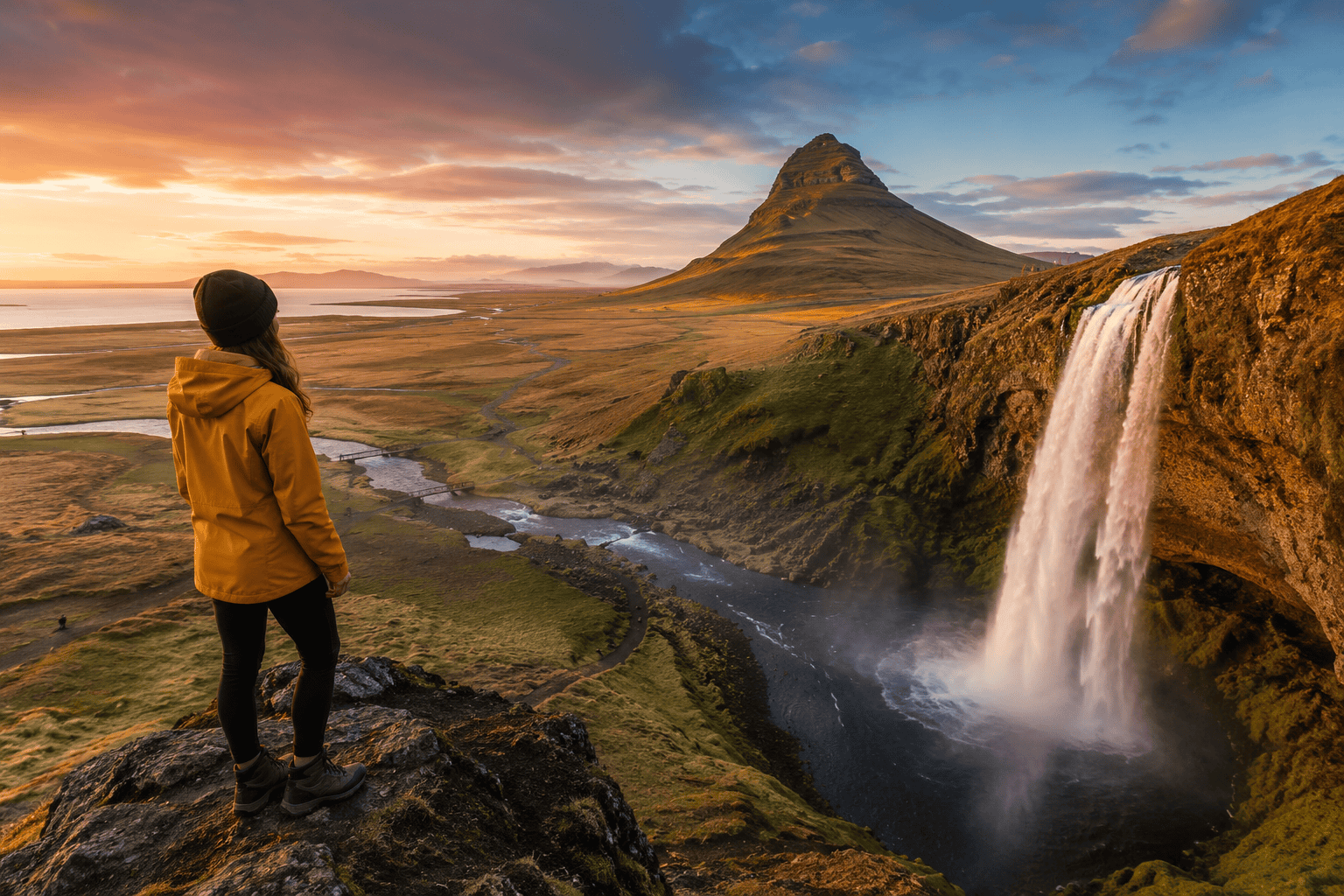
The best time of year to visit Iceland depends on what you want to experience, from the Midnight Sun and Highland adventures to the Northern Lights and ice caves. For most travelers, June through August offers the best weather, longest days, and widest access to attractions, while September through March is ideal for winter experiences. May and September provide an excellent balance of value, pleasant conditions, and lighter crowds.
Iceland is one of Europe’s most dramatic destinations, where waterfalls crash from volcanic cliffs, glaciers stretch to the horizon, and the Northern Lights flicker across winter skies. Unlike most European destinations that simply go quiet in winter, Iceland offers genuinely different experiences in every season — the timing you choose shapes almost everything about your trip.
Quick Takeaways
Start here: The best time of year to visit Iceland depends on what you want to experience, from the Midnight Sun and Highland adventures to the Northern Lights and ice...
Planning note: Iceland is one of Europe’s most dramatic destinations, where waterfalls crash from volcanic cliffs, glaciers stretch to the horizon, and the Northern Lights flicker across winter skies.
This guide breaks down each season, month by month, covering weather, daylight, costs, crowd levels, and what’s actually possible so you can match your travel dates to your goals.
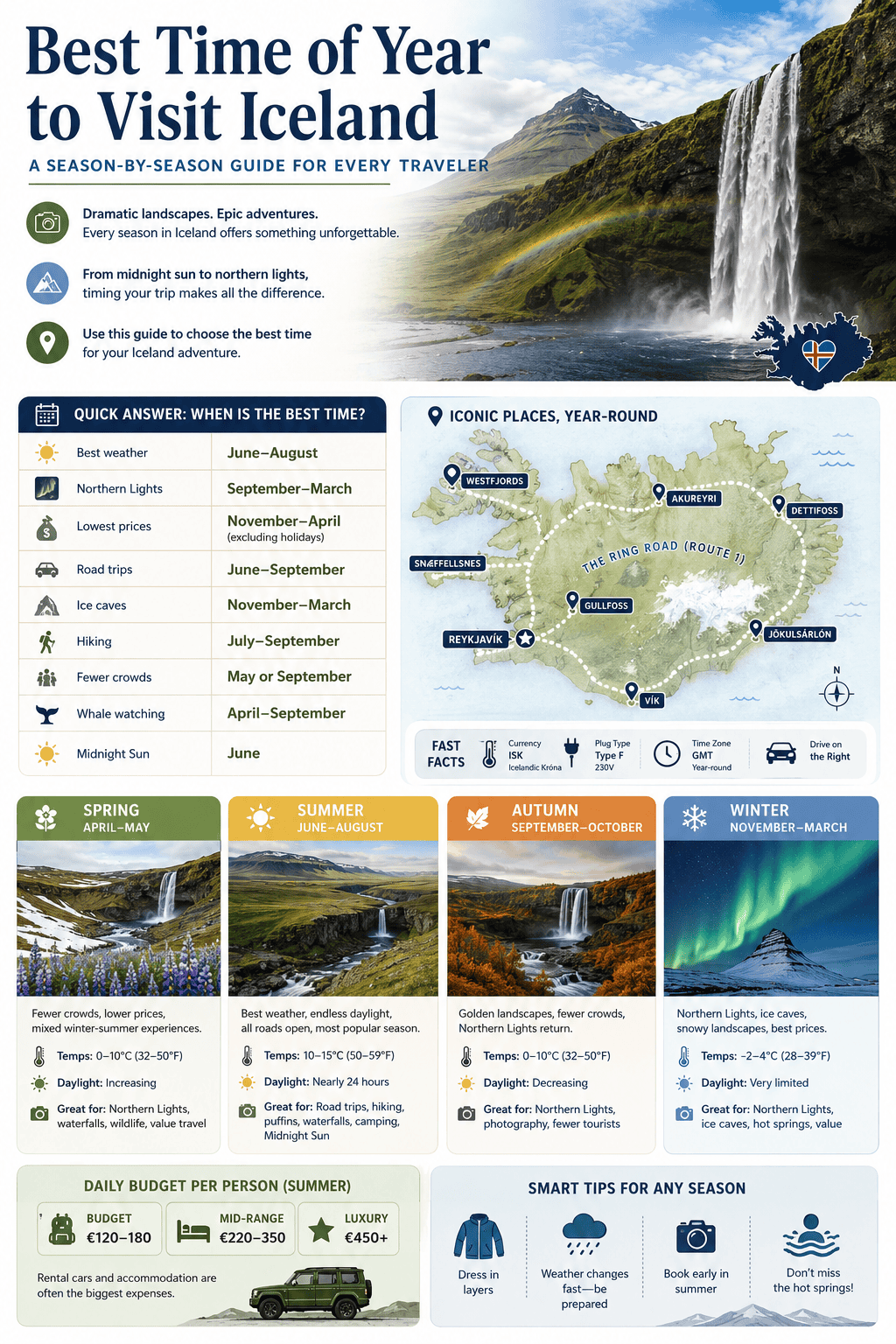
Quick Comparison: Best Time by Travel Goal
| Travel Goal | Best Months | Verdict |
|---|---|---|
| Best overall weather | June–August | Best |
| Northern Lights | September–March | Best |
| Midnight Sun | June | Best |
| Ice cave tours | November–March | Best |
| Hiking & Highlands | July–September | Best |
| Ring Road drive | June–September | Best |
| Whale watching | April–September | Good |
| Fewer crowds | May or September | Good |
| Lowest prices | November–April (ex. holidays) | Good |
| Photography (aurora + landscape) | September–October | Good |
| Budget + decent weather | May | Good |
| Peak summer crowds + prices | July–August | Avoid if budget-sensitive |
Summer in Iceland (June–August)
Best for: First-time visitors, road trips, hiking, camping, midnight sun
Summer is Iceland’s most popular season for straightforward reasons. Roads are fully open — including the remote Highland tracks — temperatures are as mild as Iceland gets, and daylight lasts nearly around the clock. Average temperatures sit between 10°C and 15°C (50–59°F), with occasional warm days nudging 20°C in sheltered areas, though wind and rain can still arrive without warning.
What’s possible in summer that isn’t reliably available other times:
- Driving the full Ring Road and the interior Highland routes (F-roads)
- Exploring Landmannalaugar and the Askja caldera
- Puffin watching along the Westfjords and South Iceland cliffs
- Glacier hiking with full daylight for safety
- Camping across Iceland’s designated campsites
- Experiencing the Midnight Sun — around the summer solstice in June, the sun barely sets
Book early or miss out. For July and August travel, rental cars, camper vans, and popular hotels along the South Coast and Ring Road can sell out 4–6 months in advance. Don’t leave this to a few weeks before departure.
Summer Budget (Per Person Per Day)
Budget traveler: €120–180 | Mid-range: €220–350 | Luxury: €450+
Rental cars and accommodation are the biggest costs. Popular hotels in the South Coast region can cost double their winter rates during peak summer.
Summer Pros and Cons
| Pros | Cons |
|---|---|
| Warmest and most stable weather | Highest accommodation prices of the year |
| Nearly 24-hour daylight | Rental cars book out months ahead |
| All roads and Highland routes open | Crowded at Golden Circle, Blue Lagoon, and waterfalls |
| Widest activity range | No Northern Lights (too much daylight) |
| Best self-driving conditions | No ice cave tours available |
Spring in Iceland (April–May)
Best for: Value-seekers, fewer crowds, whale watching, emerging landscapes
Spring is one of Iceland’s most underrated seasons and genuinely worth considering if you want to avoid summer prices without sacrificing too much daylight. Snow begins melting, waterfalls swell with runoff to some of their most dramatic flow volumes, and daylight increases rapidly through April and May.
- April: 0–7°C (32–45°F) — still cold, some snow and ice possible on roads
- May: 4–10°C (39–50°F) — noticeably more comfortable, longer evenings
Whale-watching tours from Húsavík in North Iceland begin ramping up from April, and by May the season is well underway. The Snæfellsnes Peninsula, Golden Circle, and South Coast are all accessible and relatively quiet compared to July.
Many experienced Iceland travelers consider late May one of the best-value months on the calendar — affordable rates, long days, and a fraction of the summer crowds.
F-roads (Highland routes) are closed until June or later. Don’t plan on reaching Landmannalaugar or Askja in spring — the interior remains inaccessible due to snow and soft ground, and attempting these routes early in the season can result in significant vehicle damage fines.
Autumn in Iceland (September–October)
Best for: Northern Lights, photography, shoulder-season savings, near-summer conditions
Autumn is widely regarded as Iceland’s most balanced season. Temperatures remain relatively comfortable, September in particular holds much of summer’s accessibility — most roads are still open, the landscape has transformed with golden moss and autumnal colours, and the Northern Lights return to dark skies for the first time since spring.
- September: 7–12°C (45–54°F)
- October: 2–8°C (36–46°F) — noticeably colder, some early snow possible
September is consistently one of the most recommended months by experienced Iceland travelers for good reason: it combines nearly-summer conditions with meaningfully lower hotel prices, sparser crowds, and the return of aurora-viewing darkness after months of midnight sun.
Why Photographers Love Autumn
The landscape in September and October offers some of Iceland’s most photogenic conditions: golden moss-covered lava fields, dramatic weather systems rolling across open plains, and the possibility of aurora displays reflected in still lagoon water. Top autumn photography destinations include Vík’s black sand beaches, Jökulsárlón Glacier Lagoon and Diamond Beach, and Kirkjufell Mountain on the Snæfellsnes Peninsula.
Winter in Iceland (November–March)
Best for: Northern Lights, ice caves, winter landscapes, lower prices
Winter reveals a completely different Iceland — snow-covered volcanoes, partially frozen waterfalls, long dark nights, and some of the most memorable scenery in Europe. It’s also the cheapest time to visit.
Average temperatures: −1°C to 4°C (30–39°F). Counterintuitively, Iceland is often milder than many inland European cities in winter thanks to the warming influence of the Gulf Stream.
Northern Lights
The aurora season runs from approximately September through March, with the darkest nights — and therefore the best viewing conditions — falling between November and February. Top viewing areas away from Reykjavík’s light pollution include Þingvellir National Park, the Snæfellsnes Peninsula, and the South Coast. No sighting is ever guaranteed; clear skies are the most important variable, regardless of solar activity forecasts.
Ice Cave Tours
Natural blue ice caves form inside glaciers only during colder months, making this a genuinely exclusive winter experience. The most reputable tours depart from the Vatnajökull National Park area near Jökulsárlón, typically running from November through March. These are guided-only experiences — never attempt glacier caves independently.
Winter Drawbacks
- Very short daylight hours — as few as 4–5 hours in December
- Road closures due to snow and ice, particularly outside the capital region
- Highland routes entirely inaccessible
- Self-driving requires winter driving experience; guided tours are a sensible alternative for first-timers
Month-by-Month Breakdown
| Month | Conditions | Highlights | Verdict |
|---|---|---|---|
| January | Peak winter, very short days | Northern Lights, ice caves, lowest tourist numbers | Optional |
| February | Cold, daylight increasing | Good aurora opportunities, snow landscapes | Good |
| March | Improving slowly | Winter activities still available, longer days | Good |
| April | Shoulder season, mixed | Lower prices, emerging wildlife, whale season begins | Good |
| May | Comfortable, quieter | Excellent value, long days, smaller crowds | Best value |
| June | Mild, Midnight Sun | 24-hour daylight, all roads opening, high demand | Best |
| July | Warmest month | Full Highland access, peak activity range | Best |
| August | Similar to July | Slightly fewer visitors late in month, puffins still visible | Best |
| September | Cooling, auroras return | Fall colours, Northern Lights, lower prices — top overall month | Best |
| October | Colder, fewer crowds | Increased aurora activity, affordable rates | Good |
| November | Winter begins | Ice cave season starts, cheap prices, dark for auroras | Good |
| December | Darkest month | Christmas atmosphere in Reykjavík, strong aurora potential | Optional |
Best Time to Visit Iceland for Northern Lights
If the aurora borealis is your primary reason for visiting, plan for late September through March. The best combination of darkness, reasonable weather windows, and accessible roads typically falls in:
- September — dark enough, roads still reliable, not yet the coldest
- October — consistently good aurora conditions
- February — peak darkness, ice caves also available simultaneously
- March — improving weather, still excellent aurora season
January has the longest dark nights but also some of the harshest conditions and least predictable weather windows. No Northern Lights sighting is ever guaranteed — clear skies are far more important than the calendar date. Check the Icelandic Met Office aurora forecast and plan on staying at least 4–5 nights to improve your odds.
The Icelandic Met Office aurora forecast is the most reliable free resource for real-time aurora probability and cloud cover maps. Check it nightly during your stay.
Best Time to Visit Iceland for Road Trips
The Ring Road (Route 1) is technically open year-round, but the experience varies dramatically by season. For a first-time Ring Road trip, stick to June through early September when conditions are most forgiving.
| Month | Ring Road | F-Roads (Highlands) |
|---|---|---|
| June–August | Fully safe, clear | Open from mid-June or July |
| September | Good, some weather risk | Closing from late September |
| October–May | Possible but challenging | Closed |
Travelers planning to reach remote interior destinations such as Landmannalaugar or Askja should aim for July or August — these require 4WD vehicles and are only accessible on specific F-road tracks that open after the snowmelt, typically from late June or early July. A standard 2WD rental car cannot legally or safely access F-roads.
Best Time to Visit Iceland on a Budget
Iceland is expensive year-round, but costs fluctuate considerably between peak summer and deep winter. The cheapest reliable travel window is November through early March, excluding Christmas week, New Year’s, and Easter.
Cheapest months: January and February
Best value with decent conditions: May or September
Most expensive: July and August (and Christmas/New Year’s week)
Budget-saving strategies that apply regardless of season:
- Shop for groceries at Bónus supermarkets (Iceland’s cheapest chain) rather than eating every meal out
- Book accommodation at least 3–4 months ahead for summer, 6+ months for July peak
- Share a rental car between 3–4 people to spread the single biggest cost
- Use guesthouses and farm stays (gistiheimili) over branded hotels
- Travel in May or September to access shoulder-season pricing with workable conditions
Where to Go Based on the Season
| Season | Top Destinations |
|---|---|
| Summer only | Landmannalaugar, Westfjords, Askja, Highland F-roads |
| Winter only | Vatnajökull ice caves, South Coast winter tours, Reykjavík Christmas markets |
| Year-round | Golden Circle, Blue Lagoon, Snæfellsnes Peninsula, Jökulsárlón Glacier Lagoon, Reykjanes Peninsula |
| Best in autumn | Vík black sand beach, Diamond Beach, Kirkjufell Mountain, Húsavík (whale season ending) |
Common Mistakes Travelers Make
Assuming summer means warm weather. Even in July, Iceland can feel cold, windy, and wet. Always pack a waterproof jacket, waterproof trousers, thermal layers, and waterproof hiking boots — regardless of your travel month.
Underestimating driving distances. The Ring Road is over 1,300 km long. Attempting the full circuit in fewer than seven days usually leads to exhausted, rushed sightseeing. Most itineraries benefit from 10–14 days if you want to go beyond the South Coast.
Booking too late for summer. Hotels, camper vans, and 4WD rentals along popular summer routes sell out months in advance. For July and August, book accommodation and car hire at least 4–6 months ahead.
Chasing Northern Lights in June. The Midnight Sun makes aurora viewing completely impossible during summer. If the aurora is a priority, your trip dates need to be September through March — full stop.
Taking a 2WD car onto F-roads. Highland routes require a registered 4WD vehicle. Driving a 2WD rental on F-roads voids your insurance and can result in significant rescue and damage fees.
Final Verdict: What Is the Best Time of Year to Visit Iceland?
For most first-time visitors, June through September offers the most accessible and rewarding experience — reliable weather, open roads, full activity range, and enough daylight to make the most of every day. September in particular hits a genuine sweet spot of summer-level access, fewer crowds, lower prices, and the return of aurora-viewing darkness.
If your main goal is the Northern Lights or ice caves, plan for September through March, with February and March offering a practical balance of dark skies and improving conditions. If you’re primarily motivated by budget, May or November (avoiding holidays) give you the best value without sacrificing everything.
There is no single universally correct answer — but September is the month most experienced Iceland travelers would recommend if forced to pick one.
Frequently Asked Questions
What is the best month to visit Iceland overall?
September is the single strongest month for most travelers — it combines near-summer road access and temperatures with meaningfully lower prices, fewer crowds, and the return of Northern Lights season. June and July are better if Highland access or the Midnight Sun is a priority.
Can you see the Northern Lights in summer?
No. The Midnight Sun means the sky never gets dark enough for aurora viewing between roughly late April and late August. For Northern Lights, you need to travel between September and March.
Is Iceland cheaper to visit in winter?
Yes — January and February are typically the cheapest months for flights, accommodation, and car hire. However, Christmas week, New Year’s, and Easter see prices spike even in winter. Avoid these holiday periods if budget is a priority.
How far in advance should I book Iceland in summer?
For July and August travel, book rental cars and accommodation at least 4–6 months ahead. Popular camper vans and 4WD rentals can sell out even earlier. For shoulder months like May or September, 2–3 months is usually sufficient.
Is it safe to drive in Iceland in winter?
It’s possible but significantly more challenging than summer. Snow, ice, and sudden weather changes are common. Travelers without experience driving in icy conditions should consider guided tours for winter travel, particularly outside the capital region. Always check the Icelandic Road and Coastal Administration (road.is) for live road conditions before departing.
What is Iceland like in May?
May is one of Iceland’s best-value months — it offers noticeably longer days, moderate temperatures around 4–10°C, relatively low prices, and far fewer tourists than June or July. Highland routes are still closed, but all main Ring Road attractions and the South Coast are fully accessible.

Mara Vale
Mara Vale writes Eurly travel guides for first-time Europe visitors who want practical routes, realistic pacing, and fewer avoidable planning mistakes.
Eurly guides help readers make confident travel decisions, but opening hours, ticket rules, transit disruptions, and local conditions can change. Always verify key reservations and official schedules before you travel.
By Mara Vale for Eurly
Last verified: June 2026
Mara Vale
Mara Vale writes Eurly travel guides for first-time Europe visitors who want practical routes, realistic pacing, and fewer avoidable planning mistakes.
Eurly guides are written to help readers make confident travel decisions, but opening hours, ticket rules, transit disruptions, and local conditions can change. Always verify key reservations and official schedules before you travel.