
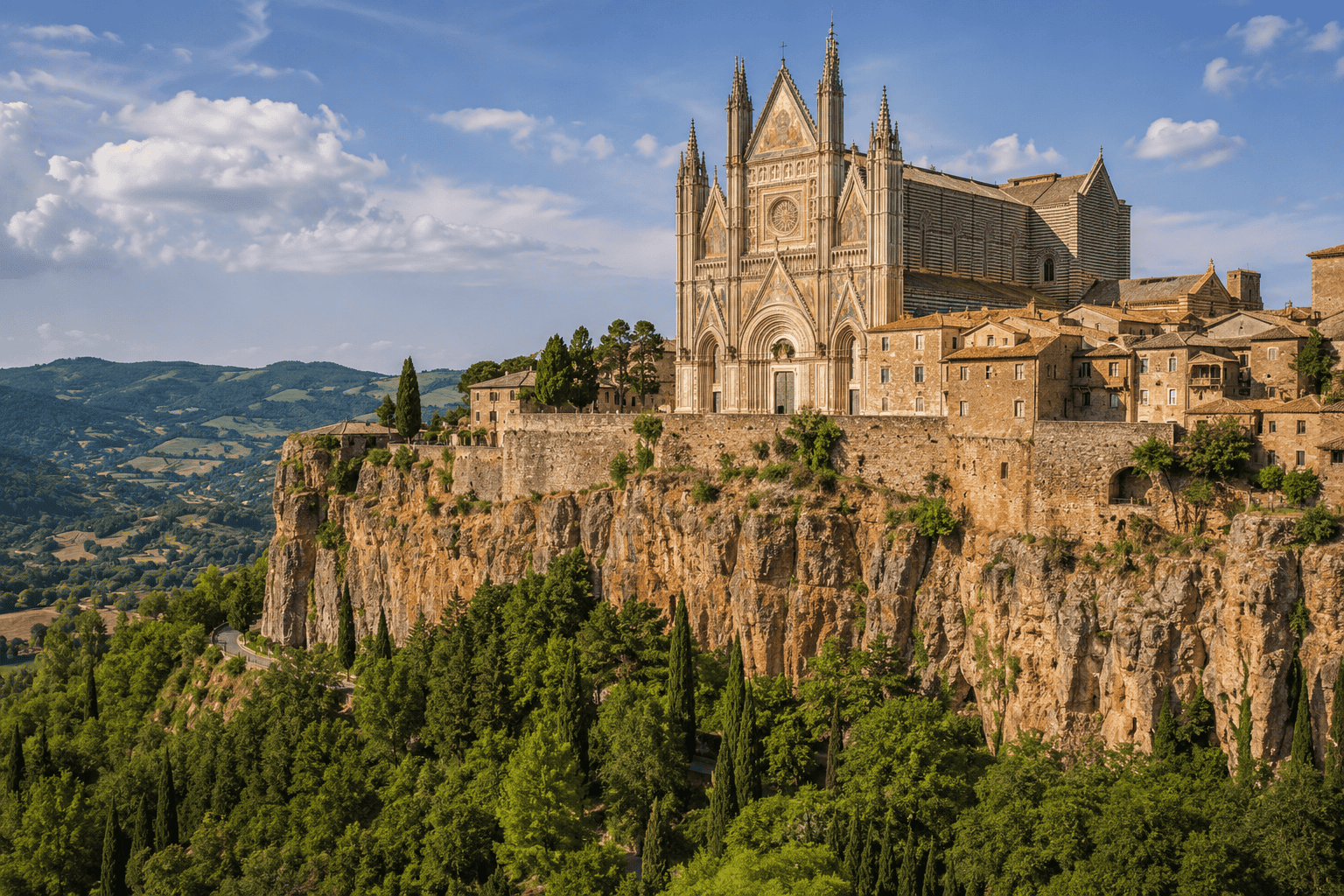
Orvieto is one of Italy’s most captivating hill towns, dramatically perched atop a volcanic cliff in the heart of Umbria between Rome and Florence. Famous for its Gothic cathedral, underground tunnels carved into the rock, and the remarkable St. Patrick’s Well, Orvieto rewards visitors with rich history, stunning views, and authentic Italian charm. Spending a night reveals an even quieter and more atmospheric side of the city.
Why Visit Orvieto?
While most tourists funnel through Florence, Rome, and Venice, Orvieto sits quietly off the main circuit offering something genuinely rare: a fully functioning medieval town with world-class art, a hidden underground city, excellent Umbrian food, and local wine — without the relentless crowds. It doesn’t feel like an open-air museum; it feels like a place people actually live.
The headline attractions are easy to list — the cathedral, the tunnels, the well — but Orvieto’s real appeal is the cumulative effect of walking unhurried through medieval streets in the early evening, after the day-trippers have gone back down the hill.
- One of Italy’s finest Gothic cathedrals, with frescoes that reportedly influenced Michelangelo
- Hundreds of caves, cisterns, and tunnels carved into volcanic tuff beneath the city
- St. Patrick’s Well: a double-helix staircase descending 53 metres
- Orvieto Classico white wine, grown on volcanic soils around the plateau
- Easy rail access from Rome (1–1.5 hrs) and Florence (1.5–2 hrs)
- Noticeably fewer crowds than Tuscany’s most visited towns
How to Get to Orvieto
By Train
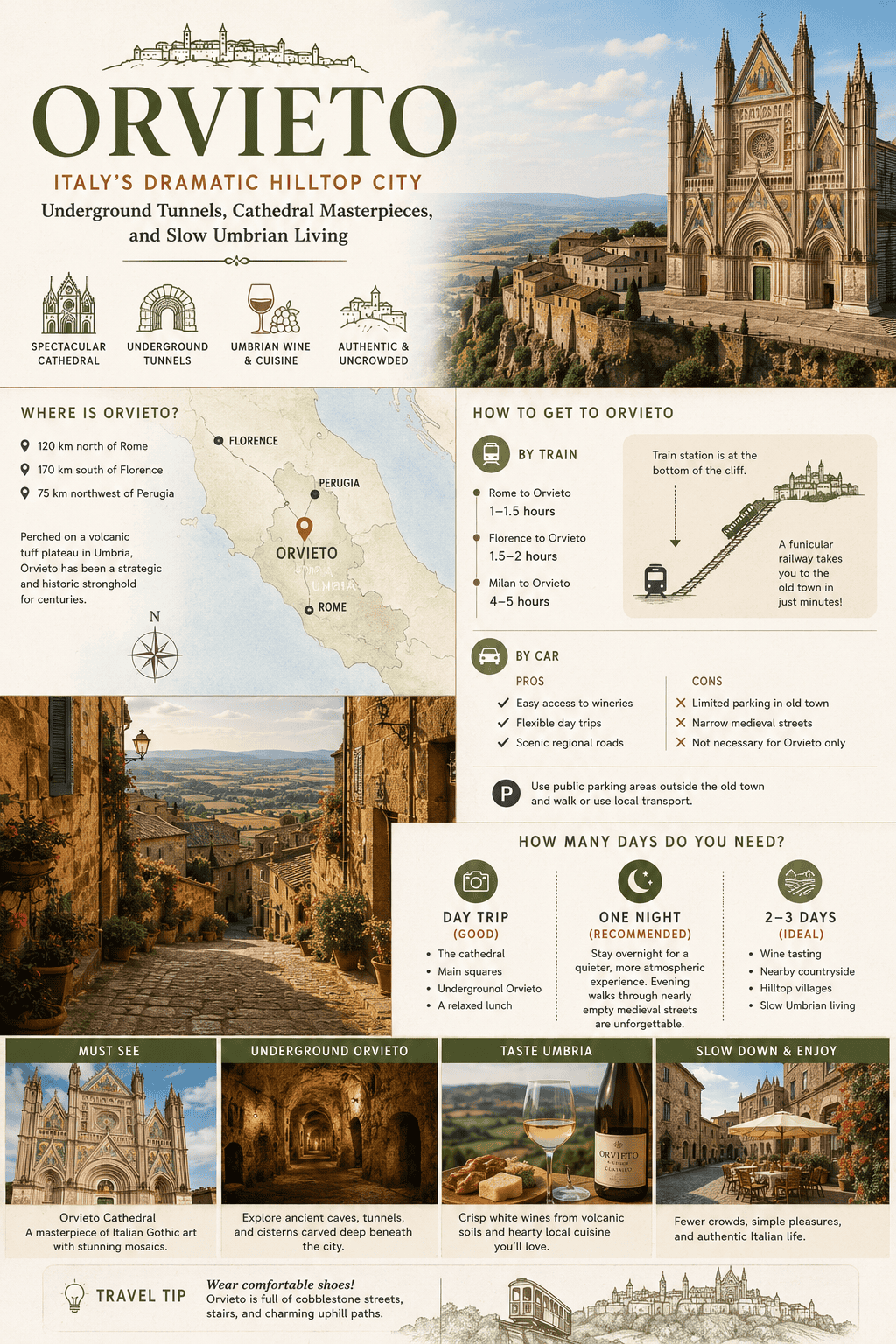
The train is the most practical option for most visitors. Orvieto sits on Italy’s main Rome–Florence rail line, so connections are frequent and straightforward.
| From | Approximate Time | Notes |
|---|---|---|
| Rome (Termini) | 1–1.5 hours | Regional and intercity trains; frequent departures |
| Florence (S.M.N.) | 1.5–2 hours | Change may be required depending on service |
| Milan | 4–5 hours | Intercity; plan for an early start |
Critical detail most visitors miss: the train station sits at the base of the cliff, not in the historic center. A funicular railway runs from the station up to Piazza Cahen at the top — the ride takes about three minutes and runs frequently throughout the day. From Piazza Cahen, local minibuses (line A and B) connect to the main squares.
Book trains in advance on Trenitalia or Italo for the best fares. Regional trains are often cheapest and stop at Orvieto; high-speed Frecciarossa services generally do not.
By Car
Driving gives you flexibility to explore rural Umbria and stop at countryside wineries, but it isn’t necessary if Orvieto is your only destination. Parking inside the historic center is severely limited — use the large free car parks near the funicular base station (Campo della Fiera) and ride up. Narrow medieval streets are not designed for through traffic.
How Many Days Do You Need in Orvieto?
IFyou’re passing through between Rome and Florence and have limited time — a day trip is viable. You can comfortably fit the cathedral, an underground tour, St. Patrick’s Well, and a long lunch.
IFyou want the full Orvieto experience — one night is the sweet spot. The city empties noticeably after 5pm, and an evening walk through near-empty medieval streets is one of the most atmospheric things you can do in central Italy.
IFyou’re drawn to slow travel, Umbrian countryside, or wine — two to three days gives you time for winery visits, day trips to Civita di Bagnoregio or Lake Bolsena, and a proper browse of the museums.
The Duomo di Orvieto
The Duomo di Orvieto is broadly regarded as one of the finest Gothic cathedrals in Italy — a striking statement given the competition. Even visitors who arrive expecting to be mildly impressed tend to stop in their tracks when they first see the façade.
The exterior is covered in gold mosaics, intricate relief sculptures, and striped stonework in alternating black basalt and pale travertine. Construction began in 1290 and continued for three centuries, which partly explains its extraordinary layered detail.
Inside, the main draw is the Cappella di San Brizio (Chapel of San Brizio), containing Luca Signorelli’s fresco cycle completed between 1499 and 1504. The cycle depicts the Apocalypse, the Resurrection, Heaven, Hell, and the Last Judgment with a psychological intensity that was radical for its time. Art historians have long argued that Michelangelo studied these frescoes closely before beginning the Sistine Chapel ceiling — the muscular dynamism of Signorelli’s figures is unmistakably present in both.
Book the Chapel of San Brizio in advance during busy periods — entry is included with the cathedral ticket but timed slots fill up. Arrive at the cathedral as early as possible (it typically opens at 9:30am) to avoid the midday rush. Dress code is enforced: shoulders and knees must be covered. Allow at least one hour; rushing the frescoes is a genuine waste.
Combined tickets covering the cathedral, the underground tours, and other Orvieto sites offer meaningful savings. Check the Opera del Duomo di Orvieto official site for current pricing and opening hours before you go.
Underground Orvieto
Beneath the streets, Orvieto contains a second city. Over millennia, residents carved hundreds of caves, tunnels, cisterns, olive presses, and storage chambers directly into the soft volcanic tuff on which the plateau sits. More than 1,200 underground spaces have been documented, many of them still only partially explored.
Guided tours (departing from Piazza del Duomo) descend into this network to reveal ancient wells, Etruscan-era chambers, medieval escape tunnels, pigeon-breeding rooms used for meat and fertiliser, and early olive-pressing facilities. The tours run in multiple languages throughout the day and last around 45 minutes.
The underground experience provides essential context for understanding Orvieto’s history: the plateau’s isolation was both its greatest defensive advantage and a constant logistical challenge, and the tunnels show exactly how resourcefully its inhabitants solved that problem over centuries. This is not a gimmicky tourist attraction — it genuinely changes how you see the city above.
St. Patrick’s Well (Pozzo di San Patrizio)
Commissioned by Pope Clement VII in 1527 — following his flight from Rome during the Sack — St. Patrick’s Well is a remarkable feat of Renaissance engineering. The pope needed a reliable water supply that would function even under siege conditions, and the solution architect Antonio da Sangallo the Younger devised has fascinated visitors ever since.
The well descends approximately 53 metres into the rock and is accessed via two independent spiral staircases, one for descent and one for ascent, so that the donkeys carrying water up never blocked those going down. The system kept the city reliably supplied for decades.
- Depth: approximately 53 metres
- Stairs: 248 steps in total (down and back up)
- Design: double helix, fully independent staircases
Wear comfortable shoes with grip — the stone steps are worn smooth in places, and the climb back out is more demanding than the descent suggests. The well is located near Piazza Cahen, a short walk from the funicular terminus.
Wandering the Historic Center
Some of the best time you’ll spend in Orvieto involves no specific attraction at all. The historic center is compact and almost entirely pedestrian-friendly — a genuine rarity for a medieval Italian city of this size.
Via del Duomo connects the cathedral area to Piazza della Repubblica, which serves as the social heart of town. Piazza del Popolo, a short walk north, hosts a local market on Thursdays and Saturdays. The residential lanes branching off the main spine — quieter, less photographed — reward unhurried exploration with hidden courtyards, artisan workshops, and excellent light for photography in the late afternoon.
Orvieto has a small but genuine craft tradition. Ceramics and woodcarving (particularly the local inlaid wood style called arte dell’intaglio) are worth seeking out in the smaller shops away from the cathedral square.
Food and Wine in Orvieto
What to Eat
Umbrian cooking is defined by restraint and quality: fewer sauces, better ingredients, slower preparation. The local food culture in Orvieto reflects this well.
- Umbrichelli: thick hand-rolled pasta, typically served with truffle sauce, wild boar ragù, or local mushrooms — the dish to order if you eat nothing else here
- Porchetta: herb-seasoned slow-roasted pork, often sold from market stalls as a simple sandwich
- Wild boar (cinghiale): a regional staple appearing in stews, pasta sauces, and cured meats
- Umbrian pecorino: aged sheep’s milk cheese, frequently served on antipasto boards with local honey
- Black truffle: Umbria produces excellent black truffles; menus in autumn lean heavily into truffle dishes
Avoid restaurants with laminated English menus positioned directly in front of the cathedral — the best value meals are found one or two streets back, where locals actually eat.
Orvieto Classico Wine
The city lends its name to one of central Italy’s historic white wine denominations. Orvieto Classico is a crisp, dry-to-off-dry white blended primarily from Grechetto and Trebbiano grapes grown on the volcanic soils around the plateau. It pairs naturally with the local pasta, fresh cheeses, and lake fish dishes.
Most restaurants pour the local white at reasonable prices by the glass or carafe. Wine lovers spending two or more nights should consider a half-day trip to one of the surrounding wineries — the countryside between Orvieto and Lake Bolsena produces some of the region’s best bottles.
Where to Stay in Orvieto
| Area | Best For | Verdict |
|---|---|---|
| Historic center (upper town) | Atmosphere, walkability, evening exploration | Best for first-timers |
| Near the train station (lower town) | Early departures, budget travelers, convenience | Good if you’re catching an early train |
| Countryside agriturismo | Wine tourism, rural atmosphere, relaxation | Optional — needs a rental car |
Staying in the historic center on top of the cliff is strongly recommended for a first visit. The upper town at night — after the day-trippers have left — is one of the best versions of Orvieto. Staying at the bottom means missing that entirely.
Typical Daily Costs
Orvieto is meaningfully more affordable than Rome, Florence, or Venice. Accommodation and restaurant prices reflect a city that serves a local population as much as tourists.
Budget traveler: €70–120/day — hostel or budget room, casual meals (pizza, trattorias), public transport and funicular
Mid-range traveler: €140–250/day — boutique hotel or B&B in the historic center, sit-down restaurant meals, main attractions
Higher-end traveler: €250+/day — boutique hotel with views, wine tastings, fine dining, agriturismo or countryside accommodation
Admission costs to watch: the cathedral is free to enter but the Chapel of San Brizio requires a ticket (around €5–7 at time of writing). Underground Orvieto tours typically cost €7–9. St. Patrick’s Well admission is around €5. A combined Orvieto Card covers multiple sites and usually saves money if you’re visiting more than two paid attractions — check the current offer at the tourist office or the Opera del Duomo site.
Best Day Trips from Orvieto
Civita di Bagnoregio
Around 30 minutes by car, Civita di Bagnoregio is a tiny hilltop village sitting on an eroding tuff ridge, connected to the outside world only by a long pedestrian bridge. Known as the “dying city” because the cliff continues to erode, it has perhaps 10–15 permanent residents but draws visitors for its extraordinary visual drama. Go early or late — midday in summer is overwhelmingly busy for such a small space.
Lake Bolsena
About 30–40 minutes south by car, Lake Bolsena is one of the largest volcanic crater lakes in Europe. The shoreline towns (Bolsena, Montefiascone) offer swimming, lakeside restaurants, and a genuinely unhurried pace. Particularly good in summer when Orvieto’s heat becomes significant.
Todi
Another Umbrian hill town, roughly an hour by car, with fewer visitors than most Tuscan equivalents and a well-preserved Romanesque-Gothic cathedral of its own. Combines naturally with Orvieto for a two-night Umbria itinerary.
Perugia
Umbria’s regional capital is around 75 km east — accessible by regional train with a change, or directly by car. Worth visiting for the Galleria Nazionale dell’Umbria, the medieval aqueduct walkway, and a strong food scene anchored by the city’s status as Italy’s chocolate capital (Baci Perugina originated here).
Best Time to Visit Orvieto
| Season | Conditions | Verdict |
|---|---|---|
| Spring (Apr–Jun) | Mild temperatures, green hills, comfortable walking | Best |
| Autumn (Sep–Oct) | Harvest season, fewer crowds, pleasant evenings | Best |
| Summer (Jul–Aug) | Hot afternoons, more visitors, lively outdoor dining | Good with adjustments |
| Winter (Nov–Mar) | Quiet, some reduced hours, lower prices | Optional — atmospheric but limited |
Spring and autumn are the most comfortable for sightseeing. September and October add the pleasure of the local grape harvest, and Orvieto’s wine bars are at their most lively during this period. If visiting in summer, plan sightseeing for before noon and after 4pm — the midday heat on an exposed plateau is significant, and the cathedral and tunnels are much more pleasant before the crowds peak.
Common Mistakes to Avoid in Orvieto
- Only visiting for a few hours. Rushing Orvieto between Rome and Florence is the most common planning mistake. One night costs relatively little extra and changes the experience completely — the city after 6pm is almost unrecognisable from the daytime version.
- Skipping the underground tour. Some visitors dismiss it as a gimmick. It isn’t. The tunnels explain Orvieto’s history in a way that walking the streets above cannot.
- Underestimating the hill inside the historic center. The funicular gets you to the top, but the historic center itself is hilly and uneven. Comfortable walking shoes with grip are not optional — this applies especially to St. Patrick’s Well and any wet-weather visit.
- Arriving midday in summer. Summer afternoons on the plateau are hot and the main sites are busiest from 11am–3pm. Adjust your schedule accordingly.
- Eating only on Via del Duomo. The restaurants nearest the cathedral are convenient but rarely the best value. Walk two streets back for significantly better food at lower prices.
Frequently Asked Questions About Orvieto
Is Orvieto worth a day trip from Rome?
Yes — it’s one of the most rewarding and straightforward day trips from Rome. Direct regional trains depart regularly from Roma Termini and take around 1–1.5 hours. You can comfortably cover the cathedral, an underground tour, St. Patrick’s Well, and lunch in a day. That said, an overnight stay is strongly recommended if your schedule allows — the evening atmosphere is exceptional.
Can you visit Orvieto without a car?
Completely. The train connects directly to the town’s base station, and the funicular takes you to the historic center in minutes. Once on top, the city is compact and walkable. Local minibuses cover the longer distances within the upper town. A car is only useful if you plan to visit countryside wineries or day-trip to Civita di Bagnoregio.
What is Orvieto most famous for?
Orvieto is best known for its Duomo (one of Italy’s greatest Gothic cathedrals), its underground cave and tunnel network, St. Patrick’s Well, its Etruscan history, and the Orvieto Classico white wine produced from the surrounding volcanic vineyards.
How long should you spend in Orvieto?
One night is the practical minimum for a satisfying visit. A full day covers the major sites; the overnight extends the experience into the evening when the city is at its quietest and most beautiful. Two to three days is ideal if you want to explore Umbria more broadly or visit nearby towns.
Is Orvieto expensive compared with other Italian cities?
No — it’s noticeably more affordable than Rome, Florence, and Venice. Accommodation, restaurant meals, and attractions are all priced for a city that serves local residents as well as tourists. A mid-range traveler spending a night typically pays considerably less than the equivalent in Italy’s major tourist centers.
What’s the best way to get from the train station to the historic center?
Take the funicular from directly outside the station exit. It runs frequently (roughly every 10 minutes during the day), takes about three minutes, and costs a small flat fare — tickets are usually available at the station or from a machine at the funicular entrance. From the top (Piazza Cahen), walk or take a local minibus to the cathedral area.
Useful Links
- Opera del Duomo di Orvieto — official cathedral and chapel tickets, opening hours
- Trenitalia — train times and tickets from Rome, Florence, and beyond
- Comune di Orvieto — local tourist and practical information

Mara Vale
Mara Vale writes Eurly travel guides for first-time Europe visitors who want practical routes, realistic pacing, and fewer avoidable planning mistakes.
Eurly guides help readers make confident travel decisions, but opening hours, ticket rules, transit disruptions, and local conditions can change. Always verify key reservations and official schedules before you travel.
By Mara Vale for Eurly
Last verified: June 2026
Mara Vale
Mara Vale writes Eurly travel guides for first-time Europe visitors who want practical routes, realistic pacing, and fewer avoidable planning mistakes.
Eurly guides are written to help readers make confident travel decisions, but opening hours, ticket rules, transit disruptions, and local conditions can change. Always verify key reservations and official schedules before you travel.