

The trip to Istanbul cost can vary wildly depending on where you stay, how you get around, and how often you indulge in rooftop dining with Bosphorus views. Istanbul is one of those rare cities where your budget can stretch surprisingly far — or disappear quickly if you rely on taxis, stay in tourist-heavy areas, or splurge every evening.
For most travellers, the trip to Istanbul cost sits in a comfortable middle ground. It’s noticeably cheaper than Paris, Rome, or London, but not as ultra-budget-friendly as parts of Southeast Asia or the Balkans. Accommodation prices have climbed in recent years, particularly in Sultanahmet and Galata, but food, public transport, and everyday sightseeing still offer excellent value.
Quick Takeaways
Start here: The trip to Istanbul cost can vary wildly depending on where you stay, how you get around, and how often you indulge in rooftop dining with Bosphorus views.
Planning note: For most travellers, the trip to Istanbul cost sits in a comfortable middle ground.
This guide breaks down a realistic Istanbul travel budget for budget, mid-range, and luxury travellers — covering accommodation, food, transport, attractions, and the money mistakes that quietly drain most first-timers.
Is Istanbul Expensive for Tourists?
Not compared to most major European cities. The honest answer to “is Istanbul expensive?” is: it depends almost entirely on your travel style.
You can comfortably experience Istanbul on:
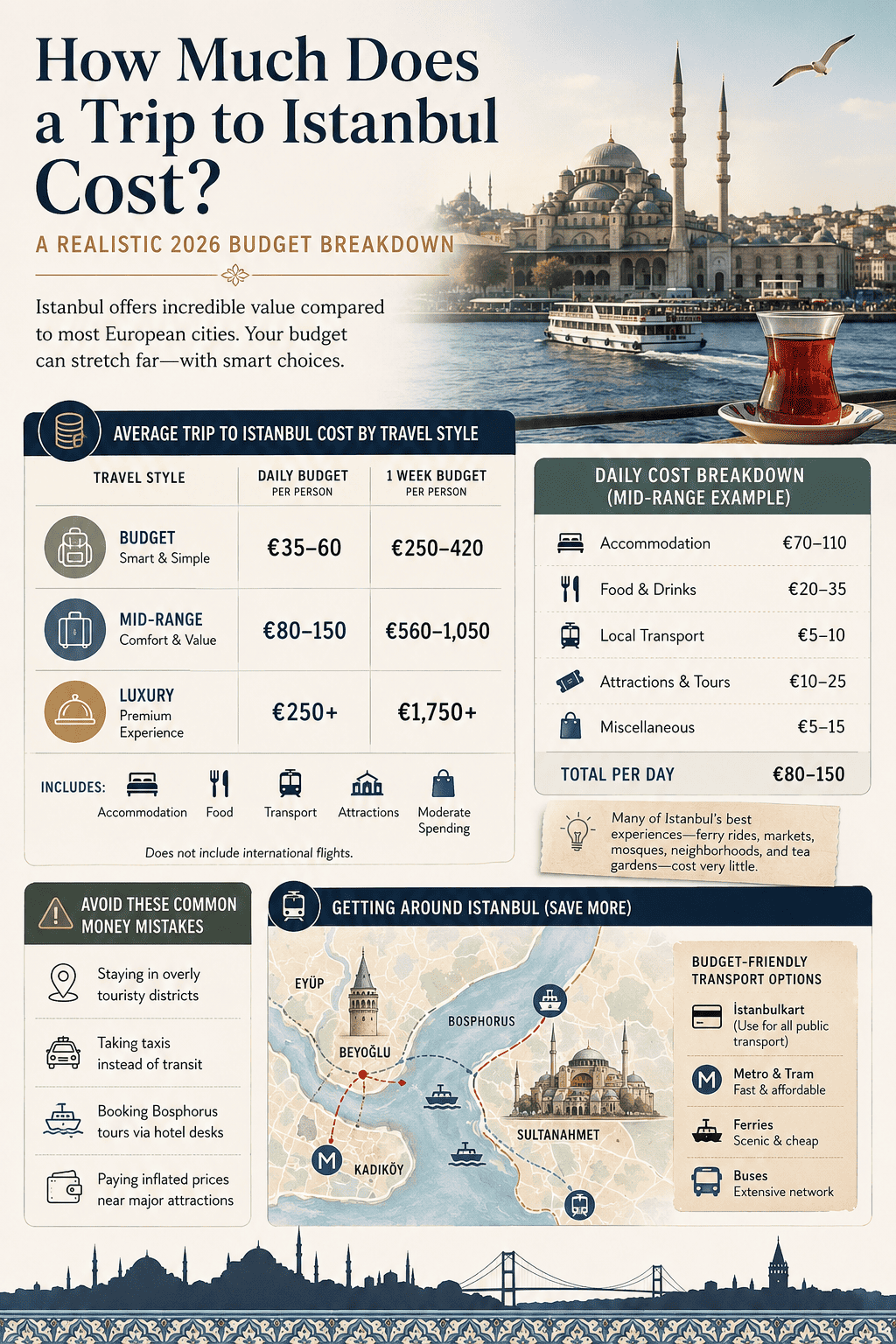
- €35–60 per day as a budget traveller
- €80–150 per day on a mid-range budget
- €250+ per day for luxury travel
Street food is genuinely cheap, public transport works well, and many of Istanbul’s most rewarding experiences — ferry crossings, markets, neighbourhood wandering, mosque visits, tea gardens — cost very little or nothing at all.
Where travellers typically overspend:
- Booking accommodation in overly touristy districts without comparing alternatives
- Taking taxis instead of the metro or tram
- Booking Bosphorus cruises through hotel desks rather than taking public ferries
- Eating at restaurants clustered directly around major attractions
Plan carefully and Istanbul feels far more affordable than cities like Barcelona, Amsterdam, or Athens.
Average Trip to Istanbul Cost by Travel Style
Here’s a realistic daily and weekly breakdown per person, excluding international flights.
| Travel Style | Daily Budget | 1-Week Budget |
|---|---|---|
| Budget | €35–60 | €250–420 |
| Mid-range | €80–150 | €560–1,050 |
| Luxury | €250+ | €1,750+ |
Each estimate covers accommodation, food, local transport, and attractions. International flights are not included in any figure.
Accommodation Costs in Istanbul
Accommodation will likely be your largest single expense, and prices vary significantly depending on the season, neighbourhood, hotel quality, whether a Bosphorus view is included, and how far in advance you book.
Budget Accommodation (€15–45/night)
Budget travellers can still find hostel dorm beds, basic pensions, and small guesthouses — particularly in Kadıköy, the side streets of Beyoğlu, and parts of Fatih away from the tourist centre.
- Hostel dorm bed: €15–25
- Basic private room: €30–45
Practical note: Be cautious with suspiciously cheap hotels in Sultanahmet that show flawless photos online. Poor soundproofing, very small rooms, and unreliable heating are common complaints.
Mid-Range Hotels (€70–150/night)
This is where Istanbul genuinely punches above its weight. A mid-range budget regularly gets you boutique hotels in renovated Ottoman buildings, rooftop breakfast terraces, and central locations that would cost considerably more in comparable European cities.
The best mid-range neighbourhoods are Karaköy, Galata, Cihangir, and Kadıköy.
- Solid 3–4 star hotel: €80–120
- Stylish boutique stay: €120–150
This range is the sweet spot for most travellers working out how much money for Istanbul they actually need.
Luxury Hotels (€250+/night)
Top-end options include the Four Seasons Bosphorus, Çırağan Palace Kempinski, and The Peninsula Istanbul. You’ll pay a premium for Bosphorus views, rooftop pools, historic palace settings, and waterfront locations. Even so, comparable luxury in London or Paris typically costs more.
Food Costs in Istanbul
Food is one of the best reasons to visit Istanbul — and it doesn’t need to cost much.
Street Food and Cheap Eats (€3–10)
You can eat very well on a tight budget. Typical prices for common street and casual dishes:
- Simit (sesame bread ring): €0.50–1
- Döner wrap: €3–6
- Lahmacun: €2–4
- Street mussels (midye dolma): €1–2 each
- Turkish tea (çay): €0.50–1
- Baklava portion: €3–6
Best areas for affordable eating: Kadıköy Market, the backstreets of Karaköy, Beşiktaş, and local lokantas in Fatih.
Mid-Range Dining (€12–30 per person)
A comfortable sit-down meal — mezze spreads, grilled meats, fresh seafood, or a generous Turkish breakfast — typically costs €12–20 per person at a good local restaurant, rising to €20–30 in trendier districts. Wine and rakı will add to this.
Tourist trap warning: Restaurants immediately around Sultanahmet Square frequently charge inflated prices for food that doesn’t match the cost.
Rooftop and Fine Dining (€50+)
Istanbul’s rooftop dining scene — particularly around Galataport, Nişantaşı, and the Bosphorus waterfront — is genuinely memorable. Doing it once is usually worth it. Doing it every evening will accelerate through your Istanbul travel budget faster than almost anything else.
Public Transport Costs in Istanbul
Public transport is one of Istanbul’s strongest advantages for cost-conscious travellers.
Istanbulkart
Pick up an Istanbulkart as soon as you arrive — it works on the metro, tram, ferries, buses, and funiculars. The card itself costs around €2–3, and individual rides typically come in under €1. It removes the need to buy single tickets and avoids any cash handling at turnstiles.
Ferries: Best Value Experience in the City
The public Şehir Hatları ferries are arguably the best-value activity Istanbul offers. For less than €1, routes like Eminönü → Kadıköy and Karaköy → Üsküdar give you Bosphorus views, skyline panoramas, and genuine local atmosphere. Many travellers pay €30–50 for private tourist cruises when the scheduled ferries offer much of the same scenery at a fraction of the cost.
Taxis
Taxis are cheaper than in Western Europe but come with known risks: drivers refusing to use meters, card machines that are conveniently broken, and longer-than-necessary routes, particularly from airports. Use BiTaksi or Uber where available, and prefer the metro or Havaist airport buses when arriving at Istanbul Airport or Sabiha Gökçen.
Attraction Costs in Istanbul
A significant number of Istanbul’s best experiences are free or very low cost.
Free Attractions
- Blue Mosque (Sultan Ahmed Mosque) — free entry
- Grand Bazaar — free to enter and browse
- Spice Bazaar (Mısır Çarşısı) — free entry
- Mosque courtyards and neighbourhood streets
- Public ferry crossings (charged as standard transit, not tourist pricing)
Paid Attractions
Entrance prices have risen substantially in recent years. Approximate current ranges:
- Topkapı Palace (including Harem): €35–50 for combined sections
- Basilica Cistern (Yerebatan Sarnıcı): €20–30
- Galata Tower: €20+
- Dolmabahçe Palace: €25–40
- Hagia Sophia main floor: currently free for general entry; inner gallery and special areas may carry variable charges
If you plan several paid attractions in a single day, sightseeing costs accumulate quickly. Prioritise the two or three sites that matter most rather than trying to tick every landmark.
How Much Should I Budget Per Day in Istanbul?
Budget Traveller: €35–60/day
Achievable if you stay in hostels, eat local food, use the Istanbulkart for all transport, and limit paid attractions.
Example breakdown:
- Hostel dorm: €20
- Food: €12
- Transport: €3
- Attractions and snacks: €10
Mid-Range Traveller: €80–150/day
The most practical balance for most visitors. At this level you can stay centrally in a decent hotel, enjoy the occasional rooftop dinner, visit major attractions without stress, take ferries freely, and sit in cafés without counting every order.
Example breakdown:
- Hotel: €90
- Food: €25
- Transport: €5
- Attractions: €20
Luxury Traveller: €250+/day
Bosphorus-view hotels, private transfers, fine dining, hammam and spa experiences, and upscale nightlife. At the very top end — palace hotels and high-end restaurants — daily spend can exceed €500 comfortably.
Can I Visit Istanbul on a Mid-Range Budget?
Absolutely — and for most travellers, mid-range is arguably the best way to experience the city. At €80–150 per day you can stay in an atmospheric boutique hotel in Karaköy or Cihangir, enjoy a proper Turkish breakfast each morning, use ferries and trams freely, visit the major historic sites, balance street food with one or two better dinners, and still feel like you’re experiencing Istanbul properly rather than surviving it.
The city rewards travellers who mix local moments — a €1 glass of tea at a neighbourhood çayhane, a ferry across to Kadıköy for lunch — with occasional considered splurges. For many visitors, Istanbul offers one of the best value-to-experience ratios of any major city in or near Europe.
Best Areas to Stay for Different Budgets
Sultanahmet
Ideal for first-time visitors who want to walk to the Blue Mosque, Hagia Sophia, and Topkapı Palace. The trade-off: the area is heavily touristic, restaurants are generally overpriced, and the neighbourhood quietens significantly after dark.
Galata and Karaköy
Strong choice for travellers who want good cafés, boutique hotel options, and proximity to both the historic peninsula and Beyoğlu’s nightlife. More expensive than other areas but the atmosphere is notably better.
Kadıköy
The Asian-side neighbourhood most recommended for longer stays, local food, lower prices, and a genuinely lived-in feel. A short ferry ride connects it to the European side. Excellent value for money and often overlooked by short-stay visitors.
Beşiktaş
A good balance of local energy, restaurants, and nightlife without being overly touristic. Well connected by ferry and metro, and closer to Bosphorus-side sights like Dolmabahçe Palace.
Money-Saving Tips for Istanbul
1. Use Public Ferries Instead of Tourist Cruises
The Şehir Hatları ferry network gives you Bosphorus scenery at standard transit prices. Most private cruise packages offer little that a regular commuter ferry doesn’t provide for a fraction of the cost.
2. Stay Outside Sultanahmet
Neighbourhoods like Kadıköy, Karaköy, and Cihangir typically offer larger rooms, better restaurants nearby, and more competitive nightly rates — often with superior atmosphere.
3. Eat Where Locals Eat
Busy lokantas (local canteen-style restaurants) with a queue outside are almost always fresher, cheaper, and more interesting than tourist-facing spots near landmark entrances.
4. Take the Metro From the Airport
The M11 metro line connects Istanbul Airport to the city centre. The Havaist bus network covers additional routes. Both are substantially cheaper than taxis and avoid the airport overcharging that remains a common complaint.
5. Don’t Overload on Paid Attractions
Some travellers book every museum and palace into a short trip and exhaust both their schedule and their budget. Istanbul’s neighbourhoods, tea gardens, ferry crossings, and markets are themselves the experience. Not everything worth doing requires a ticket.
Common Budget Mistakes in Istanbul
Skipping the Asian Side Entirely
Kadıköy and Üsküdar offer lower prices, excellent local food, and far fewer crowds than the historic European centre. A ferry there and back costs under €2 and is one of the best things you can do in the city.
Underestimating Walking Distances
Istanbul is large, hilly, and spread across two continents. A route that looks like fifteen minutes on a map can involve significant elevation changes. Factor this in when choosing where to stay and how much you rely on walking between sights.
Only Eating Near Tourist Sites
Move even one or two streets away from major attractions and both price and quality typically improve. This is especially true around Sultanahmet and the Grand Bazaar entrance.
Not Carrying Any Cash
Cards are widely accepted across most of Istanbul, but small street vendors, local tea gardens, and some market stalls still strongly prefer cash. Carry a reasonable amount for day-to-day use.
Sample 5-Day Istanbul Budget
Budget Trip (5 days)
| Category | Estimated Cost |
|---|---|
| Hostel (5 nights) | €100 |
| Food | €75 |
| Transport (Istanbulkart) | €20 |
| Attractions | €50 |
| Total | €245 |
Mid-Range Trip (5 days)
| Category | Estimated Cost |
|---|---|
| Boutique hotel (5 nights) | €500 |
| Food | €150 |
| Transport | €30 |
| Attractions | €100 |
| Total | €780 |
Neither estimate includes international flights.
Final Verdict: How Much Does a Trip to Istanbul Cost?
For most travellers, a realistic trip to Istanbul cost falls somewhere between affordable and mid-range European city pricing — with significantly more to show for it in terms of food, history, and atmosphere than you’d get at the same spend in Paris or Rome.
The city is extremely budget-flexible, but it becomes far more enjoyable when you allow enough room for the experiences that define it: a rooftop dinner with a Bosphorus view, a slow morning in a neighbourhood café, a spontaneous ferry to the Asian side, a proper Turkish breakfast that takes two hours. These things don’t require luxury spending, but they do require not watching every cent.
A comfortable budget for most visitors is €80–150 per day, excluding flights. That range lets you stay well, eat well, move freely around the city, and visit the attractions that matter to you — without the kind of constant cost-checking that gets in the way of actually being somewhere.
Frequently Asked Questions
Is Istanbul expensive for tourists?
Not compared to most major European cities. Accommodation prices have risen in recent years, particularly in central neighbourhoods, but food, public transport, and many of Istanbul’s best experiences remain genuinely affordable. Travellers from Western Europe typically find the city noticeably cheaper than home.
How much should I budget per day in Istanbul?
Most travellers should plan for €35–60 per day on a tight budget, €80–150 per day for a comfortable mid-range experience, or €250+ per day for luxury travel including upscale hotels and fine dining. All figures exclude international flights.
Can I visit Istanbul on a mid-range budget?
Yes — and many travellers find mid-range the best way to experience the city. At €80–150 per day you can stay in a well-located boutique hotel, eat well across a mix of street food and sit-down restaurants, use public ferries and transport freely, and visit the major historic sites without financial stress.
How much money do I need for one week in Istanbul?
Roughly €250–420 for budget travel, €560–1,050 for mid-range, or €1,750+ for luxury. These are in-destination estimates and do not include flights.
What is the cheapest way to get around Istanbul?
The Istanbulkart rechargeable transit card covers the metro, tram, bus, ferry, and funicular networks, with individual rides typically under €1. Public ferries across the Bosphorus are both the cheapest and most scenic way to move between the European and Asian sides.
Which neighbourhood is best value for accommodation in Istanbul?
Kadıköy on the Asian side consistently offers the best combination of lower prices, local food, and authentic neighbourhood feel. On the European side, parts of Beyoğlu, Cihangir, and Fatih (away from the tourist core) offer competitive rates with good transport links.
For current transport information and route planning, the official Istanbul Metropolitan Municipality transport portal and the Şehir Hatları ferry network are the most reliable resources.
By Mara Vale for Eurly
Last verified: May 2026. Prices are approximate and subject to seasonal variation. All costs in EUR for international reference.

Mara Vale
Mara Vale writes Eurly travel guides for first-time Europe visitors who want practical routes, realistic pacing, and fewer avoidable planning mistakes.
Eurly guides are written to help readers make confident travel decisions, but opening hours, ticket rules, transit disruptions, and local conditions can change. Always verify key reservations and official schedules before you travel.