

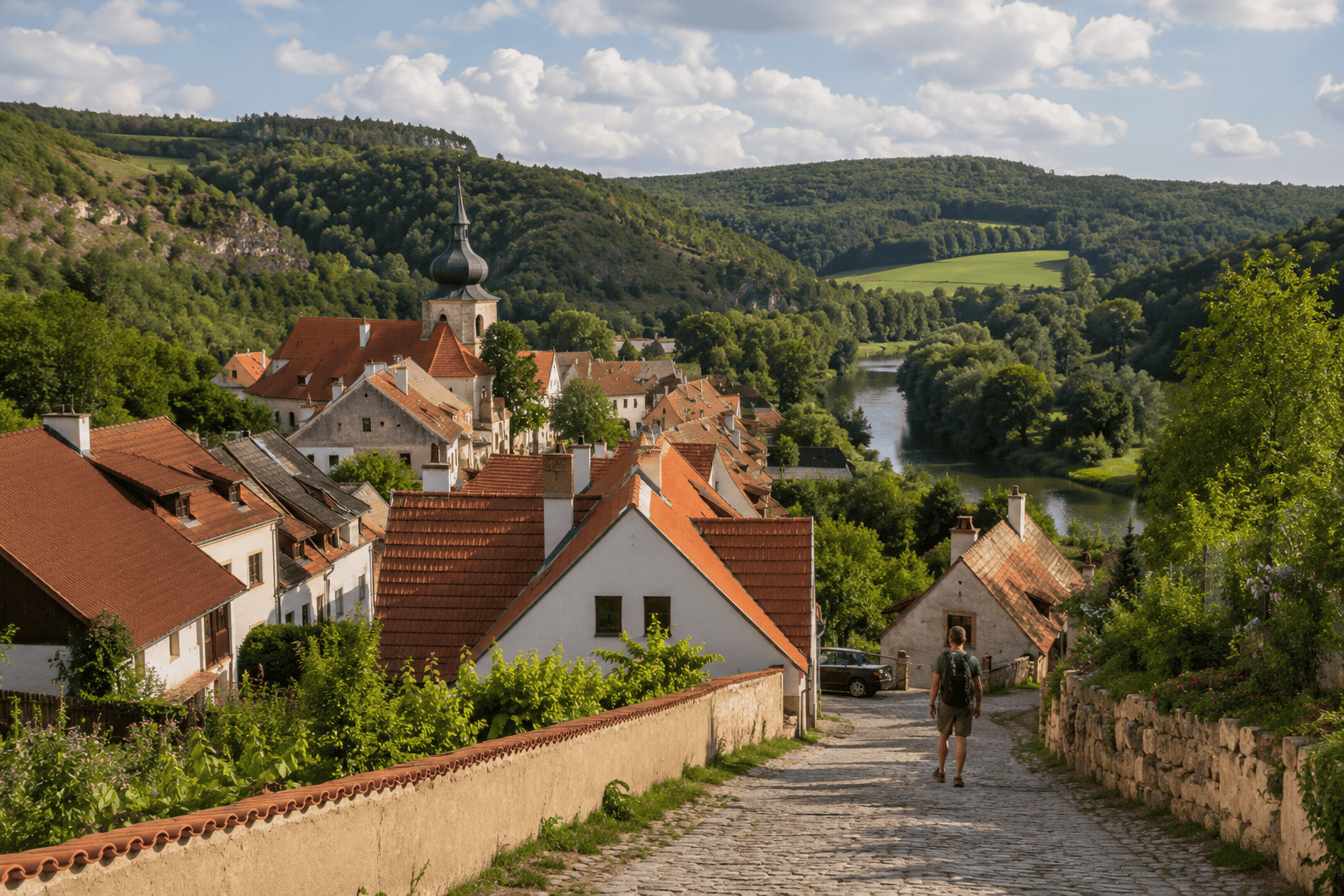
Most travelers land in Prague, spend three days admiring Gothic towers and beer halls, then leave thinking they’ve “done” the Czech Republic. But the real personality of the country often starts outside the capital — in forested hills, spa towns, wine villages, sandstone cliffs, and castle-dotted valleys that feel far removed from the Prague crowds.
The czech countryside rewards travelers who slow down. Trains are affordable, villages are compact, and distances are short enough that you can combine hiking, historic towns, wine tasting, and castle visits in one trip without constantly repacking.
This guide focuses on where to go, how to plan realistically, what the tradeoffs are between regions, and how to experience the Czech countryside beyond the postcard version.
Why Explore the Czech Countryside?
The Czech Republic is one of Europe’s easiest countries for rural travel:
-
Excellent rail connections
-
Affordable accommodations compared to Western Europe
-
Compact geography
-
Safe villages and small towns
-
Dense concentration of castles, forests, and historic centers
-
Strong local food and beer culture
You can leave Prague in the morning and be hiking sandstone canyons, cycling through vineyards, or wandering medieval streets by lunchtime.
The biggest surprise for many travelers is how diverse the landscape feels for such a small country.
Best Regions in the Czech Countryside
South Bohemia: Fairy-Tale Towns and Lakes
South Bohemia is the classic countryside route for first-time visitors.
The region combines:
-
Renaissance towns
-
Forested landscapes
-
Lakes and ponds
-
Historic castles
-
Relaxed rural atmosphere
Don’t Miss:
-
Český Krumlov
-
Hluboká Castle
-
Telč
-
Třeboň fishpond region
-
Šumava National Park
Český Krumlov gets crowded during summer afternoons with day-trippers from Prague. Staying overnight changes the experience completely. After 5 p.m., tour groups disappear and the town becomes dramatically quieter.
Best For
-
First-time countryside visitors
-
Romantic trips
-
Slow travel
-
Photography
-
Castle lovers
Tradeoff
Summer crowds can be intense in Český Krumlov. Visit in May, September, or October for a better balance of weather and atmosphere.
Moravia: Wine Villages and Folk Culture
Many travelers skip Moravia entirely, which is a mistake.
Eastern Czechia feels noticeably different from Prague:
-
More rural
-
More local
-
More wine-focused
-
Less international tourism
Base Yourself In:
-
Brno
-
Mikulov
-
Znojmo
-
Lednice-Valtice area
The South Moravian countryside is ideal for cycling between vineyards and cellar villages. White wine dominates here, and prices are refreshingly reasonable compared to Western European wine regions.
Highlights
-
Lednice Castle
-
Valtice Castle
-
Pálava wine region
-
Traditional wine cellars in villages like Petrov-Plže
Best For
-
Food and wine travelers
-
Cycling trips
-
Repeat visitors to Czechia
-
Travelers wanting fewer crowds
Tradeoff
English is less common in smaller Moravian villages than in Prague or Český Krumlov. Basic planning helps.
Bohemian Switzerland: Sandstone Cliffs and Forest Hikes
Near the German border, Bohemian Switzerland National Park offers some of Central Europe’s most dramatic landscapes.
Think:
-
Sandstone towers
-
Deep forests
-
River gorges
-
Cliff viewpoints
-
Hiking trails crossing into Germany
The region became internationally famous for the Pravčická Gate rock arch, but there’s far more beyond the main viewpoint.
Best Town Bases
-
Hřensko
-
Děčín
-
Jetřichovice
Best For
-
Hiking
-
Nature photography
-
Active travelers
-
Short countryside escapes from Prague
Tradeoff
Public transportation works, but a car gives far more flexibility in this region.
The Highlands (Vysočina): Quiet Rural Czechia
The Vysočina region sits between Prague and Brno but gets far fewer visitors.
This is where you’ll find:
-
Rolling hills
-
Tiny villages
-
Historic churches
-
Rural guesthouses
-
Slower-paced travel
Highlights
-
Telč
-
Pilgrimage Church of Saint John of Nepomuk
-
Local hiking and cycling trails
Best For
-
Travelers wanting quiet
-
Road trips
-
Rural guesthouses
-
Authentic village atmosphere
Tradeoff
Less dramatic scenery than the mountains or sandstone regions.
The Best Castles in the Czech Countryside
The Czech Republic has one of Europe’s highest castle densities.
Some are heavily restored and theatrical. Others feel more atmospheric and worn-in.
Most Impressive Castles
Karlštejn Castle
Easy day trip from Prague but crowded.
Hluboká Castle
Looks almost unreal — inspired by Windsor Castle.
Pernštejn Castle
More rugged and less polished.
Bouzov Castle
Classic fairy-tale architecture.
Loket Castle
Excellent combined with western Bohemia spa towns.
National Parks and Outdoor Areas
The Czech countryside is especially good for casual outdoor travelers because hikes are well-marked and infrastructure is excellent.
Best Outdoor Areas
| Region | Best For | Difficulty |
|---|---|---|
| Bohemian Switzerland | Dramatic hikes | Moderate |
| Šumava National Park | Forests and lakes | Easy–Moderate |
| Krkonoše Mountains | Mountain hiking | Moderate–Hard |
| Moravian Karst | Caves and nature | Easy |
| Pálava Hills | Wine-country hikes | Easy |
The Czech hiking trail system is among Europe’s best marked. Colored trail blazes are reliable even in remote areas.
How to Travel Around the Czech Countryside
By Train
For most travelers, trains are enough.
Advantages:
-
Cheap
-
Frequent
-
Comfortable
-
Reliable between major towns
Best countryside train routes:
-
Prague → Český Krumlov
-
Prague → Brno
-
Prague → Děčín
-
Brno → Mikulov
By Car
Renting a car becomes worthwhile if you want:
-
Remote villages
-
National parks
-
Flexible hiking stops
-
Wine-region exploration
Downsides
-
Historic town parking can be frustrating
-
Village roads are narrow
-
Driving in Prague is unnecessary
A common mistake is renting a car immediately upon arrival in Prague. It’s usually smarter to explore Prague first, then pick up a rental when leaving the city.
Budget Expectations in the Czech Countryside
The Czech countryside is still relatively affordable by European standards, though prices have risen in recent years.
Typical Daily Budget
| Style | Budget |
|---|---|
| Backpacker | €45–70 |
| Mid-range | €90–160 |
| Comfortable | €180+ |
Average Costs
| Expense | Typical Price |
|---|---|
| Guesthouse room | €45–90 |
| Local restaurant meal | €8–15 |
| Beer | €2–4 |
| Castle entry | €6–15 |
| Regional train ride | €5–20 |
Moravia and smaller rural regions are usually cheaper than Prague or Český Krumlov.
Best Time to Visit the Czech Countryside
Spring (April–June)
Excellent weather and green landscapes.
Best For
-
Hiking
-
Castles
-
Fewer crowds
Summer (July–August)
Warmest weather but busiest season.
Best For
-
Festivals
-
Lake regions
-
Outdoor dining
Downsides
-
Crowded tourist towns
-
Higher accommodation prices
Autumn (September–October)
Arguably the best season overall.
Best For
-
Wine regions
-
Hiking
-
Cooler temperatures
-
Fall colors
Winter
More atmospheric than practical outside major towns.
Best For
-
Christmas markets
-
Cozy guesthouses
-
Snowy castles
Mistakes Travelers Make in the Czech Countryside
Trying to See Too Much Too Fast
The country is small, but constant hotel changes kill the relaxed countryside experience.
Instead:
-
Choose 2–3 regional bases
-
Take day trips
-
Stay longer in smaller towns
Only Visiting Český Krumlov
It’s beautiful, but it’s not representative of the entire Czech countryside.
Moravia, Vysočina, and northern Bohemia offer very different experiences.
Assuming Everyone Speaks English
In major tourist areas, yes.
In rural villages:
-
Menus may only be in Czech
-
Staff may know limited English
-
Transport information may require translation apps
Learning a few Czech phrases goes a long way.
Underestimating Public Transport Timing
Small-town train and bus schedules can become infrequent in evenings or on Sundays.
Always double-check return routes before heading into remote areas.
Suggested Czech Countryside Itineraries
5-Day First-Timer Route
Day 1–2
Prague
Day 3
Český Krumlov
Day 4
South Bohemia castles and lakes
Day 5
Return to Prague
10-Day Slow Travel Route
Prague
3 days
South Bohemia
3 days
Moravia
3 days
Brno
1 day
This route balances cities, countryside, wine regions, and historic towns without feeling rushed.
Is the Czech Countryside Worth Visiting?
Absolutely — especially for travelers who prefer:
-
Independent travel
-
Affordable Europe trips
-
Historic towns without massive crowds
-
Scenic train journeys
-
Hiking mixed with culture
-
Slow travel experiences
The Czech countryside works best when approached patiently. Instead of racing between attractions, spend time in local cafés, village guesthouses, hiking trails, and wine cellars.
That’s where the country starts feeling less like a checklist destination and more like a place people actually live.
By Mara Vale for Eurly
Last verified: 2026-05-12