

Post Type: post
This european guide helps travelers plan smarter trips across Europe without overcomplicating the experience. Europe rewards travelers who understand timing, transport, budgets, and realistic itineraries instead of trying to see everything at once. With the right approach, your trip can stay enjoyable from the first city to the last.
This guide covers everything you need to plan a European trip well — from timing and transport to budgets, starter routes, and the mistakes that derail most first-time visitors.
Why Europe Is Both Easier and Harder Than You Expect
Europe is compact, connected, and full of iconic destinations. You can take a morning train from Paris and be in Amsterdam by early afternoon. That proximity is genuinely one of its best qualities.
But short distances on a map do not always translate to easy travel days. Common traps include:
- Airport transfers eating entire afternoons
- Train connections becoming stressful with heavy luggage
- Popular cities crowded and expensive in summer
- Museum-heavy days turning into exhaustion by day three
- Constant hotel changes creating a kind of low-grade burnout
The best European trips balance iconic cities with slower, regional experiences. Rather than visiting ten countries in two weeks, most travelers enjoy Europe more when they limit themselves to two to four countries, reduce the number of hotel changes, mix cities with smaller towns or nature, and build in at least one recovery day per week.
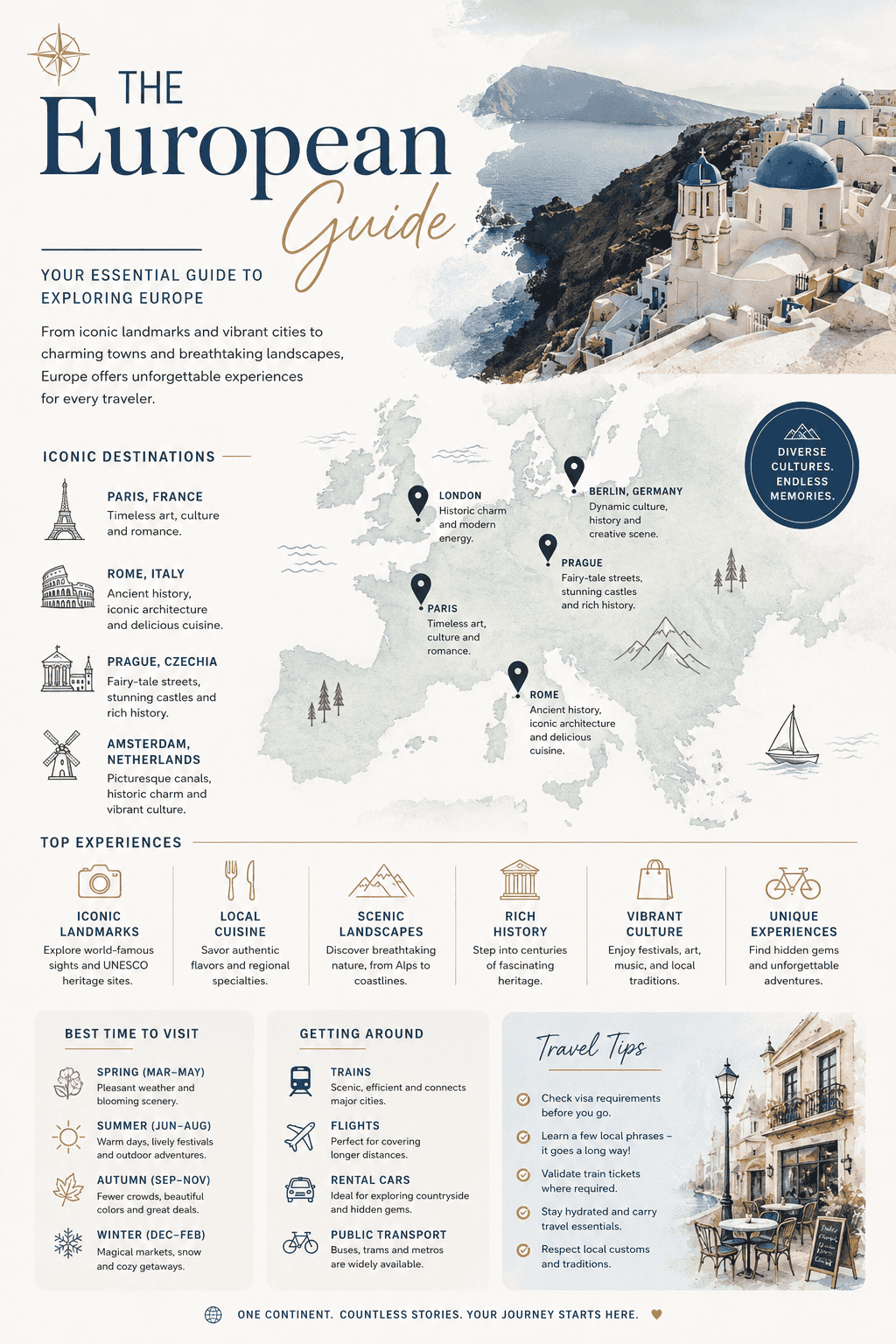
When to Visit Europe: A Practical Season Guide
Timing shapes nearly everything: prices, crowd levels, weather, and local atmosphere.
Spring (April–May)
Spring is one of the most underrated windows for European travel. Temperatures are mild, hotel prices are lower than summer, and popular sites are far less crowded. The Netherlands during tulip season, Italy before the summer heat arrives, southern Spain, and Portugal are all excellent spring choices. The main tradeoff is unpredictable weather, and some coastal resorts have not fully opened yet.
Summer (June–August)
Summer brings the longest days, beach and mountain conditions, and the biggest festivals — along with the highest prices and most intense crowds. Heat waves in southern Europe are increasingly common in July and August. Summer works best when planned strategically: start with cities earlier in the trip before moving to the mountains or coast, and book accommodation and major attractions well in advance.
Fall (September–October)
For many experienced travelers, fall is the best time to visit Europe. Warm weather lingers, tourist numbers drop noticeably, and prices fall across accommodation and transport. Italy, France, Croatia, Greece, and much of Central Europe are all excellent in September and October.
Winter (November–March)
Winter splits into two distinct experiences. Cities like Vienna, Prague, Strasbourg, and Munich transform during December’s Christmas markets — atmospheric, festive, and genuinely worth visiting despite the cold. For warmer winter travel, Portugal, southern Spain, Sicily, and parts of Greece remain mild and considerably cheaper than summer. Expect shorter daylight hours and some seasonal closures, but far fewer crowds.
How Long Should a Europe Trip Be?
The right trip length depends on your priorities and how much travel fatigue you can tolerate.
One Week
Stick to a single region. Good one-week combinations include Paris and Amsterdam, Rome and Florence, Lisbon and Porto, or the Prague–Vienna–Budapest triangle. Trying to cover more ground than this in seven days will feel rushed.
Two Weeks
Two weeks is the sweet spot for most travelers. You can comfortably combine three major cities, one or two smaller towns, and still have some slower days built in. A practical example: London, Paris, a few days in the Swiss Alps, and northern Italy. This pace allows you to see meaningful highlights without feeling like you are constantly in transit.
One Month
A month in Europe calls for a slower approach. Use regional bases and take day trips rather than moving every two to three days. Renting an apartment occasionally makes long stays more practical and helps manage costs. Build recovery days into the schedule deliberately — they are not wasted days.
Getting Around Europe: Transport Options Compared
Trains
Europe’s rail network is one of the great advantages of traveling here. For most city-to-city routes, trains are faster, more comfortable, and less stressful than flying once you factor in airport transfer time. High-speed rail performs especially well on routes like Paris to Amsterdam (Thalys/Eurostar), Rome to Florence (Frecciarossa), Madrid to Barcelona (AVE), and Vienna to Budapest.
The strongest rail countries are France, Italy, Switzerland, Germany, Austria, and the Netherlands. Book point-to-point tickets directly through national rail operators for the best prices; rail passes are not always cheaper, particularly on short itineraries. Note that some high-speed trains require paid seat reservations on top of a pass.
You can compare multi-country routes and rough journey times using Rome2Rio before committing to specific tickets.
Budget Airlines
Budget airlines make sense for long east-west jumps (London to Warsaw, say), island connections, or anywhere with no practical rail link. The hidden costs, however, are real. Airport transfer time, checked baggage fees, and strict carry-on rules can easily turn a €40 advertised fare into a €120+ travel day. Always calculate the full door-to-door cost and time before choosing a flight over a train.
Renting a Car
A car is the right choice in regions with limited rail coverage: Ireland, the Scottish Highlands, Iceland, Tuscany, Provence, the Balkans, and Alpine road trips all reward driving. Avoid renting in major cities — parking in London, Paris, Amsterdam, or Venice is expensive, difficult, and largely unnecessary given public transport quality.
Europe Budget Guide: Daily Costs by Region
Europe ranges from among the world’s most expensive destinations to genuinely budget-friendly, sometimes within the same country.
High-Cost Destinations
Switzerland, Norway, Iceland, and Denmark sit at the top of the price scale.
- Typical mid-range daily budget: €200–€400 per person (accommodation, meals, transport, one attraction)
Moderate-Cost Destinations
France, Germany, Italy, Austria, and the Netherlands fall into the mid-range tier.
- Typical mid-range daily budget: €120–€250 per person
Budget-Friendly Destinations
Portugal, Poland, Hungary, Czech Republic, Romania, Albania, and Bosnia and Herzegovina offer excellent value by European standards.
- Typical mid-range daily budget: €60–€140 per person
Practical Ways to Reduce Costs Across Europe
- Travel in shoulder season. Shifting a trip from July to September or May can reduce total costs by 30–50% across accommodation and transport.
- Stay near transit, not tourist landmarks. A hotel fifteen minutes from the historic centre by metro can save hundreds over a week-long stay.
- Mix your meals strategically. One memorable dinner, casual lunches at local places, and occasional grocery breakfasts is a sensible balance. Eating every meal beside a famous landmark is where budgets collapse.
- Use regional trains for scenic routes. In Switzerland and Austria, slower regional trains are often cheaper than high-speed options and significantly more scenic.
Starter Itineraries: Four Routes Worth Considering
Classic Western Europe (Best for First-Timers)
London, Paris, Amsterdam. This triangle has excellent transport links (Eurostar, Thalys), major landmarks, English widely spoken, and straightforward logistics. The main tradeoff is cost — all three cities are expensive. Plan for at least four nights total minimum to avoid spending most of your time on trains.
Italy Focus
Rome, Florence, Tuscany, Venice. Italy rewards a slower, deeper approach: the art, food, architecture, and countryside are all excellent. The high-speed Frecciarossa makes Rome–Florence in 1.5 hours and Florence–Venice in 2 hours. Avoid July and August if crowds concern you — spring and fall are significantly more enjoyable.
Central Europe Triangle
Prague, Vienna, Budapest. This route combines beautiful historic architecture, efficient overnight or daytime trains, strong café culture, and costs that run noticeably lower than Western Europe. Vienna to Budapest takes around 2.5 hours by direct train; Prague to Vienna takes around four hours.
Iberian Peninsula
Lisbon, Porto, Seville, Granada, Barcelona. Iberia suits slower travel and is especially strong in winter and spring when southern Europe is mild and the rest of the continent is cold. Food, architecture, and value are all high. Note that rail between Portugal and Spain is slower than in Western Europe — budget extra time or consider a flight for the Lisbon–Seville leg.
Common Europe Travel Mistakes
Trying to See Too Much
This is by far the most common error. An itinerary with twelve cities in fourteen days will likely produce stress rather than memories. Most travelers who over-schedule Europe look back on it not with satisfaction at everything they covered, but with regret that they barely experienced any of it properly. Two to four countries in two weeks is a reasonable ceiling.
Underestimating Travel Fatigue
Real travel involves laundry, transit delays, jet lag, decision fatigue, and walking distances that GPS cannot fully prepare you for. Ten-hour museum days and 6am airport departures every other morning are not sustainable. Build at least one slow morning or rest afternoon into every three or four days.
Skipping Advance Reservations
In peak season, major trains, attractions, and restaurants fill up days or weeks in advance. Book timed entries ahead for the Eiffel Tower, the Vatican Museums, the Anne Frank House, Sagrada Família, and the Alhambra. Showing up at the ticket office for any of these in July is a reliable way to waste a morning.
Overpacking
Cobblestones, narrow staircases, compact lifts, and overhead train racks punish oversized luggage. Most experienced European travelers eventually settle on carry-on only, or a compact backpack plus a small roller. Neutral, layerable clothing does most of the work.
Accommodation: Which Type Works Best
The right accommodation type depends on your travel style, group size, and trip length.
- Hotels work well for short stays, couples, and anyone who values predictability and reception desks.
- Apartments suit families, trips of five or more days in one city, and anyone who wants laundry access or a kitchen to reduce food costs.
- Hostels are no longer only for twenty-year-olds — modern European hostels with private rooms often sit in excellent locations at lower prices than comparable hotels, with the option of a social common area.
Food Culture: What Changes Across Europe
Dining culture varies significantly by region, and understanding it makes the experience much better.
Northern Europe generally means earlier dining hours, more expensive restaurants, and simpler traditional cuisine. Budget accordingly — a basic dinner in Oslo or Copenhagen can cost what a fine meal costs in Lisbon.
Southern Europe — Spain, Italy, Portugal, Greece — operates on later schedules, with dinner typically starting at 8pm or later. Meals are longer and more social. Value is generally much better, and café culture is deeply embedded in daily life.
Central Europe (Austria, Czech Republic, Hungary) is known for hearty, affordable meals, strong beer culture, and some of the continent’s finest historic café interiors. Lunch menus at sit-down restaurants often offer the best value — a two-course lunch in Prague or Vienna for €10–€15 is genuinely attainable.
Safety, Connectivity, and Practical Logistics
Europe is broadly safe, but a few consistent hazards are worth being aware of:
- Pickpocketing in crowded tourist zones and metros — particularly Paris, Barcelona, and Rome transit hubs
- Taxi overcharging at airports where metered or app-based services are not used
- Scams targeting tourists near major monuments (petition clipboards, friendship bracelets, overly helpful strangers)
Practical countermeasures: use a cross-body bag, keep passports and backup cards separate from your wallet, and use official or app-based taxis at airports.
For connectivity, most international travellers find an eSIM the simplest solution — several providers offer multi-country European data plans for €15–€30 for two to four weeks. Contactless card payments work almost everywhere in Western and Central Europe; carry a small amount of cash for rural areas, markets, and smaller towns in Eastern Europe.
For planning and booking rail journeys across borders, Interrail (for European residents) and Eurail (for non-European visitors) both offer pass options worth comparing against point-to-point ticket prices, particularly for longer trips.
Slow Travel vs Fast Travel: Choosing Your Pace
Pace is one of the most consequential decisions you will make when planning a Europe trip.
Fast travel — moving every one to two days — maximises the number of places seen. It works for travelers with limited time and specific bucket-list targets. The tradeoffs are real: fatigue accumulates quickly, and arriving in a new city often means an hour or two just finding your feet before sightseeing can begin.
Slow travel — spending four or more nights in each base — allows actual familiarity with a neighbourhood, easier budgeting (accommodation rates drop for longer stays), lower logistical stress, and a genuinely different quality of experience. The tradeoff is fewer total destinations.
Many experienced travellers eventually land on a hybrid: fewer bases, more day trips from each one. A week in Seville with day trips to Córdoba and Cádiz is often more memorable than one night in each of five cities.
Best European Destinations by Interest
- Art and museums: Paris, Florence, Madrid, Vienna
- Food lovers: Bologna, San Sebastián, Lyon, Naples
- Scenic nature: Swiss Alps, Norwegian fjords, Scottish Highlands, Dolomites
- Beaches: Greek islands, Algarve, Croatian coast, Sardinia
- History: Rome, Athens, Berlin, Kraków
- Architecture and atmosphere: Prague, Lisbon, Dubrovnik, Bruges
Frequently Asked Questions
How many countries should I visit in two weeks in Europe?
Two to four countries is a realistic and enjoyable target for a two-week trip. Three is a common sweet spot — it gives you meaningful time in each place without constant packing and transit. Trying to cover six or more countries in two weeks is possible but typically results in surface-level experiences and cumulative exhaustion.
Is a Eurail or Interrail pass worth it for Europe?
It depends on your route. Passes offer good value for long, multi-country itineraries with frequent travel — roughly three or more medium-to-long train journeys in a week. For shorter trips or routes where you can book point-to-point tickets early, individual tickets are often cheaper. Always compare pass prices against actual ticket costs for your specific route before buying. Note that many high-speed trains require a seat reservation fee on top of the pass.
What is the cheapest time to travel to Europe?
November through early March (excluding Christmas market weeks in December) is generally the cheapest period across most of Europe. Spring shoulder season — April and early May — offers a strong balance of reasonable prices and good weather. July and August are consistently the most expensive, particularly for accommodation in major cities and coastal destinations.
Do I need to book European attractions in advance?
For peak season (June–August) and popular sites, yes — often weeks in advance. Timed-entry tickets for the Vatican Museums, Sagrada Família, the Alhambra, the Eiffel Tower summit, and the Anne Frank House sell out regularly. In shoulder or off-season, advance booking is less critical but still advisable for the biggest draws. Most official booking links can be found directly on each attraction’s website.
Is Europe safe for solo travelers?
Yes, broadly speaking. Western, Central, and Northern Europe are among the safest travel regions in the world for solo travellers, including solo women. The main risks are opportunistic — pickpocketing in tourist-heavy zones and transit hubs — rather than serious crime. Standard precautions (secure bags, awareness in crowded areas, not flashing valuables) are sufficient in almost all destinations covered in a standard European itinerary.
How much does a typical two-week Europe trip cost?
This varies considerably by region, season, and travel style. A rough mid-range estimate for Western Europe (France, Italy, Netherlands) on a two-week itinerary runs €2,500–€5,000 per person including accommodation, daily transport, food, and attractions — excluding the international flight. Central or Eastern European itineraries can run meaningfully lower. Traveling in shoulder season, booking trains early, and staying slightly outside historic centres each reduce costs significantly.
By Mara Vale for Eurly
Last verified: May 2025

Mara Vale
Mara Vale writes Eurly travel guides for first-time Europe visitors who want practical routes, realistic pacing, and fewer avoidable planning mistakes.
Eurly guides are written to help readers make confident travel decisions, but opening hours, ticket rules, transit disruptions, and local conditions can change. Always verify key reservations and official schedules before you travel.