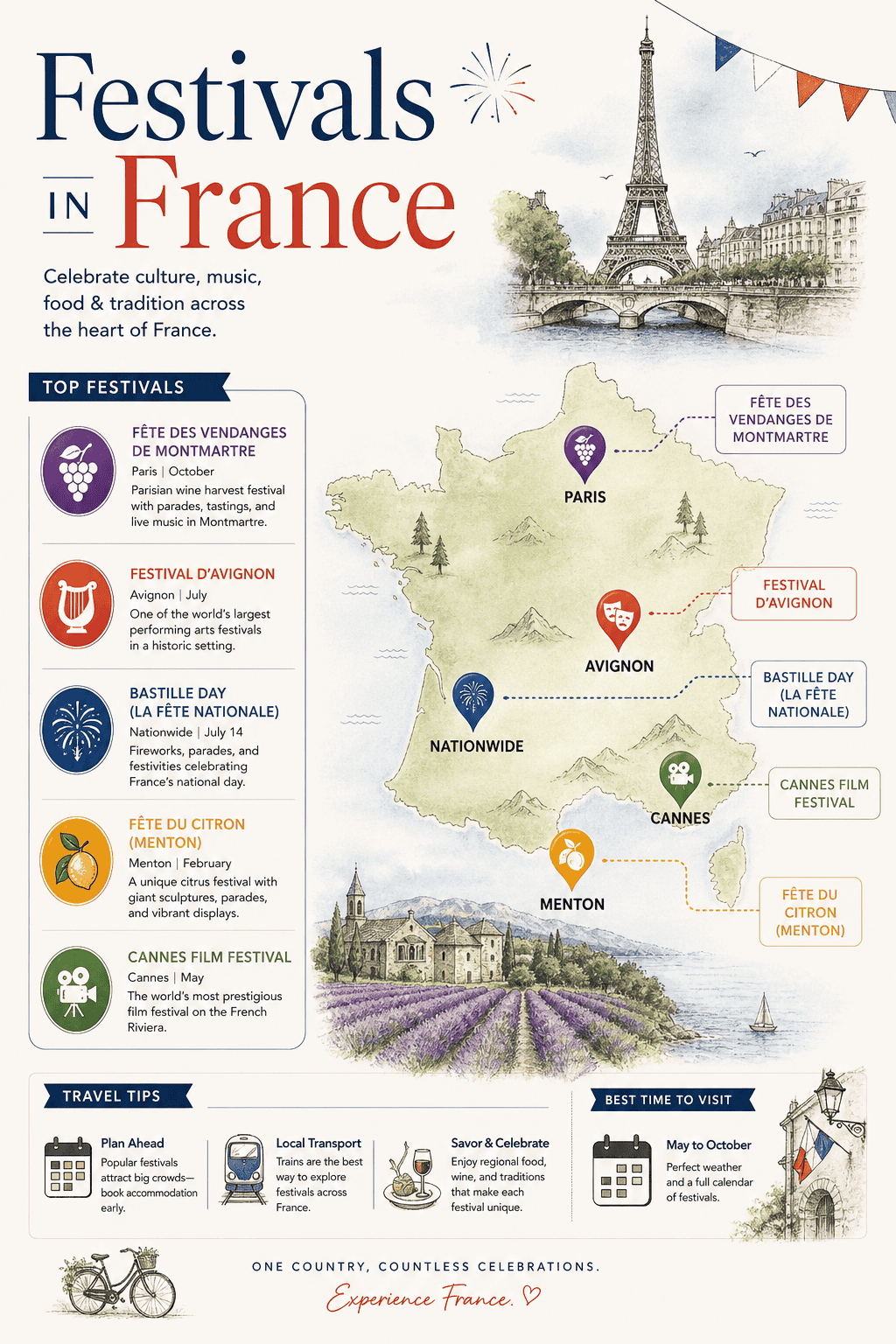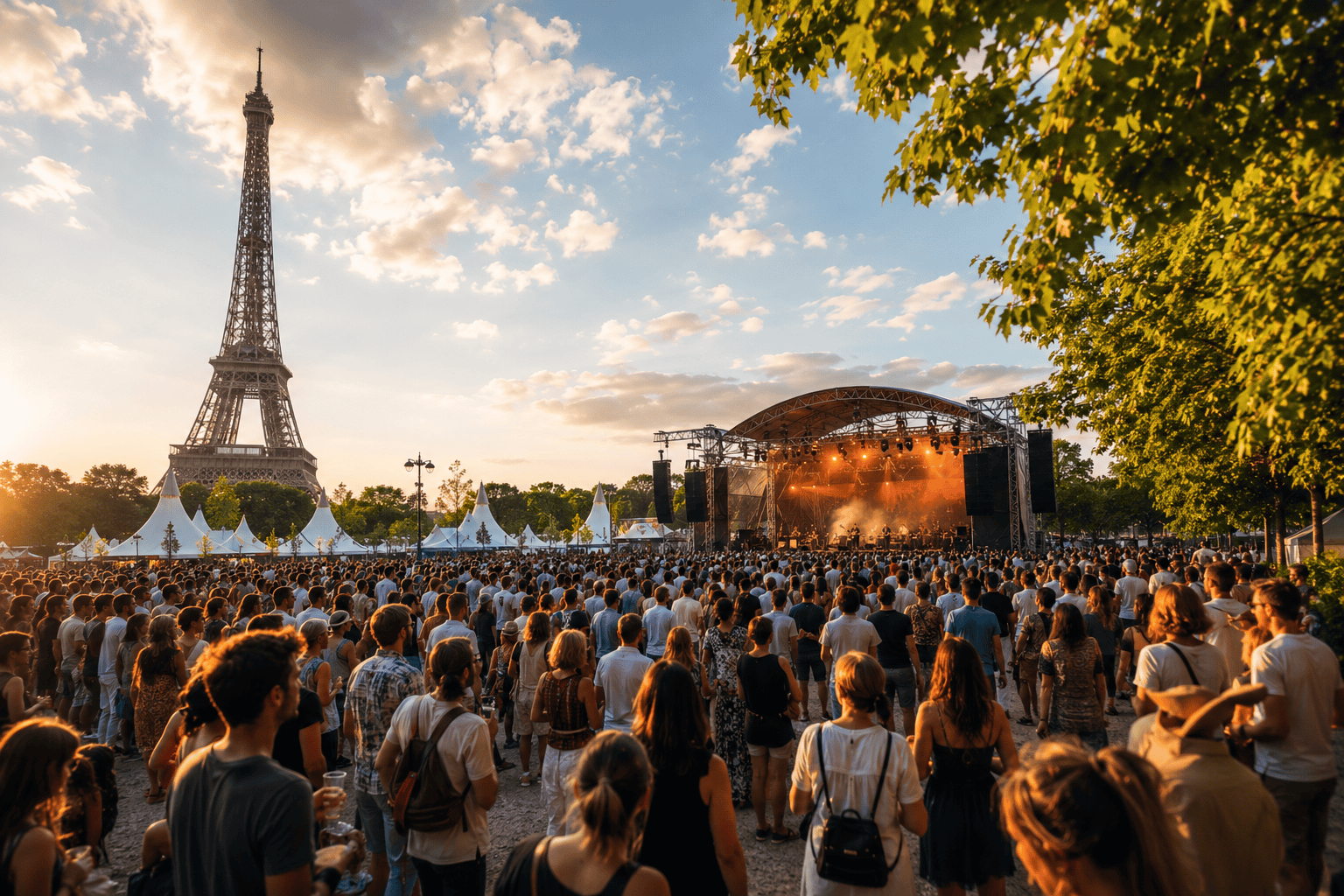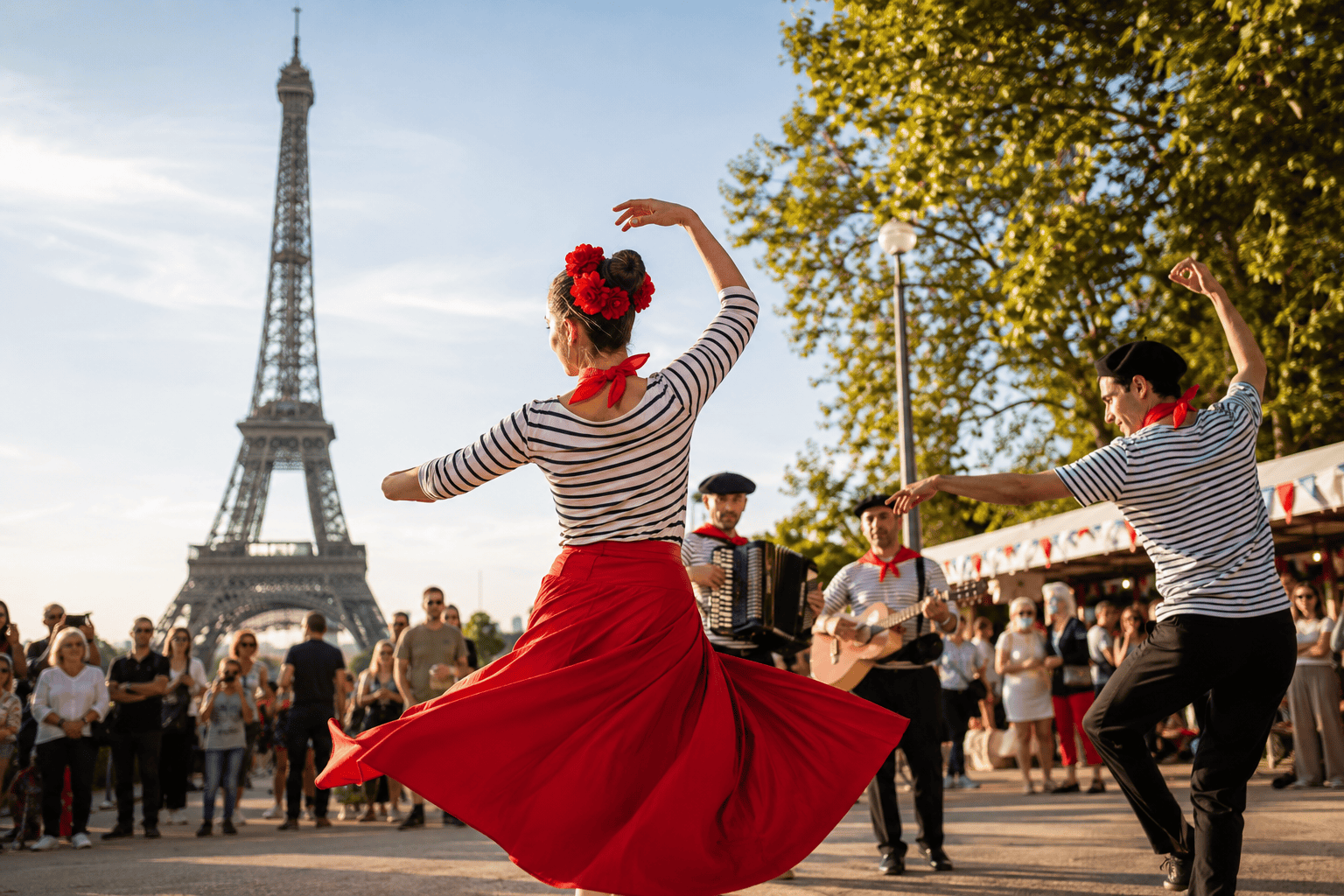
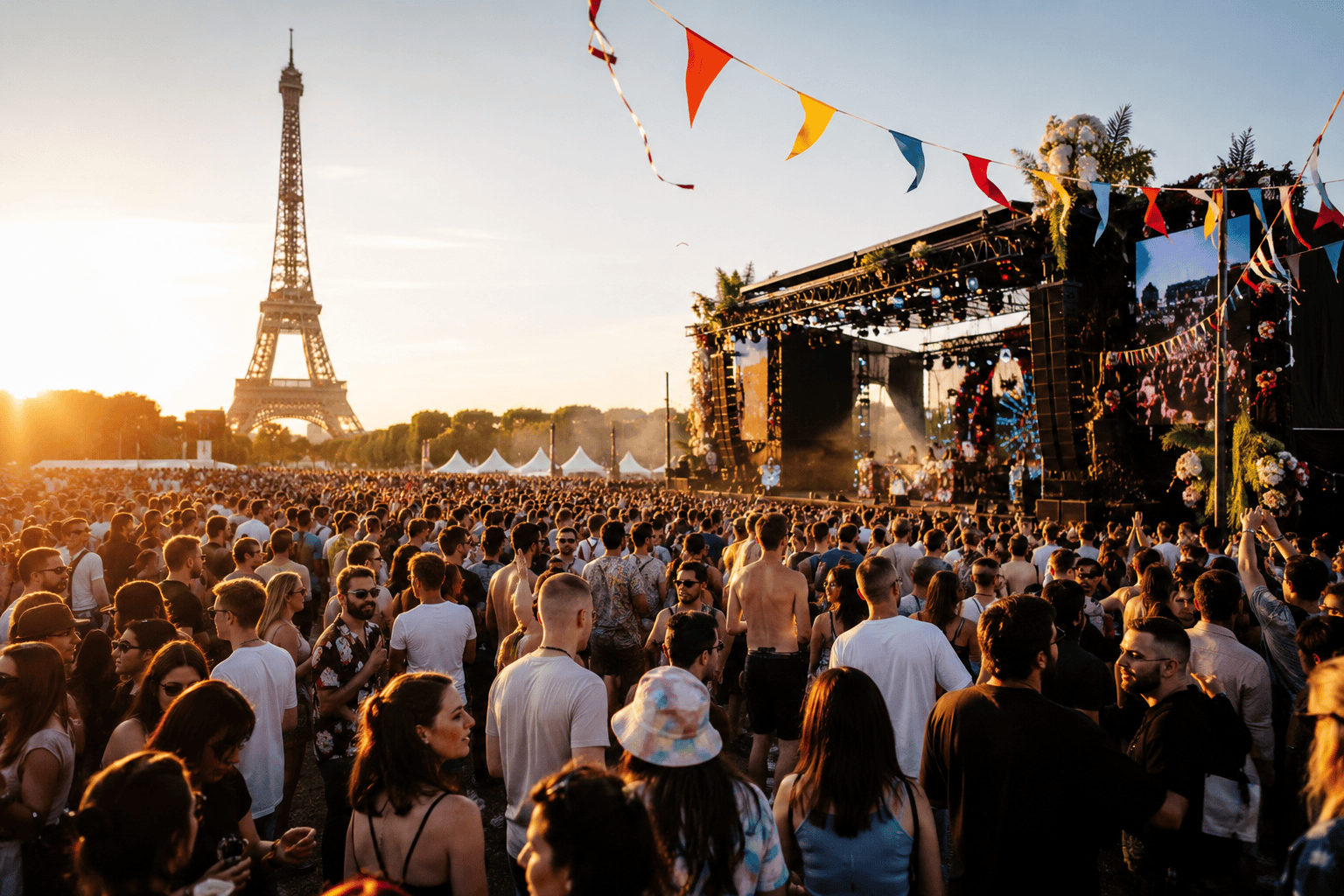
France runs on celebration. From world-famous film premieres on the Riviera to free open-air concerts in every town square, the country hosts hundreds of festivals every year — and timing your visit around one of them can completely change what you experience. This guide covers the best festivals in France by season, what each one actually involves, what it costs to attend, and how to get there without overpaying.
Quick Overview
- Peak festival season: June–August, with highlights year-round
- Free festivals: Fête de la Musique (nationwide, 21 June) and Bastille Day events (14 July) cost nothing to attend
- Big-ticket events: Cannes Film Festival, Avignon Festival, Les Vieilles Charrues
- Best for culture: Avignon (theatre), Lyon Lumières (light art), Printemps de Bourges (music)
- Book accommodation early: During major festivals, hotel prices in host cities double or triple — aim for 3–6 months ahead
Winter and Spring Festivals (January–May)
Nice Carnival — February, Nice
Nice Carnival is one of the oldest and largest carnivals in the world, running for roughly two weeks each February along the Promenade des Anglais and through the old town. The main events are the Flower Battles (batailles de fleurs), where flower-covered floats parade along the seafront, and the King Carnival processions with giant satirical papier-mâché figures.
Dates: Usually the first two weeks of February (tied to the pre-Lent calendar — dates shift each year).
Tickets: Tribune seating for the parades runs roughly €15–€35 per session. Many street sections are free to watch from the pavement, though views are limited.
Getting there: Nice-Côte d’Azur Airport connects to most European cities. From Nice Ville station, the city centre is a 10-minute walk.
Tip: Book accommodation in Nice at least 3 months in advance. Nearby Antibes or Cannes are cheaper alternatives with direct train connections (20–30 minutes, under €10).
Printemps de Bourges — April, Bourges
One of France’s most respected music discovery festivals, Printemps de Bourges has been running since 1977. The five-day event in late April focuses on French-language music and emerging artists across genres — rock, pop, hip-hop, electronic — with both ticketed indoor shows and free outdoor stages in the city centre.
Dates: Late April (typically the last week).
Tickets: Day passes from around €25–€45. A five-day pass runs €80–€120. Many outdoor concerts are free.
Getting there: Bourges is 2.5 hours from Paris Austerlitz by direct train (from around €20 booked early). The festival venues are all walkable from the station.
Tip: This is a genuine industry festival, so hotel rooms in Bourges fill quickly. Châteauroux (40 minutes by train) offers cheaper overflow accommodation.
Cannes Film Festival — May, Cannes
The Cannes Film Festival is probably France’s most internationally recognised annual event. It runs for 12 days in mid-May and transforms the Boulevard de la Croisette into a red-carpet zone. The competition screenings and industry screenings require accreditation, but there are real options for regular visitors: a limited number of public tickets are available for out-of-competition films, and the short film screenings at the Cinéma de la Plage (open-air beach cinema) are free to attend.
Dates: Mid-May, 12 days (exact dates vary).
Public access: Short and independent film screenings are available to the public — check the official site for the public ticket release date, usually 1–2 weeks before the festival opens.
Getting there: Cannes station is on the main TGV line. From Nice Airport, the train takes around 30 minutes (€5–€10). Nice to Cannes by train is around 40 minutes.
Tip: Accommodation in Cannes during the festival starts at €150+ per night for a basic room. Antibes (15 minutes by train, ~€7) is the most practical cheaper base.
Summer Festivals (June–August)
Fête de la Musique — 21 June, Nationwide
Every year on 21 June — the summer solstice — France holds Fête de la Musique, a completely free nationwide music celebration. Every town and city opens its streets, parks, courtyards, and public spaces to live performances: classical, jazz, electronic, folk, hip-hop, amateur, and professional. In Paris alone, thousands of concerts take place across all 20 arrondissements.
Cost: Free. No tickets, no registration.
Best cities for it: Paris (most density of events), Lyon, Bordeaux, Marseille, Nantes, and Strasbourg all have strong programmes. Even small villages hold events.
Tip: This is one of the best days of the year to be in France if you’re already visiting. Check local mairie (town hall) websites for neighbourhood-level programmes.
Festival d’Avignon — July, Avignon
Avignon Festival is Europe’s largest theatre and performing arts festival, held every July for three weeks in the Vaucluse. The official (“In”) programme takes place across the city’s historic monuments — the Palais des Papes courtyard is the most famous stage — while the fringe (“Off”) programme runs simultaneously with hundreds of companies performing in venues across town, many with free or low-cost access.
Dates: First three weeks of July.
Tickets (In programme): €8–€38 per show, with reduced rates for under-26s and early-bird bookings.
Tickets (Off programme): €8–€18 per show; some performances are free.
Getting there: Avignon TGV station has direct high-speed trains from Paris (~2h40), Marseille (~35 min), and Lyon (~1h). A shuttle bus connects TGV station to the city centre.
Tip: Buy “In” tickets early — the most popular shows sell out within days of going on sale in spring. The “Off” festival is more spontaneous and easier to access on arrival.
Bastille Day — 14 July, Nationwide
France’s national day on 14 July is marked with free events across the entire country. The Paris military parade on the Champs-Élysées is the main televised spectacle, but every city, town, and village holds its own celebrations: fireworks, outdoor dances (bals des pompiers — fire station dances that are a genuine French tradition), and concerts. No tickets needed anywhere.
Cost: Free everywhere.
Best fireworks beyond Paris: Lyon’s fireworks over the Rhône, the Eiffel Tower display seen from Trocadéro or Champ-de-Mars, and the Marseille harbour display are all consistently good.
Tip: Arrive early for the Champs-Élysées parade (4–5 hours early for a good spot). For fireworks in Paris, the best free viewing areas fill up from early evening.
Les Vieilles Charrues — July, Carhaix-Plouguer (Brittany)
Les Vieilles Charrues is France’s biggest music festival by attendance — over 70,000 people per day — held across four days in July in the small Breton town of Carhaix-Plouguer. The lineup spans mainstream pop and rock to electronic and world music. The atmosphere is strongly community-focused; this is not a luxury festival.
Dates: Third or fourth week of July (four days).
Tickets: Day passes around €50–€65; four-day passes €130–€160. Camping is additional (around €30 for the full event).
Getting there: Carhaix is not on a main rail line. The festival runs shuttle buses from Brest (1.5h), Quimper (1h), and Rennes (2h), with trains connecting those cities to Paris.
Tip: Camping on-site is recommended — the festival town essentially triples in population and accommodation nearby is extremely limited.
Festival Interceltique de Lorient — August, Lorient (Brittany)
For ten days every August, Lorient becomes the global capital of Celtic culture. The Festival Interceltique brings together musicians, dancers, and artists from all seven Celtic nations — Brittany, Ireland, Scotland, Wales, Cornwall, the Isle of Man, and Galicia — for concerts, parades, and free street performances. Around 700,000 people attend across the ten days.
Dates: First ten days of August.
Tickets: Ticketed evening concerts from €15–€45. The Grand Parade and many daytime events are free.
Getting there: Lorient station has direct TGV connections from Paris (~3h15) and regional trains from Rennes and Vannes.
Tip: Book accommodation 4–6 months ahead. Vannes (40 minutes by train) is a practical alternative base.
Rock en Seine — August, Paris
Rock en Seine is Paris’s main outdoor rock and alternative music festival, held over three days in late August in the grounds of the Domaine National de Saint-Cloud, just west of the city. The setting is unusually beautiful for a music festival — a hillside park with views over the Seine — and the lineup typically includes major international headliners alongside French and European acts.
Dates: Last weekend of August (three days).
Tickets: Day passes from around €55–€75; three-day passes from €120–€150.
Getting there: RER C to Pont de Saint-Cloud or the Brimborion cable car from Boulogne. The festival is 30–40 minutes from central Paris by public transport.
Tip: This is one of the most accessible major festivals in France — no camping needed, and Paris accommodation is well-connected.
Autumn and Winter Festivals (September–December)
Nantes Voyage à Nantes — Summer into Autumn, Nantes
While technically a city-wide art trail rather than a single event, Voyage à Nantes runs from late June through September and functions as one of France’s most creative cultural festivals. Permanent and temporary public artworks, installations, and events are scattered throughout the city, with a free green line painted on pavements to guide visitors between them.
Cost: The trail itself is free. Some venues charge entry (usually under €10).
Getting there: Nantes is 2h15 from Paris Montparnasse by TGV (from €25 booked early).
Fête des Lumières — December, Lyon
Lyon’s Festival of Lights is arguably the most spectacular free event in France. For four nights in early December (around 8 December), the entire city is transformed: public buildings, streets, bridges, and squares are covered in large-scale light installations and video projections by artists from around the world. Around two million visitors attend across the four nights.
Dates: Four nights, typically 5–8 December (dates adjusted for weekend proximity).
Cost: Completely free. No tickets needed for any of the main displays.
Getting there: Lyon Part-Dieu station is on the main TGV axis — 2 hours from Paris, 1h40 from Marseille, 1h55 from Strasbourg.
Tip: Book accommodation 4–6 months in advance. Hotel prices in Lyon during Fête des Lumières are some of the highest of the year. Bourg-en-Bresse (30 minutes by train) is a workable base if Lyon is sold out.
Festival Planning: Practical Tips
Booking Accommodation
For any festival drawing over 30,000 people, treat accommodation as your first booking — before tickets, before trains. In smaller host towns (Carhaix, Lorient, Avignon), rooms within 30km can be fully booked 3–4 months ahead at peak season prices.
Getting Around During Festivals
Most major French festivals run dedicated shuttle buses from the nearest train station. Driving to the event site is almost never the right choice — parking is usually remote, traffic is bad on arrival and departure days, and rail connections exist for every event on this list.
Budget Planning
- Free festivals (Fête de la Musique, Bastille Day, Fête des Lumières): Cost nothing to attend. Your main expenses are travel and accommodation.
- Mid-range ticketed events (Avignon Off, Printemps de Bourges): Budget €80–€150 for tickets across a weekend, plus travel and accommodation.
- Large music festivals (Les Vieilles Charrues, Rock en Seine): Budget €120–€200 for a multi-day pass, plus €30–€50 for camping or accommodation.
- Premium events (Cannes public access, Avignon In): Individual shows are affordable (€15–€38), but accommodation costs during these events are significantly higher than normal.
Official External Resources
- Festival d’Avignon — Official Site — programme, tickets, and accreditation
- Festival de Cannes — Official Site — public screenings and accreditation information
- Fête de la Musique — Official France.fr Directory — event finder by city
Frequently Asked Questions
What is the biggest festival in France?
By daily attendance, Les Vieilles Charrues in Brittany is France’s largest music festival, drawing over 70,000 people per day. Fête des Lumières in Lyon attracts the most total visitors of any French event — roughly two million over four nights — though it is a free, city-wide event rather than a gated festival.
Which festivals in France are completely free?
Fête de la Musique (21 June, nationwide), Bastille Day celebrations (14 July, nationwide), Fête des Lumières (Lyon, December), and much of the Festival Interceltique de Lorient’s daytime programme are entirely free to attend. The Festival d’Avignon’s “Off” fringe also includes free performances.
When is the best time to visit France for festivals?
June and July offer the highest density of major events: Fête de la Musique, Avignon Festival, Bastille Day, and Les Vieilles Charrues all fall within six weeks of each other. If summer travel isn’t possible, February (Nice Carnival) and December (Fête des Lumières in Lyon) are the strongest alternatives.
Do I need to book Avignon Festival tickets in advance?
For the official “In” programme, yes — popular shows sell out days after the ticket release in spring. For the “Off” fringe programme, advance booking is not usually required, though some smaller venues have limited capacity. The “Off” programme suits spontaneous planning far better than the “In” programme.
Can tourists attend the Cannes Film Festival?
Without industry accreditation, access to competition screenings is not available to the general public. However, a limited number of public tickets are released for out-of-competition films, and the Cinéma de la Plage beach screenings are free. The Croisette itself is open to everyone during the festival.
Which French festival is best for families?
Fête de la Musique and Bastille Day are the most family-friendly — they’re free, spread across entire cities, and involve no crowded festival site logistics. Festival Interceltique de Lorient is also well-suited to families, with a mix of ticketed concerts and free parades and street performances throughout the city.
By Mara Vale for Eurly
Last verified: May 2025. Festival dates, ticket prices, and programme formats change annually — always confirm via official festival websites before booking travel.