Post Type: post
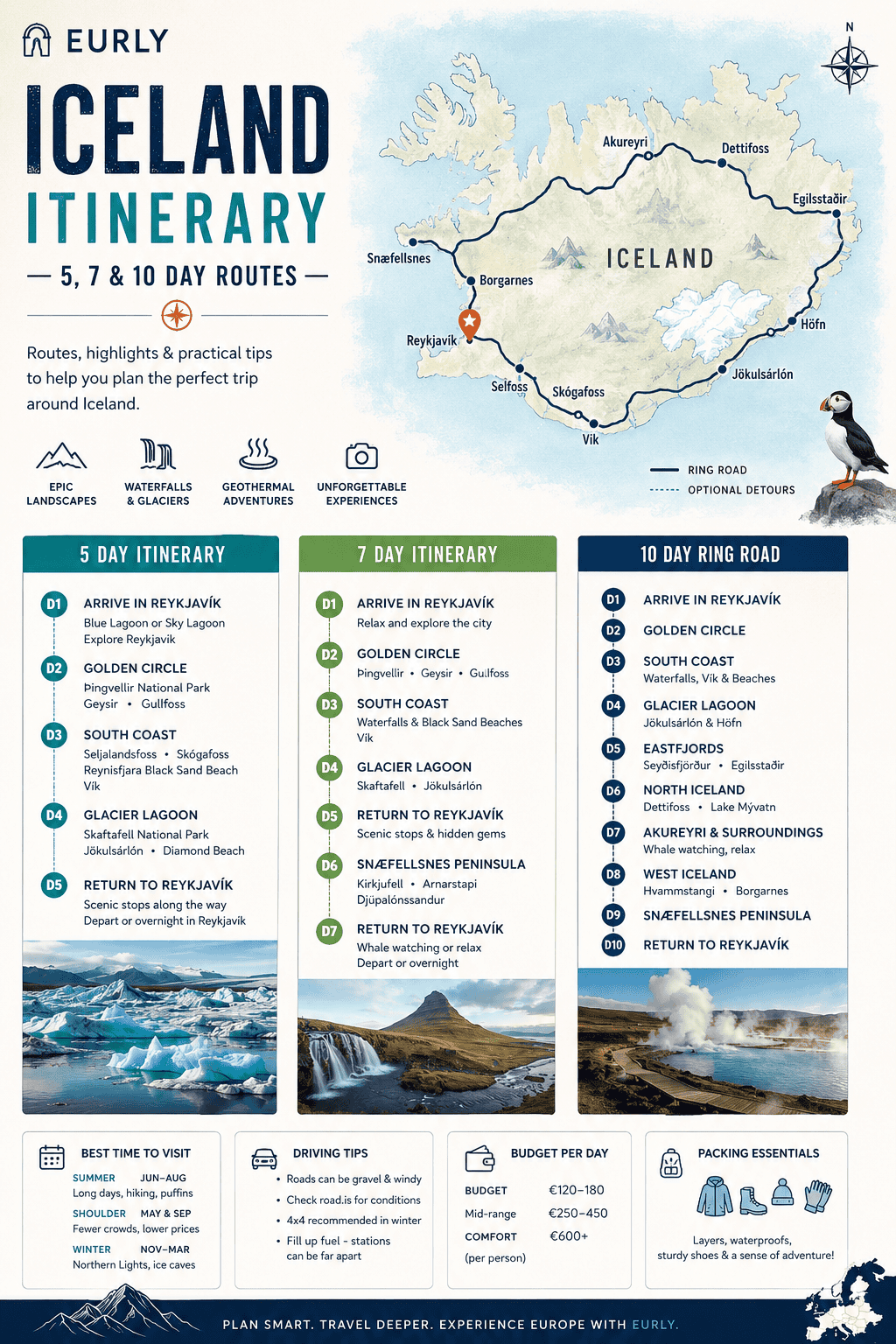
This Iceland itinerary guide helps you plan a realistic 5, 7, or 10-day road trip without rushing through the country’s best landscapes. Distances are longer than they look, weather can close roads unexpectedly, and trying to fit every waterfall and lagoon into one trip often leads to burnout instead of enjoyment. These itineraries include honest advice on driving times, costs, accommodation strategy, and where to slow down.
Quick Facts Before You Start Planning
- Trip lengths covered: 5 days, 7 days, 10 days
- Main gateway: Keflavík International Airport (KEF), 50 km from Reykjavík
- Getting around: Rental car (essential for most itineraries)
- Daily budget range: €120–600+ depending on travel style
- Best shoulder seasons: May and September (lower prices, manageable weather)
- Currency: Icelandic Króna (ISK); card payments accepted almost everywhere

Best Time to Visit Iceland
The season you visit shapes nearly every decision — from which roads are open to how long you have daylight for driving.
Summer (June–August)
Peak season brings the midnight sun, hiking access to highland routes like the Laugavegur Trail, and puffin sightings along the south coast. The tradeoffs are real: accommodation books out months ahead, the most famous stops (Seljalandsfoss, Jökulsárlón) feel crowded mid-day, and rental car prices are at their highest. Book everything well in advance.
Winter (November–March)
The draw is the aurora borealis, blue ice caves inside Vatnajökull glacier, and a landscape blanketed in snow. The challenge is short daylight — as few as four to five hours in December — unpredictable weather, and roads that can close overnight. Highland F-roads are entirely off-limits. Winter works well for travellers who stay flexible and base themselves wisely.
Shoulder Seasons (May and September)
For most independent travellers, May and September offer the best balance. Crowds are thinner, prices drop noticeably, and weather — while never guaranteed — tends to be more manageable than deep winter without the chaos of July. September also brings a reasonable chance of northern lights on clear nights.
How Many Days Do You Actually Need?
The honest answer depends on what you want to see — and how much you enjoy driving.
3–4 days: Enough for Reykjavík, the Golden Circle, and the western end of the South Coast. Not enough for glacier lagoons or anything north of Vík.
5–7 days: The sweet spot for first-time visitors. You can cover the South Coast properly, reach Jökulsárlón, and add either the Snæfellsnes Peninsula (7 days) or a slower pace on the same route (5 days).
10+ days: The Ring Road becomes viable. You gain access to the Eastfjords, North Iceland, Lake Mývatn, and Akureyri — regions that feel genuinely different from the classic south coast corridor.
The 5-Day Iceland Itinerary
This is the most practical first-trip route: focused on the south, with no wasted driving time and two nights in the same place to reduce packing and unpacking fatigue.
Day 1 — Arrive at Keflavík + Reykjavík
Most transatlantic and European flights land at Keflavík before noon. Collect your rental car immediately — the airport desks are straightforward — and resist the urge to drive south straight away.
A sensible first day looks like this: soak at the Blue Lagoon (pre-book; it’s 20 minutes from the airport) or the more local Sky Lagoon on the Reykjavík waterfront, then ease into the city. Walking Laugavegur street, looking up at Hallgrímskirkja, and grabbing dinner near the Old Harbour is enough for a jet-lagged arrival day.
Budget note: public geothermal swimming pools (like Vesturbæjarlaug or Laugardalslaug) cost around €8–10 and offer a more local experience than the Blue Lagoon’s €60–90 standard entry.
Overnight: Reykjavík
Day 2 — The Golden Circle
Driving time: approximately 4–5 hours including stops.
The Golden Circle is one of Iceland’s most-visited day routes for good reason: three genuinely impressive sites within 300 km of Reykjavík, all accessible on a single loop.
- Þingvellir National Park — a UNESCO World Heritage site where the Eurasian and North American tectonic plates are visibly pulling apart. Allow at least 90 minutes.
- Geysir geothermal area — the original geyser, now mostly dormant, but neighbouring Strokkur erupts every 5–8 minutes.
- Gullfoss waterfall — a two-tiered cascade on the Hvítá river that looks different from every angle.
Optional additions if you have time: the Secret Lagoon near Flúðir, the Kerið volcanic crater (€5 entry), or Friðheimar tomato farm for a casual lunch. Don’t add all three — pick one.
Overnight: Hella or Selfoss (positions you well for Day 3)
Day 3 — South Coast: Waterfalls, Black Sand, and Vík
Driving time: approximately 4 hours including stops.
This is frequently the day travellers describe as Iceland’s most scenic. The route east from Selfoss follows the base of steep cliffs with almost constant views.
- Seljalandsfoss — a curtain waterfall you can walk behind on a dirt path (bring waterproofs)
- Skógafoss — wide, powerful, and worth climbing the staircase beside it for elevated views
- Dyrhólaey — a basalt arch headland with puffin colonies in summer
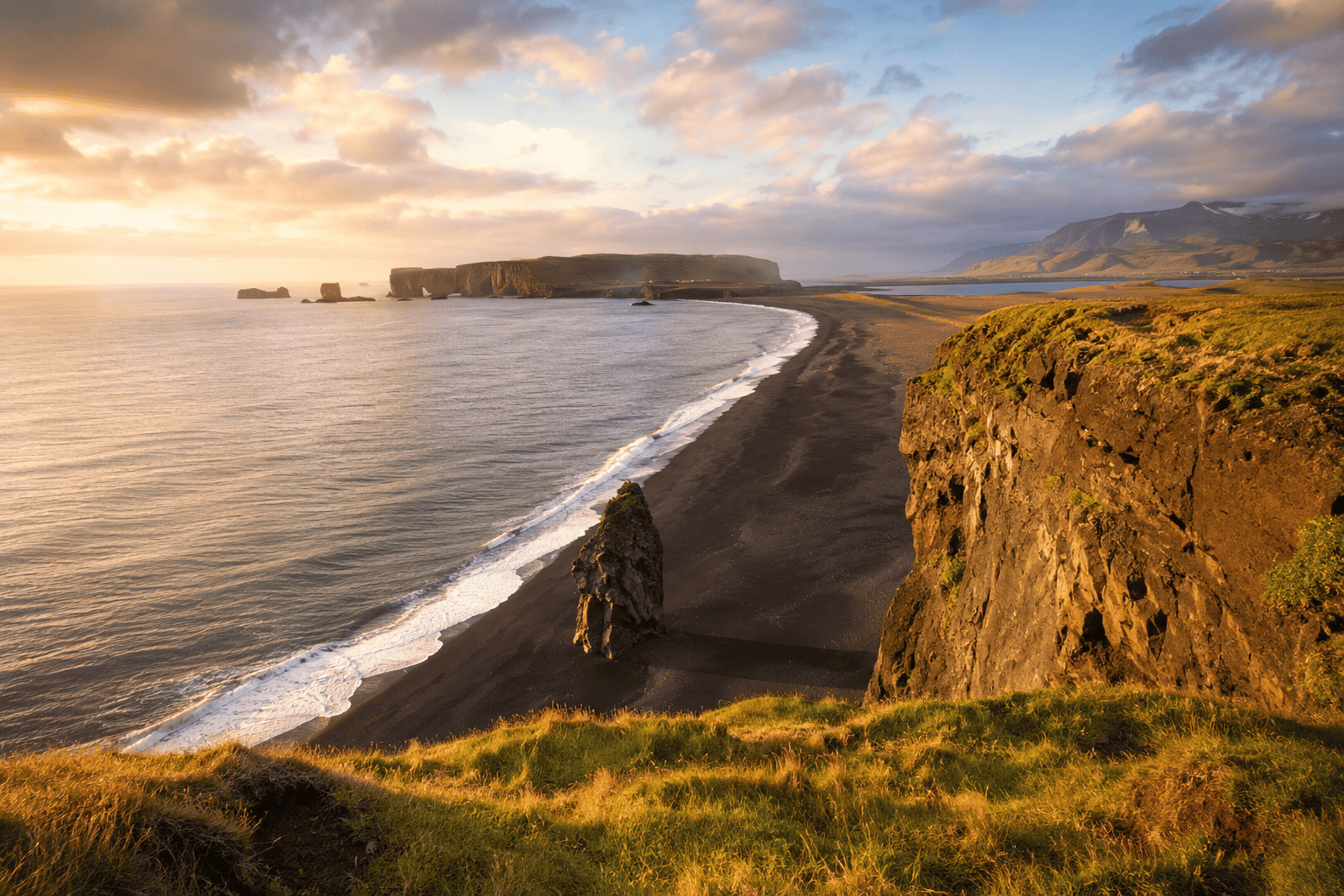
- Reynisfjara — the black sand beach below basalt columns; one of Iceland’s most dramatic coastal spots
- Vík — a small village worth a quick stop
Safety note: Never stand with your back to the ocean at Reynisfjara. Sneaker waves arrive without warning and have caused fatalities. Stay behind the warning signs at all times.
Overnight: Vík
Day 4 — Glacier Lagoon Country
Driving time: approximately 2.5 hours east from Vík, plus time at each stop.
The landscape east of Vík gets progressively more remote — flat glacial outwash plains stretching to the horizon, then sudden green canyon walls.
- Fjaðrárgljúfur canyon — a moss-carpeted gorge carved by glacial meltwater, viewable from above on a short walking trail
- Skaftafell (part of Vatnajökull National Park) — trailhead for glacier hikes and the short walk to Svartifoss waterfall
- Jökulsárlón Glacier Lagoon — icebergs calving from the Breiðamerkurjökull glacier into a tidal lake; boat tours (zodiac or amphibious) are widely considered among Iceland’s best paid experiences
- Diamond Beach — just across the road from Jökulsárlón, where ice chunks wash onto black sand
Overnight: Höfn or near Jökulsárlón
Day 5 — Return West to Reykjavík (or Keflavík)
This is a long driving day — roughly 5–6 hours without stops. Use it selectively: revisit a stop you rushed on Day 3, or simply enjoy the drive.
If your flight departs early the next morning, stay near Keflavík Airport. If you have a late flight or one more full day, return to Reykjavík for a final evening.
The 7-Day Iceland Itinerary
A week removes the windshield-tour feeling from the 5-day route and adds one of Iceland’s most underrated regions: the Snæfellsnes Peninsula.
Days 1–4
Follow the 5-day itinerary exactly as described above, overnighting in Reykjavík, Hella/Selfoss, Vík, and near Jökulsárlón.
Day 5 — Slower Return West
Instead of driving straight back to Reykjavík, use this day for the stops that got skipped:
- Hidden waterfalls on the road between Vík and Selfoss
- A local geothermal pool — Seljavallalaug is free and feels genuinely off-the-beaten-path
- The Lava Centre in Hvolsvöllur if volcanic geology interests you
Overnight: Reykjavík
Day 6 — Snæfellsnes Peninsula
Driving time: approximately 2.5 hours from Reykjavík to reach the peninsula tip.
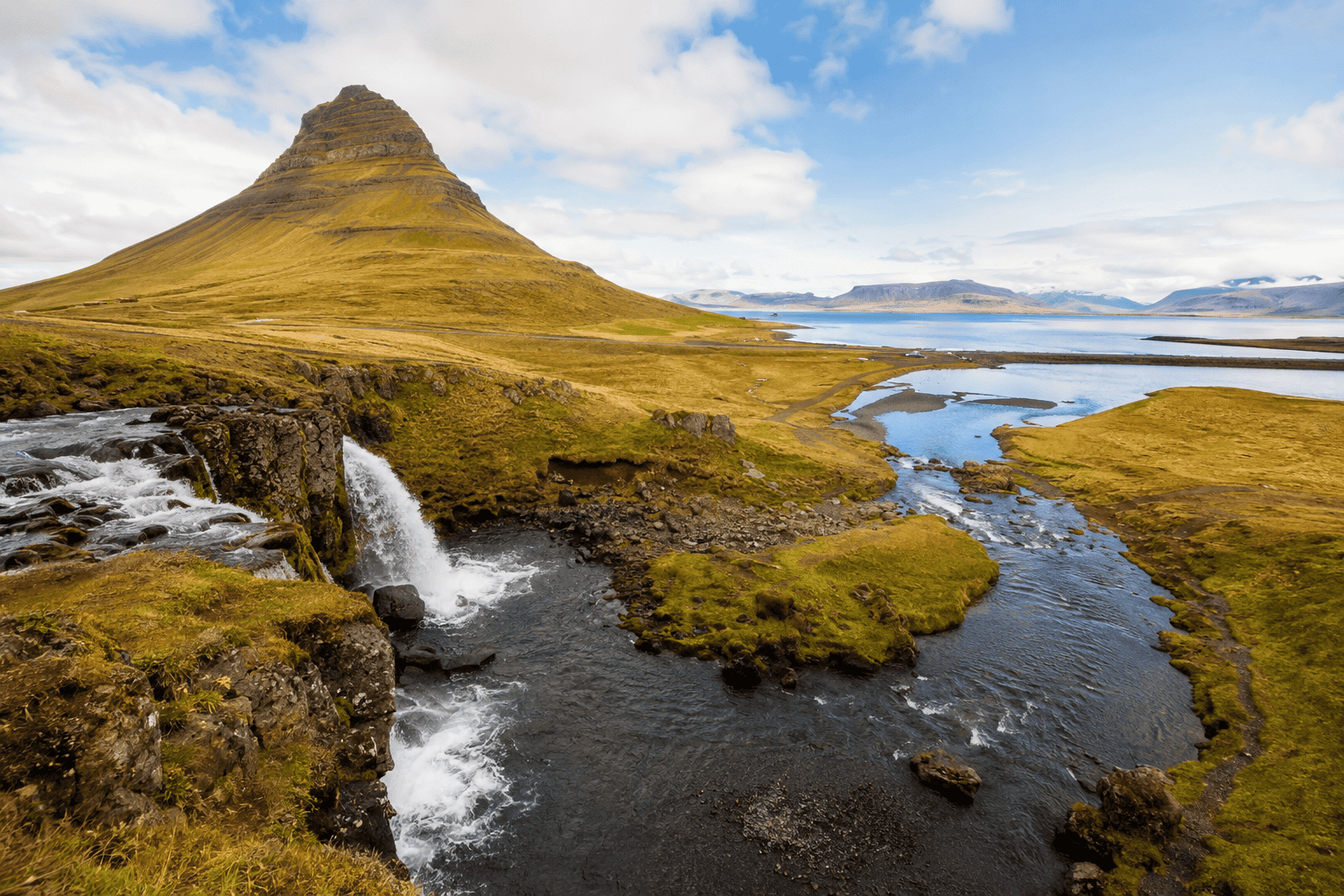
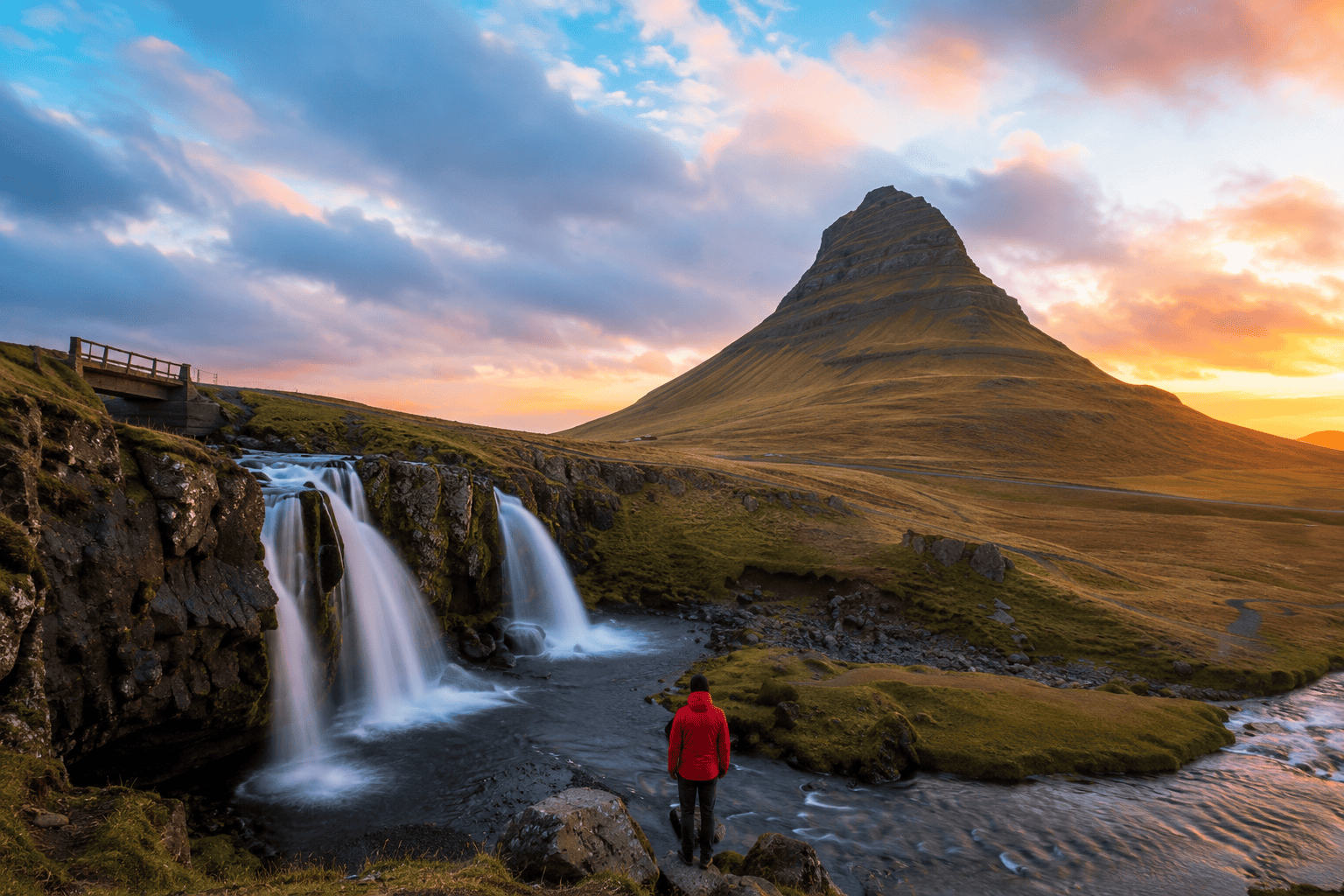
Often called “Iceland in miniature,” Snæfellsnes packs lava fields, glacier-capped volcano, fishing villages, and dramatic sea cliffs into a manageable day loop or overnight.
- Kirkjufell — Iceland’s most-photographed mountain, near Grundarfjörður
- Arnarstapi — coastal basalt formations and a short cliff walk
- Djúpalónssandur — a black pebble beach with the rusted remains of a British trawler
- Snæfellsjökull National Park — the glacier Jules Verne used as the entrance to the centre of the Earth in his novel
Overnight: Stykkishólmur or Borgarnes
Day 7 — Return to Reykjavík
An unhurried final morning before returning the rental car. Borgarnes has a well-regarded settlement exhibition if you want a last cultural stop. Back in Reykjavík: whale watching from the Old Harbour runs year-round, or revisit a neighbourhood you didn’t linger in on Day 1.
The 10-Day Iceland Ring Road Itinerary
Ten days is the minimum to drive the full Ring Road (Route 1, roughly 1,330 km) without feeling like you’re simply ticking counties off a list. You’ll need a 4×4 vehicle if travelling outside summer.
Route Overview
- Day 1: Arrive Keflavík → Reykjavík
- Day 2: Golden Circle → overnight near Selfoss
- Day 3: South Coast → overnight in Vík
- Day 4: Glacier lagoon country → overnight near Höfn
- Day 5: Eastfjords → overnight in Egilsstaðir
- Day 6: Lake Mývatn → overnight near Mývatn
- Day 7: Dettifoss + drive to Akureyri
- Day 8: Akureyri + whale watching → overnight Akureyri
- Day 9: West Iceland → overnight in Borgarnes or Snæfellsnes
- Day 10: Return to Reykjavík → fly
The Eastfjords: Iceland’s Most Overlooked Region
Most travellers who try to complete the Ring Road in under 10 days effectively skip the Eastfjords by driving through without stopping. That’s a mistake worth correcting if you have the time. The fjord roads are winding, slower, and completely free of tour buses. Expect reindeer on hillsides, quiet fishing harbours, and the kind of calm that the South Coast corridor rarely offers.
Key stops: Seyðisfjörður (a blue-painted village accessible only by a single mountain road), Djúpivogur, and Egilsstaðir as an overnight base.
North Iceland: Lake Mývatn and Dettifoss
The Mývatn region looks like a landscape designed by a geologist with theatrical tendencies. The lake itself sits in a zone of active volcanism, surrounded by lava formations, mud pots, and steam vents.
- Hverir — a geothermal field of boiling mud and sulphurous vents
- Dimmuborgir — strange lava pillars and arches, accessible on marked trails
- Mývatn Nature Baths — a less commercialised alternative to the Blue Lagoon
Dettifoss, roughly an hour from Mývatn, is Europe’s most powerful waterfall by volume — not the tallest, but the sheer noise and spray on approach is unlike anything else in the country. Road access varies by season; check current conditions at road.is before committing.
Akureyri
Iceland’s second-largest city is genuinely pleasant rather than merely a logistics stop. The botanic garden (free entry) blooms surprisingly well given the latitude, the café culture is relaxed, and whale watching from Eyjafjörður is considered some of the best in Iceland year-round. In winter, the small ski area above the city is locally popular.
Renting a Car in Iceland: What First-Timers Get Wrong
A rental car is almost non-negotiable for any itinerary beyond Reykjavík, but Icelandic driving conditions surprise a significant number of visitors each year.
Gravel roads and F-roads: Many scenic routes — including tracks toward interior highland destinations — are unpaved. Flying rocks can crack windscreens, and most standard rental insurance doesn’t cover gravel damage unless you pay for a specific gravel protection add-on. Read the terms carefully before declining extras.
4×4 versus 2WD: For summer and the main Ring Road route, a standard 2WD is sufficient. For F-roads, winter driving, or the Westfjords, a 4×4 is not optional — it’s a legal requirement on some tracks. The cost difference is worth it for peace of mind in shoulder season.
Weather: Check vedur.is (Iceland Met Office) and road.is (Icelandic Road Administration) every morning before setting out. A forecast that looks manageable at 8am can change to a road closure by noon. Build flexibility into your plans rather than booking non-refundable evening activities every day.
Wind: More dangerous than snow for most drivers. Strong gusts can push a car across a lane or, if you open a car door carelessly, rip it off the hinges. This is a documented claim type at Icelandic rental companies, not an exaggeration.
Iceland Trip Budget: What to Expect
Iceland is consistently among the more expensive destinations in Europe, but costs vary substantially depending on how you travel.
Budget Traveller — €120–180 per day
- Hostel dormitory or basic guesthouse
- Self-catering from supermarkets (Krónan and Bónus are the cheapest chains)
- Economy rental car, basic insurance
- Free or low-cost stops (most waterfalls, viewpoints, national park trails)
Mid-Range Traveller — €250–450 per day
- En-suite guesthouse or rural hotel
- Mix of supermarket lunches and restaurant dinners
- Comfortable rental car, full insurance package
- 1–2 paid excursions (glacier hike, boat tour, ice cave)
Higher-End Traveller — €600+ per day
- Boutique hotels and design guesthouses
- Restaurant meals throughout
- 4×4 vehicle with comprehensive cover
- Private guided tours, luxury lagoon entries
The single biggest variable is accommodation. Farm stays (many with outdoor hot tubs and home-cooked breakfasts) frequently undercut standard guesthouses while offering a more memorable experience. Search platforms like Bungalo or local booking sites alongside the usual aggregators.
Where to Stay Along Your Iceland Itinerary
The most common mistake is treating Reykjavík as a base and driving in and out every day. It sounds convenient until you realise you’re adding 2–3 hours of repetitive driving each day. The better approach is to move your accommodation base with you, staying as close as possible to each day’s main destination.
Practical overnight bases that work well with the routes above:
- Hella or Selfoss — positioned well after the Golden Circle, before the South Coast
- Vík — small, fills up fast, but ideally placed for the black sand beaches
- Höfn — the practical overnight after Jökulsárlón; known for langoustine if you want a splurge dinner
- Egilsstaðir — the main town hub of the Eastfjords
- Akureyri — the most comfortable city base in the north
- Stykkishólmur or Borgarnes — for Snæfellsnes access
Book ahead for summer and for any property near Jökulsárlón — inventory is genuinely limited in that region year-round.
What to Pack for Iceland
Iceland’s weather changes quickly and often within a single day. Pack for conditions, not aesthetics.
- Waterproof outer layer (jacket and trousers) — essential regardless of season
- Insulating mid-layer — fleece or down, depending on season
- Moisture-wicking base layers
- Waterproof hiking boots or trail shoes
- Swimsuit — you will use geothermal pools
- Power bank — remote areas have limited charging options
- Sleep mask — essential in summer when it doesn’t get dark
- Microspike traction devices — for winter ice walking; crampons if glacier hiking
The packing mistake that costs people their comfort most frequently: bringing clothes suited to a European city break rather than outdoor activity. Even if you’re not planning to hike, you’ll spend a lot of time outside in wind.
Northern Lights: Managing Expectations
The aurora borealis is visible in Iceland between September and March on clear, dark nights — but no itinerary can guarantee a sighting. The key factors are solar activity (unpredictable), cloud cover (often the main obstacle), and light pollution (stay outside Reykjavík).
If seeing the northern lights is a priority:
- Travel between October and February for the best combination of darkness and aurora season
- Book accommodation outside cities, away from light pollution
- Keep evenings unscheduled so you can drive toward clear skies if needed
- Use an aurora forecast app — many Icelandic guesthouses will wake guests if the lights appear
A week with three overcast nights and two clear ones is typical. Treat it as a possible bonus rather than a guaranteed headline experience.
Common Iceland Itinerary Mistakes to Avoid
1. Underestimating driving times. Iceland looks small on a standard map, but speeds on coastal and mountain roads average 60–80 km/h in good conditions. A 200 km leg can easily take 3.5 hours.
2. Over-scheduling every day. When weather closes a stop or road, you need somewhere to redirect. Itineraries packed to the hour collapse under normal Icelandic conditions.
3. Only eating at tourist restaurants. Grocery stores are a lifeline for budget management. A packed lunch from Bónus costs a fraction of a café meal at a waterfall car park.
4. Skipping unnamed stops. Some of Iceland’s most memorable moments happen at a pull-off with no signage — a canyon glimpsed through fog, a waterfall visible only from the road. Leave time for the unexpected.
5. Ignoring wind warnings. Icelandic wind advisories are issued by the Met Office when conditions become dangerous for driving. They are worth taking seriously, particularly on the south coast and on exposed highland plateaus.
Self-Drive Versus Guided Tours
Self-driving offers maximum flexibility for photographers, those who like detours, and travellers who want to set their own pace. It works best in summer when roads are clear and conditions are predictable.
Guided tours make sense for winter ice cave visits (which legally require a guide), solo travellers who don’t want to navigate alone in dark conditions, and anyone uncomfortable driving on unfamiliar icy roads. Many experienced Iceland visitors do both: self-drive the main route and book a guided glacier hike or ice cave tour as a day activity.
Frequently Asked Questions
Is one week enough for Iceland?
Yes, a 7-day Iceland itinerary covers the South Coast, Golden Circle, glacier lagoon area, and Snæfellsnes Peninsula at a manageable pace. You won’t see the full Ring Road, but you’ll cover the highlights most first-time visitors prioritise without feeling rushed.
Do I need a 4×4 for the Ring Road?
For the paved Ring Road (Route 1) in summer, a standard 2WD car is sufficient. In winter, a 4×4 with winter tyres is strongly recommended. For any F-road (mountain tracks marked with an F prefix), a 4×4 is legally required regardless of season.
How far in advance should I book Iceland accommodation?
For peak summer (June–August), book at least 3–4 months ahead — particularly for the South Coast and near Jökulsárlón, where options are limited. For shoulder seasons, 4–6 weeks is usually sufficient, though booking earlier always gives you more choice.
Can I do Iceland without a rental car?
You can see Reykjavík and join day tours from the capital without renting a car, but you’ll be dependent on tour scheduling and won’t be able to explore at your own pace. For any multi-day itinerary beyond Reykjavík, a rental car provides flexibility that public transport cannot replicate — Iceland’s bus network is very limited outside Reykjavík.
When is the cheapest time to visit Iceland?
January and February are typically the cheapest months, with lower accommodation rates and fewer crowds. The tradeoff is limited daylight and more frequent weather disruptions. May and September offer the best cost-to-experience ratio for most travellers: noticeably cheaper than summer peak without the extreme winter constraints.
Is Iceland safe to drive in winter?
Yes, with appropriate preparation. Rent a 4×4 with winter tyres, check road conditions at road.is each morning, respect weather warnings, and avoid driving in blizzards or high wind advisories. Many Icelandic roads are well-maintained even in winter; the risk comes from drivers unfamiliar with icy surfaces or who ignore forecast alerts.
By Mara Vale for Eurly
Last verified: May 2025. Prices, road conditions, and attraction access change seasonally — always confirm current information through official Icelandic sources before travel.